Sahraoui Abderrazak, Elarref Mohamed
Department of Anesthesia, Intensive Care, Pain and Palliative Care, Hamad Medical Corporation - Hamad General Hospital, Doha, Qatar.
Qatar Med J. 2014 Jun 16;2014(1):1-11. doi: 10.5339/qmj.2014.1. eCollection 2014.
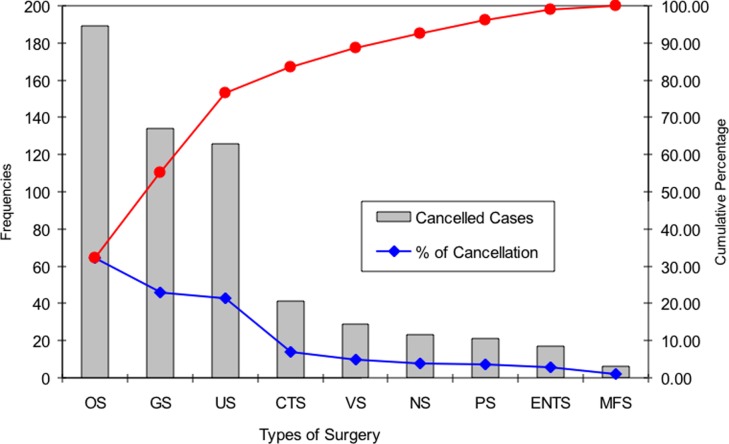
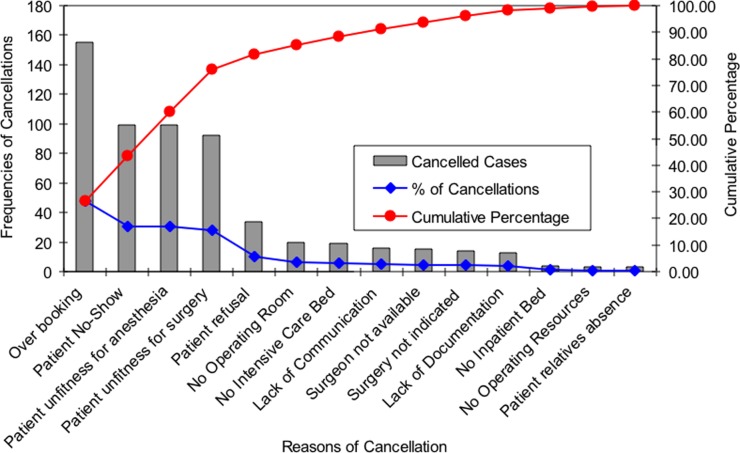
Late cancellations of scheduled elective surgery limit the ability of the surgical care service to achieve its goals. Attributes of these cancellations differ between hospitals and regions. The rate of late cancellations of elective surgery conducted in Hamad General Hospital, Doha, Qatar was found to be 13.14% which is similar to rates reported in hospitals elsewhere in the world; although elective surgery is performed six days a week from 7:00 am to 10:00 pm in our hospital. Simple and systematic analysis of these attributes typically provides limited solutions to the cancellation problem. Alternatively, the application of the theory of constraints with its five focusing steps, which analyze the system in its totality, is more likely to provide a better solution to the cancellation problem. To find the constraint, as a first focusing step, we carried out a retrospective and descriptive study using a quantitative approach combined with the Pareto Principle to find the main causes of cancellations, followed by a qualitative approach to find the main and ultimate underlying cause which pointed to the bed crisis. The remaining four focusing steps provided workable and effective solutions to reduce the cancellation rate of elective surgery.
择期手术的晚期取消限制了手术护理服务实现其目标的能力。这些取消情况的特征在不同医院和地区有所不同。卡塔尔多哈哈马德总医院进行的择期手术晚期取消率为13.14%,这与世界其他地方医院报告的比率相似;尽管我院每周七天、每天从早上7点到晚上10点都进行择期手术。对这些特征进行简单而系统的分析通常只能为取消问题提供有限的解决方案。相反,应用约束理论及其五个聚焦步骤,对系统进行全面分析,更有可能为取消问题提供更好的解决方案。作为第一个聚焦步骤,为了找到约束因素,我们采用定量方法结合帕累托原则进行了一项回顾性描述性研究,以找出取消手术的主要原因,随后采用定性方法找出主要和最终的根本原因,结果指向床位危机。其余四个聚焦步骤提供了可行且有效的解决方案,以降低择期手术的取消率。