Kowalska Joanna, Szewczyńska Małgorzata, Pośniak Małgorzata
Department of Chemical, Aerosol and Biological Hazards, Central Institute for Labour Protection - National Research Institute, Czerniakowska 16, 00-701, Warsaw, Poland,
Environ Sci Pollut Res Int. 2015 Apr;22(7):5241-52. doi: 10.1007/s11356-014-3672-3. Epub 2014 Oct 18.
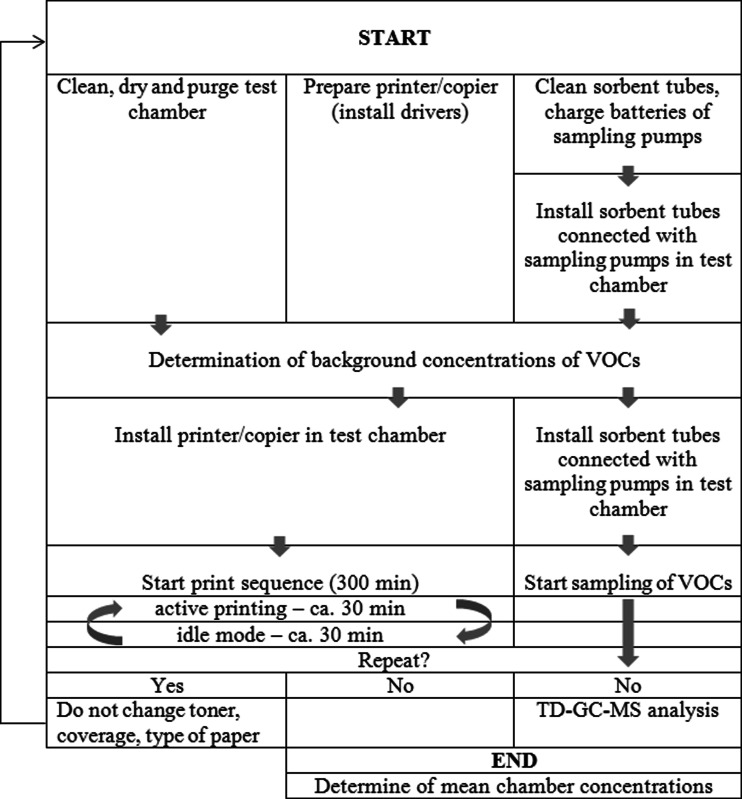
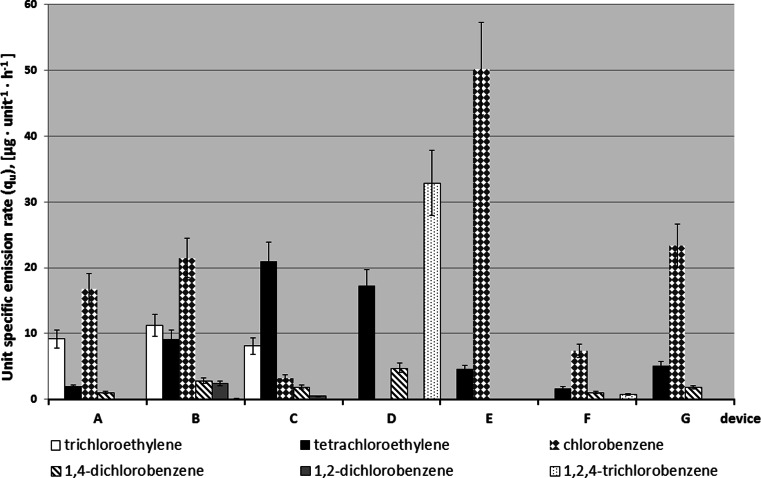
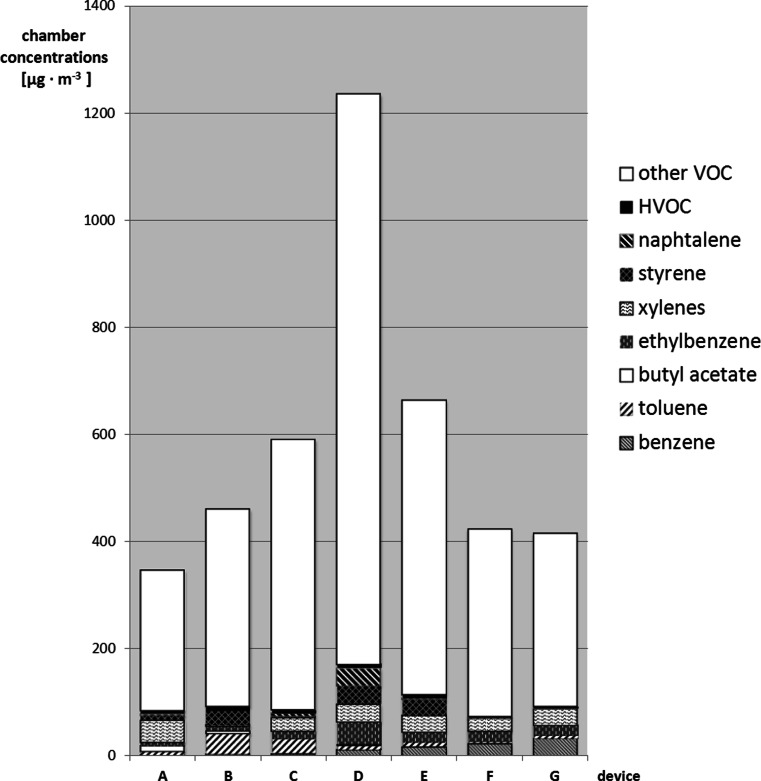
Office devices can release volatile organic compounds (VOCs) partly generated by toners and inks, as well as particles of paper. The aim of the presented study is to identify indoor emissions of volatile halogenated organic compounds into the office workspace environment. Mixtures of organic pollutants emitted by seven office devices, i.e. printers and copiers, were analyzed by taking samples in laboratory conditions during the operation of these appliances. Tests of volatile organic compound emissions from selected office devices were conducted in a simulated environment (test chamber). Samples of VOCs were collected using three-layered thermal desorption tubes. Separation and identification of organic pollutant emissions were made using thermal desorption combined with gas chromatography coupled to mass spectrometry. Test chamber studies indicated that operation of the office printer and copier would contribute to the significant concentration level of VOCs in typical office indoor air. Among the determined volatile halogenated compounds, only chlorinated organic compounds were identified, inter alia: trichloroethylene - carcinogenic - and tetrachloroethylene - possibly carcinogenic to human. The results show that daily exposure of an office worker to chemical factors released by the tested printing and copying units can be variable in terms of concentrations of VOCs. The highest emissions in the test chamber during printing were measured for ethylbenzene up to 41.3 μg m(-3), xylenes up to 40.5 μg m(-3) and in case of halogenated compounds the highest concentration for chlorobenzene was 6.48 μg m(-3). The study included the comparison of chamber concentrations and unit-specific emission rates of selected VOCs and the identified halogenated compounds. The highest amount of total VOCs was emitted while copying with device D and was rated above 1235 μg m(-3) and 8400 μg unit(-1) h(-1) on average.
办公设备会释放部分由碳粉、油墨以及纸张颗粒产生的挥发性有机化合物(VOCs)。本研究的目的是确定挥发性卤代有机化合物向办公工作区环境的室内排放情况。通过在实验室条件下,在这些办公设备运行期间采集样本,分析了七种办公设备(即打印机和复印机)排放的有机污染物混合物。在模拟环境(测试舱)中对选定办公设备的挥发性有机化合物排放进行了测试。使用三层热解吸管收集VOCs样本。采用热解吸结合气相色谱 - 质谱联用技术对有机污染物排放进行分离和鉴定。测试舱研究表明,办公打印机和复印机的运行会导致典型办公室内空气中VOCs达到显著浓度水平。在已测定的挥发性卤代化合物中,仅鉴定出了氯代有机化合物,其中包括:具有致癌性的三氯乙烯以及可能对人类致癌的四氯乙烯。结果表明,办公室工作人员日常接触测试的打印和复印设备释放的化学因子,其VOCs浓度可能会有所不同。打印过程中测试舱内排放最高的是乙苯,高达41.3 μg m(-3),二甲苯高达40.5 μg m(-3),对于卤代化合物,氯苯的最高浓度为6.48 μg m(-3)。该研究包括对选定VOCs和已鉴定卤代化合物的舱内浓度与单位特定排放率的比较。使用设备D复印时,总VOCs排放量最高,平均评级高于1235 μg m(-3)和8400 μg 单位(-1) h(-1)。