Zhai Jinguo, Zhao Jingping, Chen Min, Li Jun, Su Zhonghua
School of Mental Health, Jining Medical University, Jining, Shandong Province, China.
Institute of Mental Health, Second Xiangya Hospital,Central South University, Changsha, Hunan Province,China.
Shanghai Arch Psychiatry. 2012 Dec;24(6):328-34. doi: 10.3969/j.issn.1002-0829.2012.06.004.
Findings from previous studies linking brain-derived neurotrophic factor (BDNF) and schizophrenia are inconsistent and few studies have assessed the relationship between BDNF C270T gene polymorphisms and the clinical and cognitive symptoms of schizophrenia.
Compare the prevalence of the BDNF C270T gene polymorphisms between patients with schizophrenia and controls and, in the patients, assess the relationship of genotypes to the severity of symptoms.
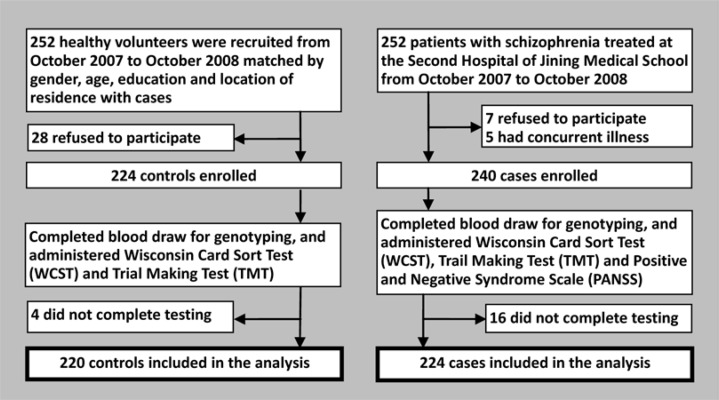
BDNF C270T genotype and allele frequency were measured using Polymerase Chain Reaction methods in 224 drug-free patients with schizophrenia and 220 controls. Psychotic symptoms were assessed using the Positive and Negative Syndrome Scale (PANSS), and cognitive functioning was assessed using the Wisconsin Card Sorting Test (WCST) and the Trail Making Test (TMT). In the patient group, differences in severity of symptoms across the three genotypes (i.e., C/C, C/T, and T/T) of C270T were assessed using one-way analysis of variance.
The frequency of the T allele was much higher in patients than in controls (15.6% vs. 4.3%, χ(2)=31.47, p<0.001) and the C/T genotype was more common among patients than controls (27.7% vs. 7.7%, χ(2)=34.93, p<0.001). Compared to controls, patients performed poorly on all the cognitive tests, but there were no significant differences in the cognitive measures between patients with the three different genotypes. The total PANSS score, the PANSS negative symptoms subscale score, and the PANSS general psychopathology subscale score were not significantly different between the three groups of patients. However, the PANSS positive symptoms subscale score showed a small, statistically significant elevation in the severity of positive symptoms in the C/T genotype compared to the C/C genotype.
We confirm previous findings about differences in the prevalence of the BDNF C270T gene polymorphisms in schizophrenia, but do not find strong evidence of a relationship between different genotypes and the severity of the clinical or cognitive symptoms of schizophrenia. Clinical and cognitive symptoms in schizophrenia fluctuate over the course of the illness and with treatment, so stable, individual-specific measures of these parameters (that is, traits) need to be identified before it will be possible to definitively assess their relationship to different genotypes.
先前有关脑源性神经营养因子(BDNF)与精神分裂症之间联系的研究结果并不一致,且很少有研究评估BDNF C270T基因多态性与精神分裂症临床及认知症状之间的关系。
比较精神分裂症患者与对照组中BDNF C270T基因多态性的患病率,并在患者中评估基因型与症状严重程度之间的关系。
采用聚合酶链反应方法,对224例未服用药物的精神分裂症患者和220例对照者进行BDNF C270T基因型和等位基因频率检测。使用阳性和阴性症状量表(PANSS)评估精神病性症状,使用威斯康星卡片分类测验(WCST)和连线测验(TMT)评估认知功能。在患者组中,采用单因素方差分析评估C270T三种基因型(即C/C、C/T和T/T)之间症状严重程度的差异。
患者中T等位基因频率远高于对照组(15.6%对vs·4.3%,χ(2)=31.47,p<0.001),且C/T基因型在患者中比对照组更常见(27.7%对vs·7.7%,χ(2)=34.93,p<0.001)。与对照组相比,患者在所有认知测试中表现较差,但三种不同基因型患者在认知测量方面无显著差异。三组患者的PANSS总分、PANSS阴性症状分量表得分和PANSS一般精神病理分量表得分无显著差异。然而,与C/C基因型相比,C/T基因型患者的PANSS阳性症状分量表得分在阳性症状严重程度上显示出微小但具有统计学意义的升高。
我们证实了先前关于精神分裂症中BDNF C270T基因多态性患病率差异的研究结果,但未发现不同基因型与精神分裂症临床或认知症状严重程度之间存在密切关系的有力证据。精神分裂症的临床和认知症状在疾病过程中以及治疗过程中会发生波动,因此在能够明确评估这些参数(即特质)与不同基因型之间的关系之前,需要确定稳定的、个体特异性的测量方法。