Choi Se Young, Ryu Jae Hyung, Chang In Ho, Kim Tae-Hyoung, Myung Soon Chul, Moon Young Tae, Kim Kyung Do, Kim Jin Wook
Department of Urology, Chung-Ang University Hospital, Seoul, Korea.
Korean J Urol. 2014 Oct;55(10):643-9. doi: 10.4111/kju.2014.55.10.643. Epub 2014 Oct 10.
This study aimed to confirm the utility of the European Organization for Research and Treatment of Cancer (EORTC) and the Spanish Urological Club for Oncological Treatment (CUETO) scoring systems and to determine which model is preferred as a prognostic model in Korean patients with non-muscle-invasive bladder cancer.
Between 1985 and 2011, 531 patients who were treated by transurethral resection of bladder cancer were retrospectively analyzed by use of the EORTC and CUETO models. Statistically, we performed Kaplan-Meier survival analysis; calculated Harrell's concordance index, receiver operating characteristic (ROC) curve, and cutoff values; and performed univariate and multivariate Cox proportional hazards regression analyses.
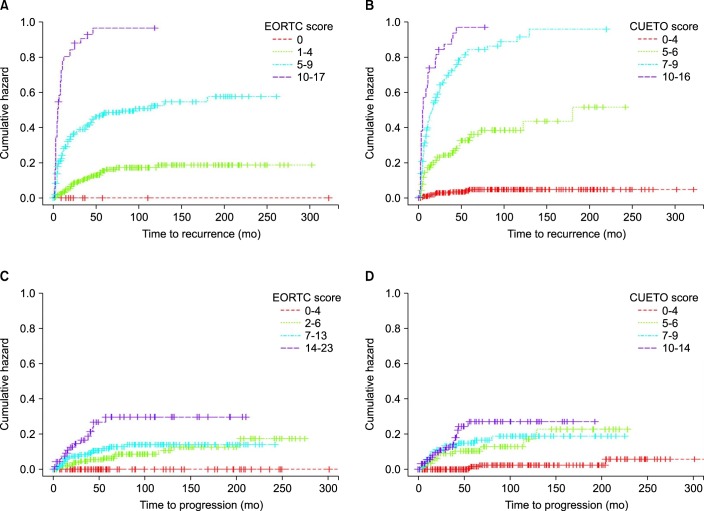
For risk of recurrence, with the use of the EORTC model, all groups had statistically significant differences except between the group with a score of 0 and the group with a score of 1-4. With the use of the CUETO model, all groups differed significantly. For risk of progression, with the use of the EORTC model, significant differences were observed between all groups except between the group with a score of 2-6 and the group with a score of 7-13. With the use of the CUETO model, a significant difference was observed between the group with a score of 0 and the other groups. The concordance index of the EORTC and CUETO models was 0.759 and 0.836 for recurrence and 0.704 and 0.745 for progression, respectively. The area under the ROC curve for the EORTC and CUETO models was 0.832 and 0.894 for recurrence and 0.722 and 0.724 for progression, respectively.
Both scoring systems, especially the CUETO model, showed value in predicting recurrence and progression in Korean patients, which will help in individualizing treatment and follow-up schedules.
本研究旨在证实欧洲癌症研究与治疗组织(EORTC)和西班牙肿瘤治疗泌尿俱乐部(CUETO)评分系统的实用性,并确定哪种模型作为韩国非肌层浸润性膀胱癌患者的预后模型更受青睐。
1985年至2011年间,对531例行膀胱癌经尿道切除术的患者采用EORTC和CUETO模型进行回顾性分析。统计学上,我们进行了Kaplan-Meier生存分析;计算了Harrell一致性指数、受试者工作特征(ROC)曲线和临界值;并进行了单因素和多因素Cox比例风险回归分析。
对于复发风险,使用EORTC模型时,除评分为0的组和评分为1 - 4的组之间外,所有组在统计学上均有显著差异。使用CUETO模型时,所有组之间均有显著差异。对于进展风险,使用EORTC模型时,除评分为2 - 6的组和评分为7 - 13的组之间外,所有组之间均观察到显著差异。使用CUETO模型时,评分为0的组与其他组之间存在显著差异。EORTC和CUETO模型的一致性指数在复发方面分别为0.759和0.836,在进展方面分别为0.704和0.745。EORTC和CUETO模型的ROC曲线下面积在复发方面分别为0.832和0.894,在进展方面分别为0.722和0.724。
两种评分系统,尤其是CUETO模型,在预测韩国患者的复发和进展方面显示出价值,这将有助于制定个体化的治疗和随访计划。