Metabolism and Cancer Group, Translational Research Laboratory, Catalan Institute of Oncology-Girona (ICO-Girona) , Girona , Spain ; Girona Biomedical Research Institute (IDIBGI) , Girona , Spain.
Computational and Mathematical Biology Research Group, Centre de Recerca Matemàtica (CRM) , Barcelona , Spain.
Front Oncol. 2014 Sep 29;4:262. doi: 10.3389/fonc.2014.00262. eCollection 2014.
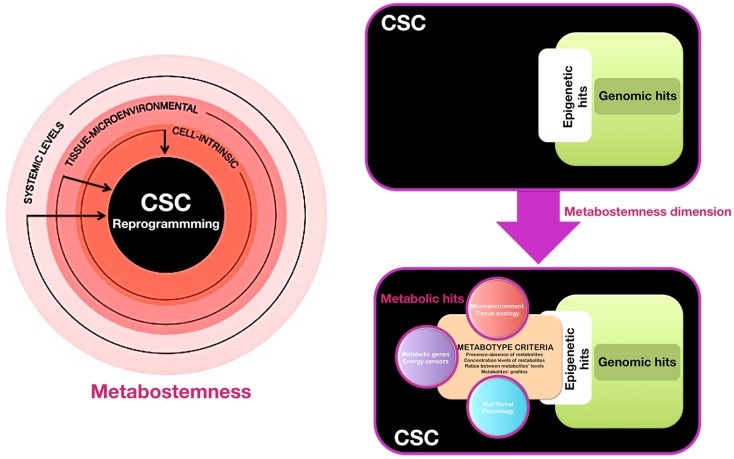
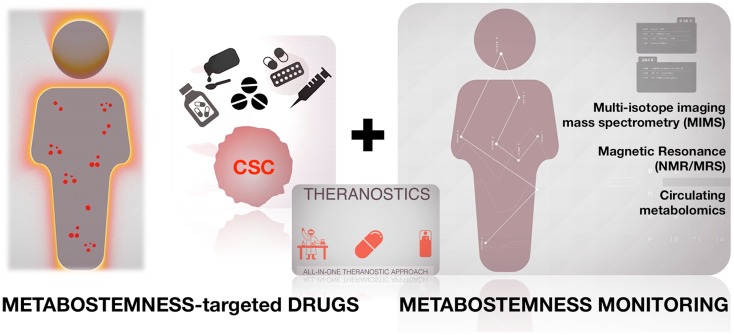
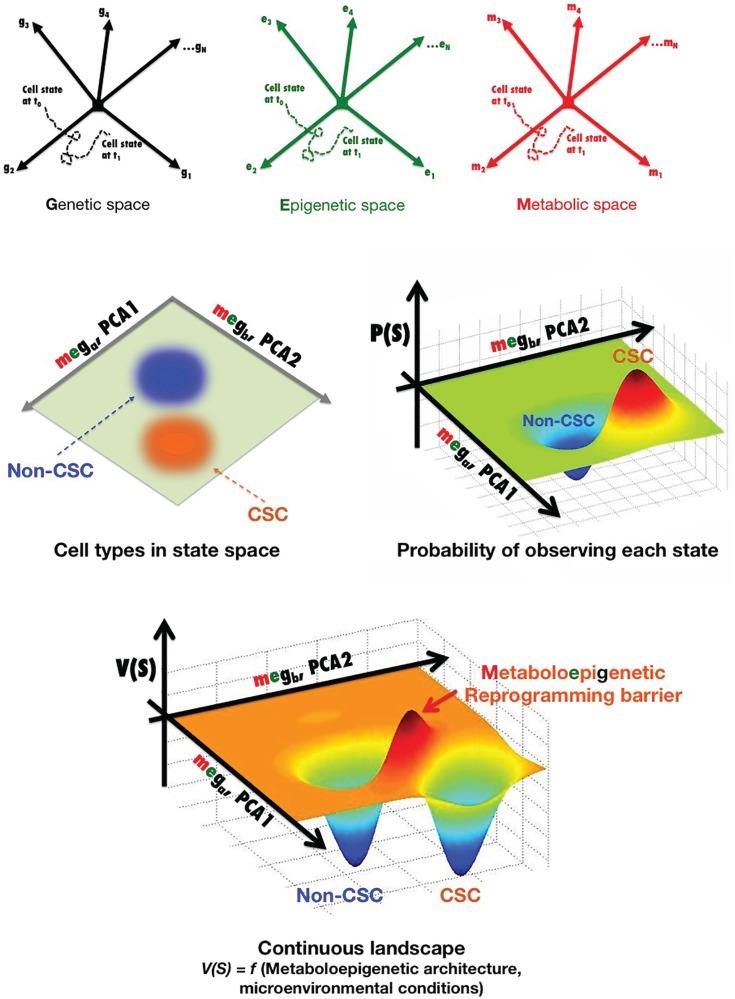
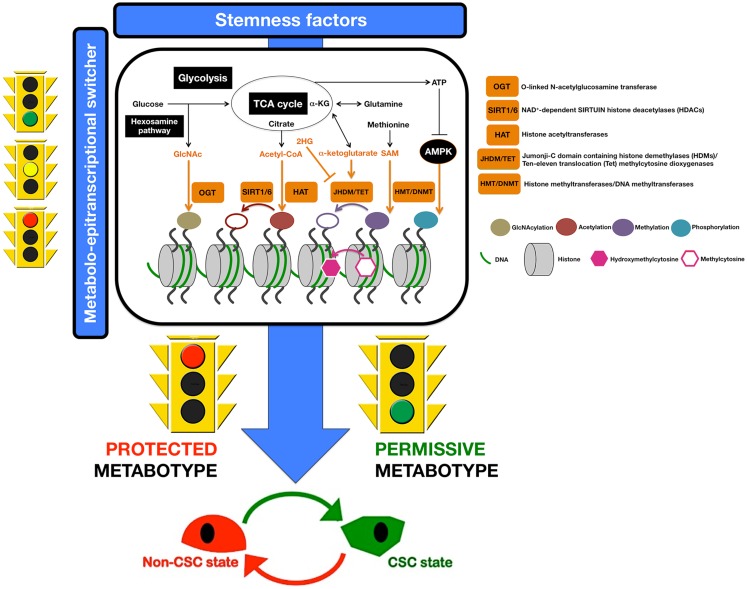
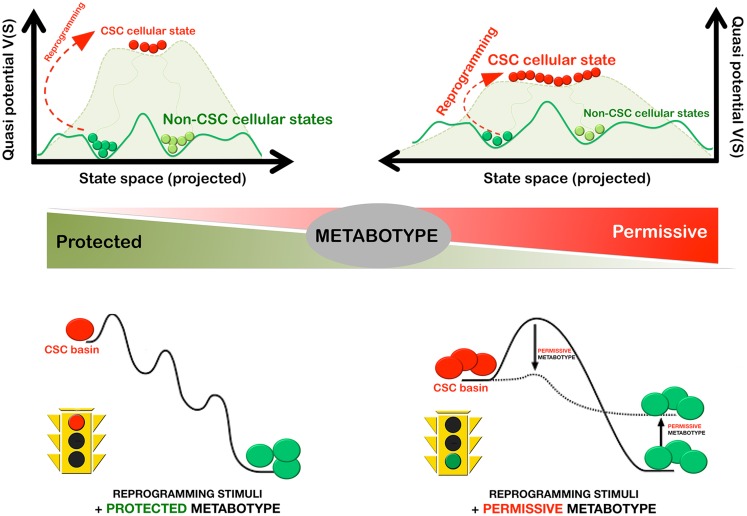
The acquisition of and departure from stemness in cancer tissues might not only be hardwired by genetic controllers, but also by the pivotal regulatory role of the cellular metabotype, which may act as a "starter dough" for cancer stemness traits. We have coined the term metabostemness to refer to the metabolic parameters causally controlling or functionally substituting the epitranscriptional orchestration of the genetic reprograming that redirects normal and tumor cells toward less-differentiated cancer stem cell (CSC) cellular states. Certain metabotypic alterations might operate as pivotal molecular events rendering a cell of origin susceptible to epigenetic rewiring required for the acquisition of aberrant stemness and, concurrently, of refractoriness to differentiation. The metabostemness attribute can remove, diminish, or modify the nature of molecular barriers present in Waddington's epigenetic landscapes, thus allowing differentiated cells to more easily (re)-enter into CSC cellular macrostates. Activation of the metabostemness trait can poise cells with chromatin states competent for rapid dedifferentiation while concomitantly setting the idoneous metabolic stage for later reprograming stimuli to finish the journey from non-cancerous into tumor-initiating cells. Because only a few permitted metabotypes will be compatible with the operational properties owned by CSC cellular states, the metabostemness property provides a new framework through which to pharmacologically resolve the apparently impossible problem of discovering drugs aimed to target the molecular biology of the cancer stemness itself. The metabostemness cancer hallmark generates a shifting oncology theory that should guide a new era of metabolo-epigenetic cancer precision medicine.
癌症组织中干性的获得和丧失不仅可能由遗传控制器硬连线决定,还可能由细胞代谢表型的关键调节作用决定,这种代谢表型可能作为癌症干性特征的“起始面团”。我们创造了“代谢干性”一词,是指因果控制或功能替代重新编程的转录后调控的代谢参数,这种重新编程将正常和肿瘤细胞重新定向为分化程度较低的癌症干细胞(CSC)细胞状态。某些代谢表型改变可能作为关键分子事件发挥作用,使起源细胞易受表观遗传重排的影响,从而获得异常干性,并同时对分化产生抗性。代谢干性属性可以消除、减少或改变 Waddington 表观遗传景观中存在的分子障碍的性质,从而允许分化细胞更容易(重新)进入 CSC 细胞宏观状态。代谢干性特征的激活可以使具有快速去分化能力的染色质状态的细胞处于平衡状态,同时为后期重编程刺激设定合适的代谢阶段,完成从非癌性到起始肿瘤细胞的转变。因为只有少数允许的代谢表型与 CSC 细胞状态所拥有的操作特性兼容,所以代谢干性特性提供了一个新的框架,通过该框架可以从药理学上解决发现旨在针对癌症干性本身的分子生物学的药物这一显然不可能的问题。代谢干性癌症标志产生了一个不断变化的肿瘤学理论,应该指导代谢 - 表观遗传学癌症精准医学的新时代。