Fuller Zachary L, Haynes Gwilym D, Zhu Dianhui, Batterton Matthew, Chao Hsu, Dugan Shannon, Javaid Mehwish, Jayaseelan Joy C, Lee Sandra, Li Mingmei, Ongeri Fiona, Qi Sulan, Han Yi, Doddapaneni Harshavardhan, Richards Stephen, Schaeffer Stephen W
Department of Biology, The Pennsylvania State University, University Park, Pennsylvania 16802-5301
Department of Biology, The Pennsylvania State University, University Park, Pennsylvania 16802-5301.
G3 (Bethesda). 2014 Oct 17;4(12):2433-49. doi: 10.1534/g3.114.014860.
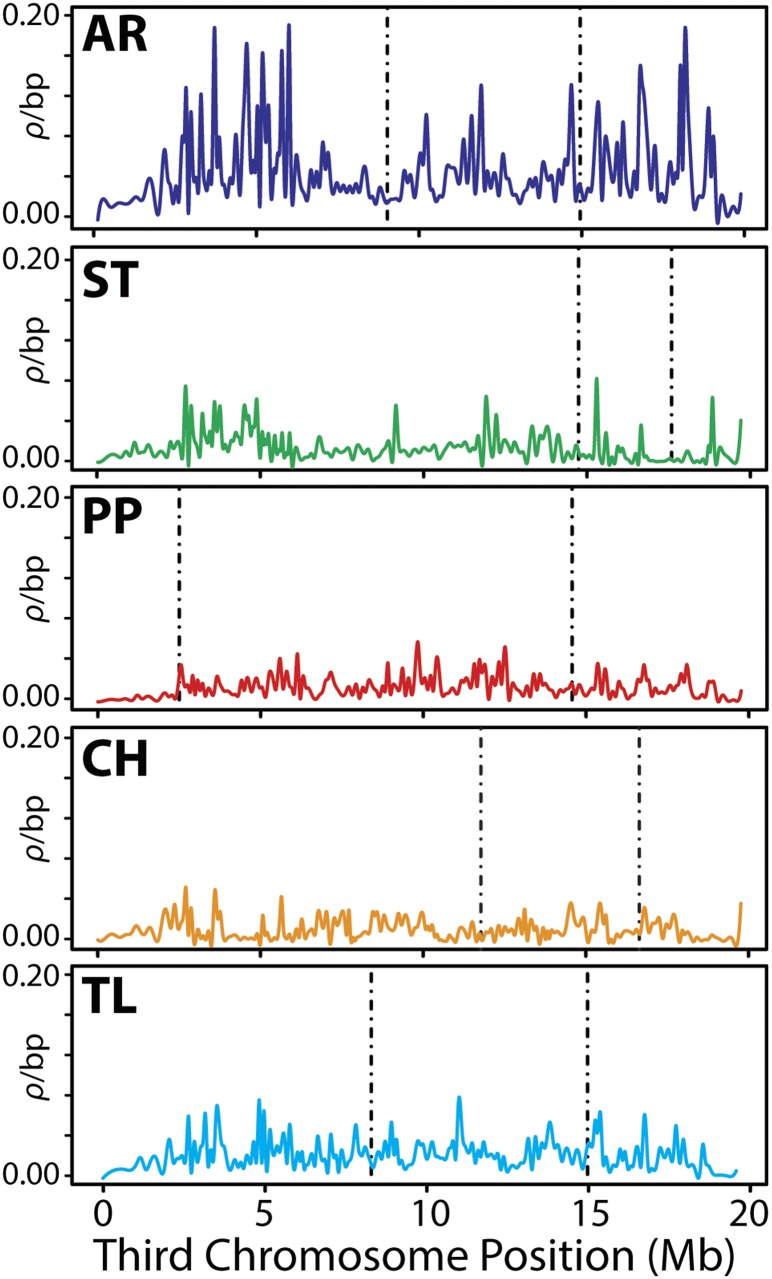
There has been a renewed interest in investigating the role of stabilizing selection acting on genome-wide traits such as codon usage bias. Codon bias, when synonymous codons are used at unequal frequencies, occurs in a wide variety of taxa. Standard evolutionary models explain the maintenance of codon bias through a balance of genetic drift, mutation and weak purifying selection. The efficacy of selection is expected to be reduced in regions of suppressed recombination. Contrary to observations in Drosophila melanogaster, some recent studies have failed to detect a relationship between the recombination rate, intensity of selection acting at synonymous sites, and the magnitude of codon bias as predicted under these standard models. Here, we examined codon bias in 2798 protein coding loci on the third chromosome of D. pseudoobscura using whole-genome sequences of 47 individuals, representing five common third chromosome gene arrangements. Fine-scale recombination maps were constructed using more than 1 million segregating sites. As expected, recombination was demonstrated to be significantly suppressed between chromosome arrangements, allowing for a direct examination of the relationship between recombination, selection, and codon bias. As with other Drosophila species, we observe a strong mutational bias away from the most frequently used codons. We find the rate of synonymous and nonsynonymous polymorphism is variable between different amino acids. However, we do not observe a reduction in codon bias or the strength of selection in regions of suppressed recombination as expected. Instead, we find that the interaction between weak stabilizing selection and mutational bias likely plays a role in shaping the composition of synonymous codons across the third chromosome in D. pseudoobscura.
人们对研究稳定选择作用于全基因组特征(如密码子使用偏好)的作用重新产生了兴趣。当同义密码子以不同频率使用时,密码子偏好现象在多种分类群中都存在。标准进化模型通过遗传漂变、突变和弱纯化选择之间的平衡来解释密码子偏好的维持。在重组受到抑制的区域,选择的效力预计会降低。与在黑腹果蝇中的观察结果相反,最近的一些研究未能检测到重组率、同义位点上的选择强度与这些标准模型预测的密码子偏好程度之间的关系。在这里,我们使用47个个体的全基因组序列,研究了拟暗果蝇第三染色体上2798个蛋白质编码基因座的密码子偏好,这些个体代表了五种常见的第三染色体基因排列。利用超过100万个分离位点构建了精细尺度的重组图谱。正如预期的那样,染色体排列之间的重组被证明受到显著抑制,从而可以直接研究重组、选择和密码子偏好之间的关系。与其他果蝇物种一样,我们观察到一种强烈的突变偏好,即远离最常用的密码子。我们发现不同氨基酸之间同义多态性和非同义多态性的速率是可变的。然而,我们并未观察到如预期那样在重组受到抑制的区域密码子偏好或选择强度的降低。相反,我们发现弱稳定选择和突变偏好之间的相互作用可能在塑造拟暗果蝇第三染色体上同义密码子的组成中发挥作用。