
手机短信提醒在医疗保健服务中的应用:一项叙述性文献综述。
Use of mobile phone text message reminders in health care services: a narrative literature review.
作者信息
Kannisto Kati Anneli, Koivunen Marita Hannele, Välimäki Maritta Anneli
机构信息
Department of Nursing Science, University of Turku, Turku, Finland.
出版信息
J Med Internet Res. 2014 Oct 17;16(10):e222. doi: 10.2196/jmir.3442.
BACKGROUND
Mobile text messages are a widely recognized communication method in societies, as the global penetration of the technology approaches 100% worldwide. Systematic knowledge is still lacking on how the mobile telephone text messaging (short message service, SMS) has been used in health care services.
OBJECTIVE
This study aims to review the literature on the use of mobile phone text message reminders in health care.
METHODS
We conducted a systematic literature review of studies on mobile telephone text message reminders. The data sources used were PubMed (MEDLINE), CINAHL, Proquest Databases/ PsycINFO, EMBASE, Cochrane Library, Scopus, and hand searching since 2003. Studies reporting the use of SMS intended to remind patients in health services were included. Given the heterogeneity in the studies, descriptive characteristics, purpose of the study, response rates, description of the intervention, dose and timing, instruments, outcome measures, and outcome data from the studies were synthesized using a narrative approach.
RESULTS
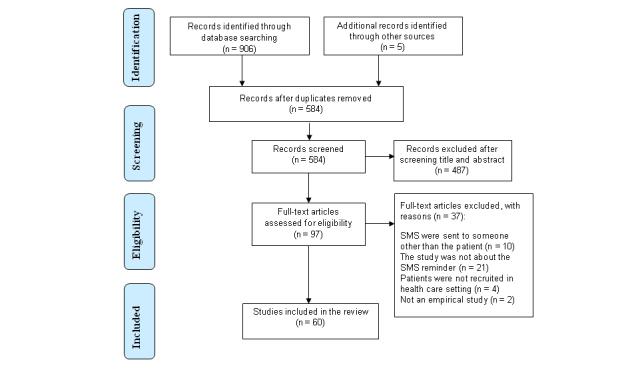
From 911 initial citations, 60 studies were included in the review. The studies reported a variety of use for SMS. Mobile telephone text message reminders were used as the only intervention in 73% (44/60) of the studies, and in 27% (16/60) of the remaining studies, SMS was connected to another comprehensive health intervention system. SMS reminders were sent to different patient groups: patients with HIV/AIDS (15%, 9/60) and diabetes (13%, 8/60) being the most common groups. The response rates of the studies varied from 22-100%. Typically, the text message reminders were sent daily. The time before the specific intervention to be rendered varied from 10 minutes (eg, medication taken) to 2 weeks (eg, scheduled appointment). A wide range of different evaluation methods and outcomes were used to assess the impact of SMS varying from existing databases (eg, attendance rate based on medical records), questionnaires, and physiological measures. About three quarters of the studies (77%, 46/60) reported improved outcomes: adherence to medication or to treatment reportedly improved in 40% (24/60) of the studies, appointment attendance in 18% (11/60) of the studies, and non-attendance rates decreased in 18% (11/60) of the studies. Other positive impacts were decreased amount of missed medication doses, more positive attitudes towards medication, and reductions in treatment interruptions.
CONCLUSIONS
We can conclude that although SMS reminders are used with different patient groups in health care, SMS is less systematically studied with randomized controlled trial study design. Although the amount of evidence for SMS application recommendations is still limited, having 77% (46/60) of the studies showing improved outcomes may indicate its use in health care settings. However, more well-conducted SMS studies are still needed.
背景
随着移动短信技术在全球的普及率接近100%,移动短信已成为社会中广泛认可的通信方式。关于移动电话短信(短消息服务,SMS)在医疗保健服务中的应用,目前仍缺乏系统的知识。
目的
本研究旨在综述关于在医疗保健中使用手机短信提醒的文献。
方法
我们对关于移动电话短信提醒的研究进行了系统的文献综述。自2003年以来,使用的数据源包括PubMed(MEDLINE)、CINAHL、Proquest数据库/PsycINFO、EMBASE、Cochrane图书馆、Scopus,并进行了手工检索。纳入报告在医疗服务中使用短信以提醒患者的研究。鉴于研究的异质性,使用叙述性方法综合了研究的描述性特征、研究目的、回复率、干预描述、剂量和时间、工具、结局测量以及研究的结局数据。
结果
从911条初始引用中,有60项研究纳入综述。这些研究报告了短信的多种用途。在73%(44/60)的研究中,移动电话短信提醒被用作唯一的干预措施,在其余27%(16/60)的研究中,短信与另一个综合健康干预系统相关联。短信提醒发送给不同的患者群体:艾滋病毒/艾滋病患者(15%,9/60)和糖尿病患者(13%,8/60)是最常见的群体。研究的回复率从22%到100%不等。通常,短信提醒每天发送。在具体干预实施前的时间从10分钟(如服药)到2周(如预约就诊)不等。广泛使用了不同的评估方法和结局来评估短信的影响,包括现有数据库(如基于病历的出勤率)、问卷调查和生理测量。约四分之三的研究(77%,46/60)报告了改善的结局:据报道,在40%(24/60)的研究中,药物依从性或治疗依从性得到改善,在18%(11/60)的研究中,预约就诊情况得到改善,在18%(11/60)的研究中,未就诊率下降。其他积极影响包括漏服药物剂量减少、对药物的态度更积极以及治疗中断减少。
结论
我们可以得出结论,尽管短信提醒在医疗保健中用于不同的患者群体,但使用随机对照试验研究设计对短信进行的系统研究较少。尽管关于短信应用建议的证据量仍然有限,但77%(46/60)的研究显示结局得到改善,这可能表明其在医疗保健环境中的应用。然而,仍然需要更多精心设计的短信研究。
 Zotero 插件