RECOVER Injury Research Centre, The University of Queensland, Brisbane, Australia.
National Health and Medical Research Council (NHMRC) Centre for Research Excellence in Better Outcomes for Compensable Injury, Brisbane, Australia.
JMIR Mhealth Uhealth. 2024 Aug 14;12:e55625. doi: 10.2196/55625.
Population studies show that musculoskeletal conditions are a leading contributor to the total burden of healthy life lost, second only to cancer and with a similar burden to cardiovascular disease. Prioritizing the delivery of effective treatments is necessary, and with the ubiquity of consumer smart devices, the use of digital health interventions is increasing. Messaging is popular and easy to use and has been studied for a range of health-related uses, including health promotion, encouragement of behavior change, and monitoring of disease progression. It may have a useful role to play in the management and self-management of musculoskeletal conditions.
Previous reviews on the use of messaging for people with musculoskeletal conditions have focused on synthesizing evidence of effectiveness from randomized controlled trials. In this review, our objective was to map the musculoskeletal messaging literature more broadly to identify information that may inform the design of future messaging interventions and summarize the current evidence of efficacy, effectiveness, and economics.
Following a prepublished protocol developed using the Joanna Briggs Institute Manual for Evidence Synthesis, we conducted a comprehensive scoping review of the literature (2010-2022; sources: PubMed, CINAHL, Embase, and PsycINFO) related to SMS text messaging and app-based messaging for people with musculoskeletal conditions. We described our findings using tables, plots, and a narrative summary.
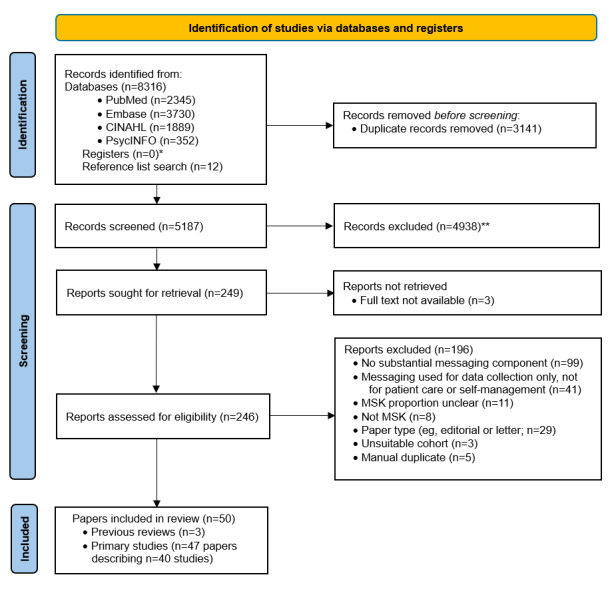
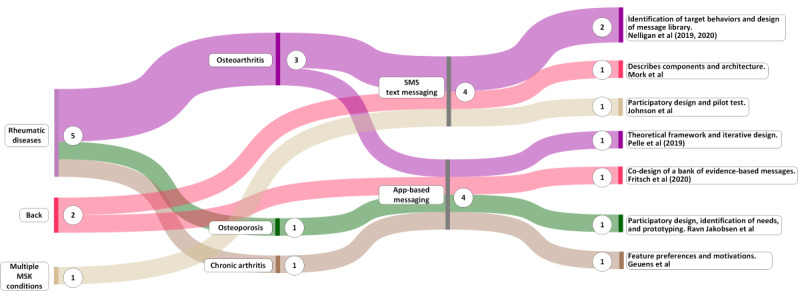
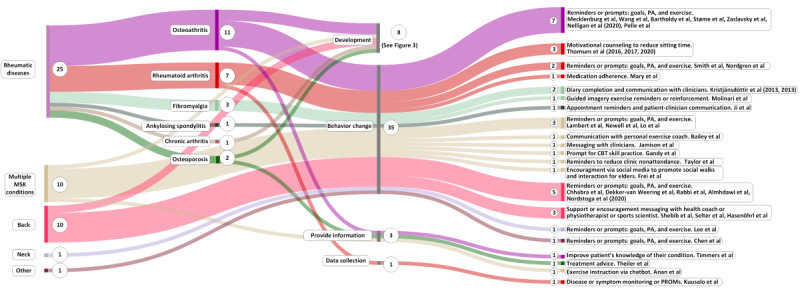
We identified a total of 8328 papers for screening, of which 50 (0.6%) were included in this review (3/50, 6% previous reviews and 47/50, 94% papers describing 40 primary studies). Rheumatic diseases accounted for the largest proportion of the included primary studies (19/40, 48%), followed by studies on multiple musculoskeletal conditions or pain sites (10/40, 25%), back pain (9/40, 23%), neck pain (1/40, 3%), and "other" (1/40, 3%). Most studies (33/40, 83%) described interventions intended to promote positive behavior change, typically by encouraging increased physical activity and exercise. The studies evaluated a range of outcomes, including pain, function, quality of life, and medication adherence. Overall, the results either favored messaging interventions or had equivocal outcomes. While the theoretical underpinnings of the interventions were generally well described, only 4% (2/47) of the papers provided comprehensive descriptions of the messaging intervention design and development process. We found no relevant economic evaluations.
Messaging has been used for the care and self-management of a range of musculoskeletal conditions with generally favorable outcomes reported. However, with few exceptions, design considerations are poorly described in the literature. Further work is needed to understand and disseminate information about messaging content and message delivery characteristics, such as timing and frequency specifically for people with musculoskeletal conditions. Similarly, further work is needed to understand the economic effects of messaging and practical considerations related to implementation and sustainability.
INTERNATIONAL REGISTERED REPORT IDENTIFIER (IRRID): RR2-10.1136/bmjopen-2021-048964.
人群研究表明,肌肉骨骼疾病是导致健康生命损失的主要原因之一,仅次于癌症,与心血管疾病的负担相似。优先提供有效的治疗方法是必要的,随着消费者智能设备的普及,数字健康干预措施的使用正在增加。信息传递简单易用,且已针对一系列与健康相关的用途进行了研究,包括健康促进、鼓励行为改变和疾病进展监测。它在肌肉骨骼疾病的管理和自我管理中可能发挥着有用的作用。
先前关于信息传递用于肌肉骨骼疾病患者的综述侧重于综合随机对照试验的有效性证据。在本次综述中,我们的目的是更广泛地绘制肌肉骨骼信息传递文献图谱,以确定可能为未来信息传递干预措施设计提供信息的内容,并总结当前的疗效、有效性和经济学证据。
根据 Joanna Briggs 研究所证据综合手册制定的预发表方案,我们对 2010 年至 2022 年期间(来源:PubMed、CINAHL、Embase 和 PsycINFO)与肌肉骨骼疾病患者的 SMS 文本消息传递和基于应用程序的消息传递相关的文献进行了全面的范围综述。我们使用表格、图表和叙述性摘要来描述我们的发现。
我们共筛选出 8328 篇论文,其中 50 篇(0.6%)被纳入本综述(3/50,6%为先前综述,47/50,94%为描述 40 项主要研究的论文)。风湿性疾病占纳入的主要研究比例最大(19/40,48%),其次是多种肌肉骨骼疾病或疼痛部位(10/40,25%)、背痛(9/40,23%)、颈痛(1/40,3%)和“其他”(1/40,3%)。大多数研究(33/40,83%)描述了旨在促进积极行为改变的干预措施,通常通过鼓励增加体育锻炼。这些研究评估了一系列结果,包括疼痛、功能、生活质量和药物依从性。总体而言,结果要么有利于信息传递干预措施,要么结果不确定。尽管干预措施的理论基础通常描述得很好,但只有 4%(2/47)的论文提供了对信息传递干预设计和开发过程的全面描述。我们没有发现相关的经济评估。
信息传递已被用于多种肌肉骨骼疾病的护理和自我管理,通常报告的结果是有利的。然而,除了少数例外,文献中对设计考虑因素的描述很差。需要进一步研究以了解和传播有关信息传递内容和消息传递特征的信息,例如特定于肌肉骨骼疾病患者的消息传递时间和频率。同样,需要进一步研究以了解信息传递的经济影响以及与实施和可持续性相关的实际考虑因素。
国际注册报告标识符(IRRID):RR2-10.1136/bmjopen-2021-048964。