1] Ruth L. and David S. Gottesman Institute for Stem Cell and Regenerative Medicine Research, Albert Einstein College of Medicine, Bronx, New York, USA. [2] Department of Hematology, Oncology and Clinical Immunology, Heinrich Heine University, Düsseldorf, Germany. [3] Department of Cell Biology, Albert Einstein College of Medicine, Bronx, New York, USA.
1] Ruth L. and David S. Gottesman Institute for Stem Cell and Regenerative Medicine Research, Albert Einstein College of Medicine, Bronx, New York, USA. [2] Department of Cell Biology, Albert Einstein College of Medicine, Bronx, New York, USA.
Nat Med. 2014 Nov;20(11):1315-20. doi: 10.1038/nm.3707. Epub 2014 Oct 19.
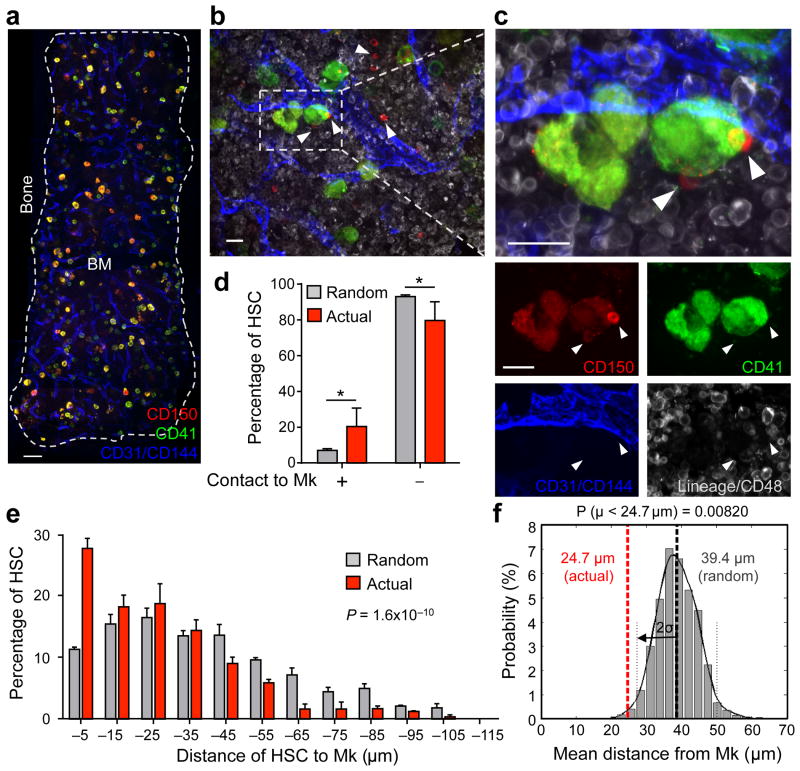
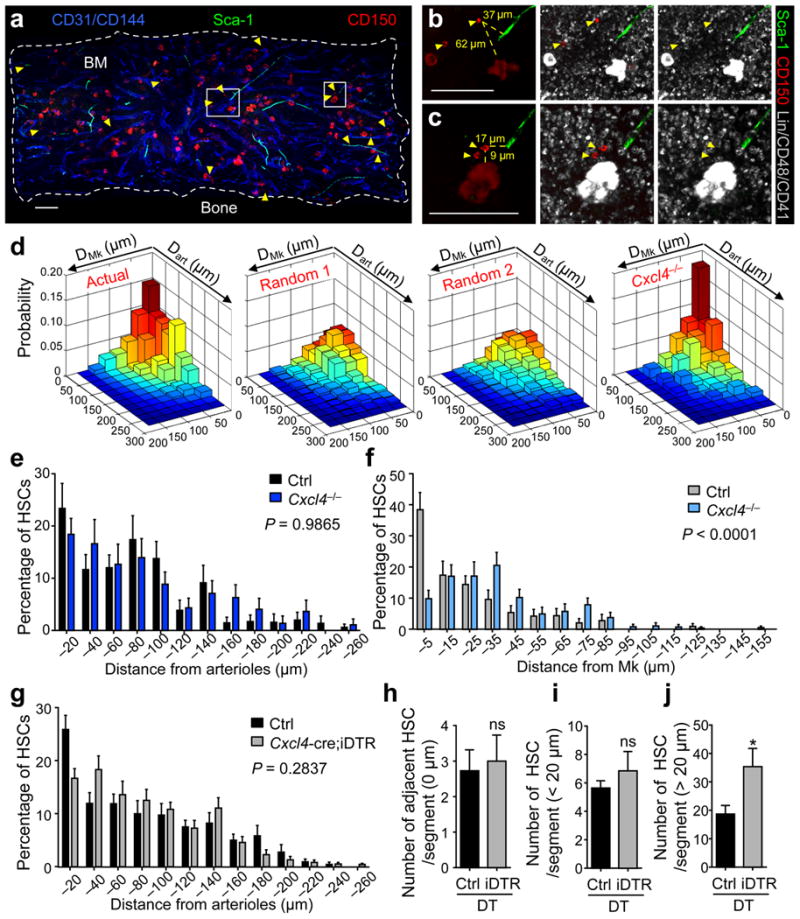
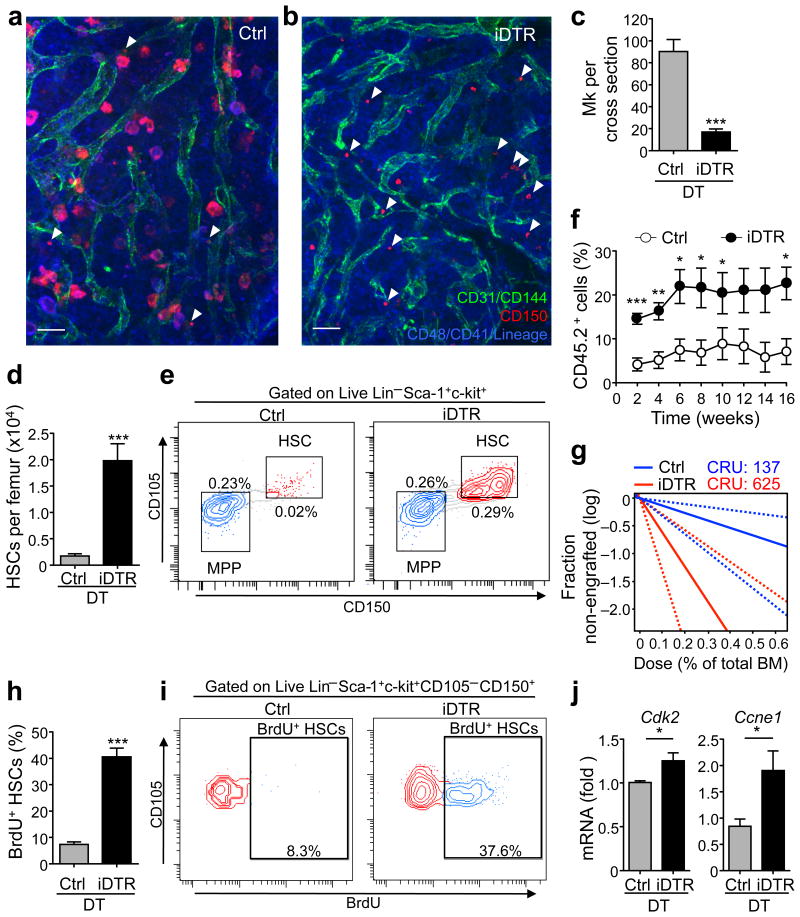
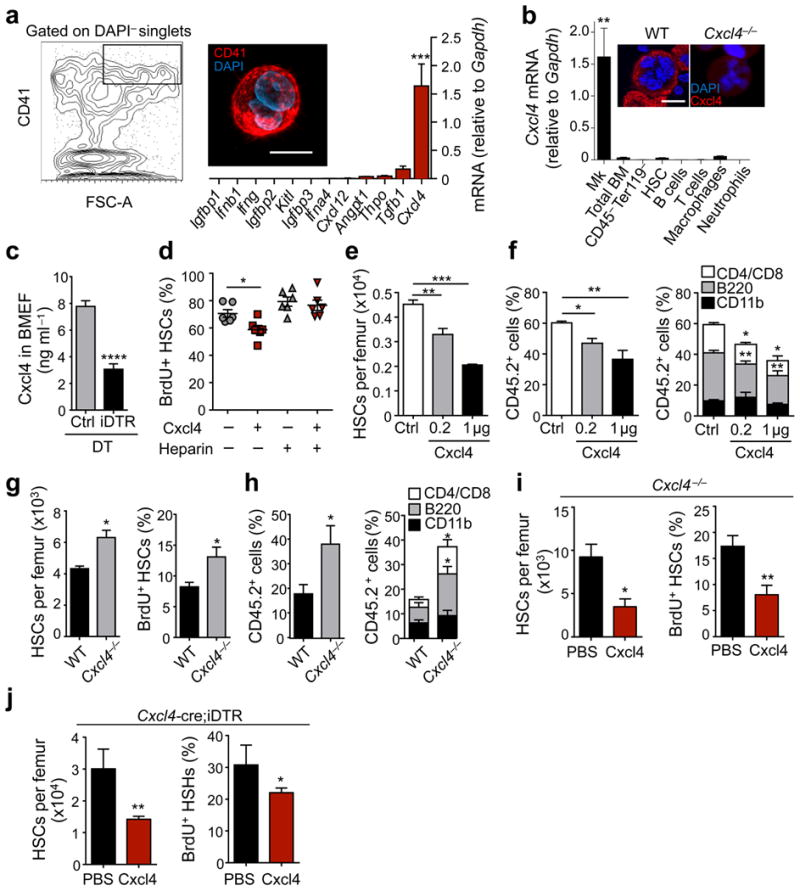
In the bone marrow, hematopoietic stem cells (HSCs) lodge in specialized microenvironments that tightly control the proliferative state of HSCs to adapt to the varying needs for replenishment of blood cells while also preventing HSC exhaustion. All putative niche cells suggested thus far have a nonhematopoietic origin. Thus, it remains unclear how feedback from mature cells is conveyed to HSCs to adjust their proliferation. Here we show that megakaryocytes (MKs) can directly regulate HSC pool size in mice. Three-dimensional whole-mount imaging revealed that endogenous HSCs are frequently located adjacent to MKs in a nonrandom fashion. Selective in vivo depletion of MKs resulted in specific loss of HSC quiescence and led to a marked expansion of functional HSCs. Gene expression analyses revealed that MKs are the source of chemokine C-X-C motif ligand 4 (CXCL4, also named platelet factor 4 or PF4) in the bone marrow, and we found that CXCL4 regulates HSC cell cycle activity. CXCL4 injection into mice resulted in a reduced number of HSCs because of their increased quiescence. By contrast, Cxcl4(-/-) mice exhibited an increased number of HSCs and increased HSC proliferation. Combined use of whole-mount imaging and computational modeling was highly suggestive of a megakaryocytic niche capable of independently influencing HSC maintenance by regulating quiescence. These results indicate that a terminally differentiated cell type derived from HSCs contributes to the HSC niche, directly regulating HSC behavior.
在骨髓中,造血干细胞(HSCs)定位于专门的微环境中,这些微环境严格控制 HSCs 的增殖状态,以适应不断变化的血细胞补充需求,同时防止 HSC 衰竭。迄今为止,所有推测的龛位细胞都具有非造血细胞的起源。因此,尚不清楚成熟细胞的反馈信息如何传递给 HSCs 以调整其增殖。在这里,我们证明巨核细胞(MKs)可以在小鼠中直接调节 HSC 池的大小。三维整体成像显示,内源性 HSCs 经常以非随机的方式定位于 MKs 附近。MKs 的选择性体内耗竭导致 HSC 静止的特异性丧失,并导致功能性 HSC 的显著扩增。基因表达分析显示,MKs 是骨髓中趋化因子 C-X-C 基序配体 4(CXCL4,也称为血小板因子 4 或 PF4)的来源,我们发现 CXCL4 调节 HSC 细胞周期活性。将 CXCL4 注射到小鼠中会导致 HSC 数量减少,因为它们的静止状态增加。相比之下,Cxcl4(-/-) 小鼠表现出更多的 HSCs 和增加的 HSC 增殖。整体成像和计算建模的联合使用高度提示存在一个巨核细胞龛位,能够通过调节静止状态来独立影响 HSC 的维持。这些结果表明,一种源自 HSCs 的终末分化细胞类型有助于 HSC 龛位,直接调节 HSC 的行为。