Martin Loren, Sample Hannah, Gregg Michael, Wood Caleb
Department of Graduate Psychology, Azusa Pacific University 901 E Alosta Ave, Azusa, 91702, California.
Brain Behav. 2014 Sep;4(5):754-64. doi: 10.1002/brb3.273. Epub 2014 Aug 13.
As purported causal factors are identified for autism spectrum disorder (ASD), new assays are needed to better phenotype animal models designed to explore these factors. With recent evidence suggesting that deficits in social motivation are at the core of ASD behavior, the development of quantitative measures of social motivation is particularly important. The goal of our study was to develop and validate novel assays to quantitatively measure social motivation in mice.
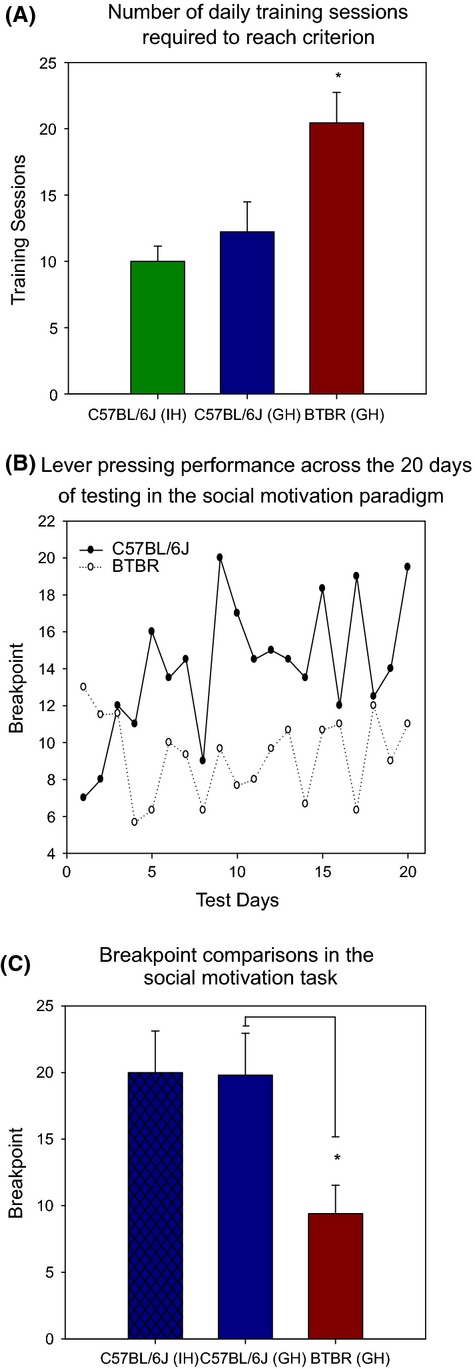
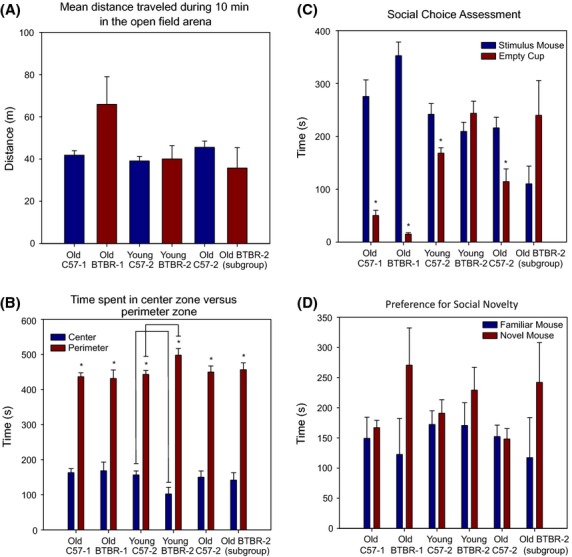
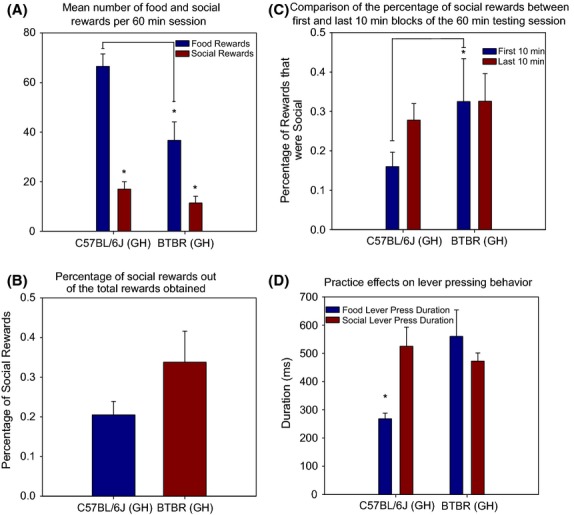
In order to test the validity of our paradigms, we compared the BTBR strain, with documented social deficits, to the prosocial C57BL/6J strain. Two novel conditioning paradigms were developed that allowed the test mouse to control access to a social partner. In the social motivation task, the test mice lever pressed for a social reward. The reward contingency was set on a progressive ratio of reinforcement and the number of lever presses achieved in the final trial of a testing session (breakpoint) was used as an index of social motivation. In the valence comparison task, motivation for a food reward was compared to a social reward. We also explored activity, social affiliation, and preference for social novelty through a series of tasks using an ANY-Maze video-tracking system in an open-field arena.
BTBR mice had significantly lower breakpoints in the social motivation paradigm than C57BL/6J mice. However, the valence comparison task revealed that BTBR mice also made significantly fewer lever presses for a food reward.
The results of the conditioning paradigms suggest that the BTBR strain has an overall deficit in motivated behavior. Furthermore, the results of the open-field observations may suggest that social differences in the BTBR strain are anxiety induced.
随着自闭症谱系障碍(ASD)的假定因果因素被确定,需要新的检测方法来更好地表征旨在探索这些因素的动物模型。最近有证据表明,社会动机缺陷是ASD行为的核心,因此开发社会动机的定量测量方法尤为重要。我们研究的目的是开发并验证用于定量测量小鼠社会动机的新检测方法。
为了测试我们范式的有效性,我们将有记录的社会缺陷的BTBR品系与亲社会的C57BL/6J品系进行了比较。开发了两种新的条件范式,使测试小鼠能够控制与社会伙伴的接触。在社会动机任务中,测试小鼠通过按压杠杆来获得社会奖励。奖励偶然性设定为递增比率强化,测试环节最后一次试验中达到的杠杆按压次数(断点)用作社会动机的指标。在效价比较任务中,将对食物奖励的动机与社会奖励进行比较。我们还通过在开放场地竞技场中使用ANY-Maze视频跟踪系统的一系列任务,探索了活动、社会归属以及对社会新奇性的偏好。
在社会动机范式中,BTBR小鼠的断点显著低于C57BL/6J小鼠。然而,效价比较任务显示,BTBR小鼠对食物奖励的杠杆按压次数也显著减少。
条件范式的结果表明,BTBR品系在动机行为方面总体存在缺陷。此外,开放场地观察的结果可能表明,BTBR品系的社会差异是由焦虑引起的。