Gaig Carles, Vilas Dolores, Infante Jon, Sierra María, García-Gorostiaga Inés, Buongiorno Mariateresa, Ezquerra Mario, Martí Maria José, Valldeoriola Francesc, Aguilar Miquel, Calopa Matilde, Hernandez-Vara Jorge, Tolosa Eduardo
Parkinson's Disease and Movement Disorders Unit, Neurology Service, Institut de Neurociències Hospital Clínic, University of Barcelona, Barcelona, Spain; Institut d'investigacions Biomèdiques August Pi i Sunyer (IDIBAPS), Barcelona, Spain; Centro de Investigación Biomédica en Red de Enfermedades Neurodegenerativas (CIBERNED), Madrid, Spain.
Parkinson's Disease and Movement Disorders Unit, Neurology Service, Institut de Neurociències Hospital Clínic, University of Barcelona, Barcelona, Spain.
PLoS One. 2014 Oct 17;9(10):e108982. doi: 10.1371/journal.pone.0108982. eCollection 2014.
Idiopathic Parkinson's disease (IPD) and LRRK2-associated PD (LRRK2-PD) might be expected to differ clinically since the neuropathological substrate of LRRK2-PD is heterogeneous. The range and severity of extra-nigral nonmotor features associated with LRRK2 mutations is also not well-defined.
To evaluate the prevalence and time of onset of nonmotor symptoms (NMS) in LRRK2-PD patients.
The presence of hyposmia and of neuropsychiatric, dysautonomic and sleep disturbances was assessed in 33 LRRK2-G2019S-PD patients by standardized questionnaires and validated scales. Thirty-three IPD patients, matched for age, gender, duration of parkinsonism and disease severity and 33 healthy subjects were also evaluated.
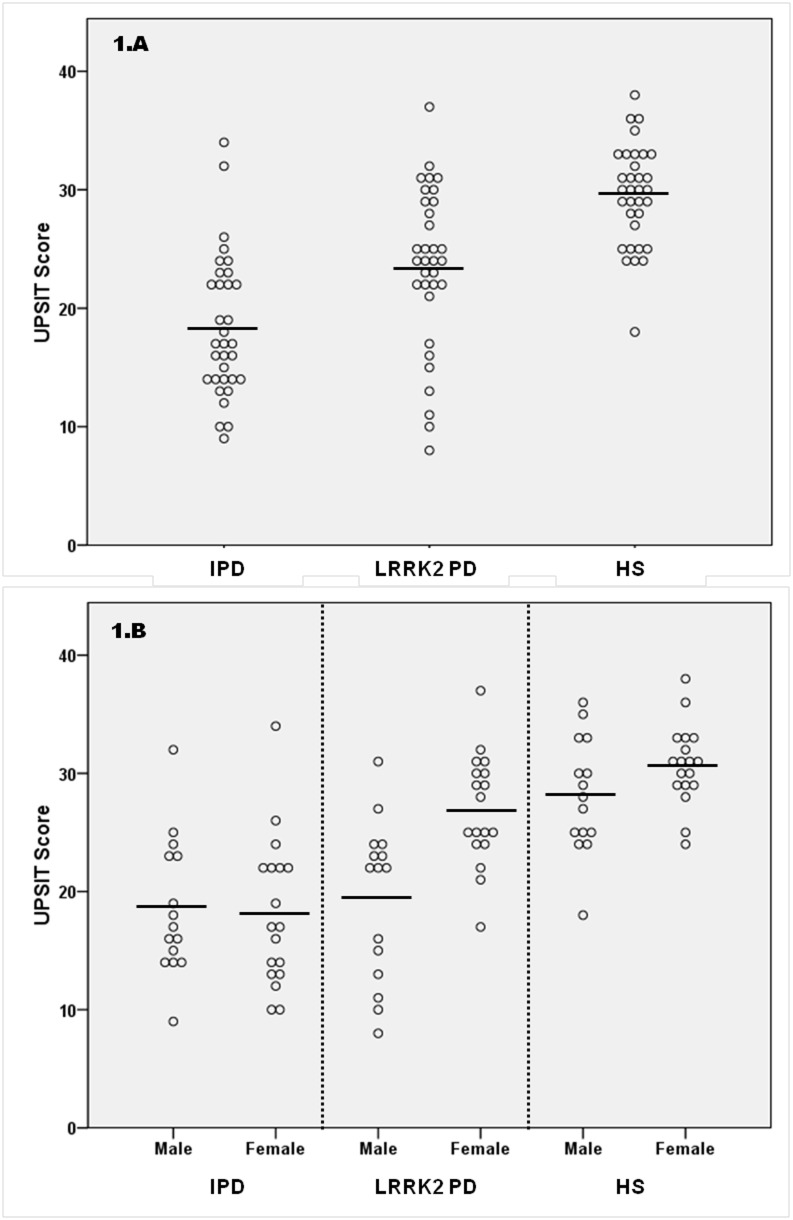
University of Pennsylvania Smell Identification Test (UPSIT) scores in LRRK2-G2019S-PD were higher than those in IPD (23.5±6.8 vs 18.4±6.0; p = 0.002), and hyposmia was less frequent in G2019S carriers than in IPD (39.4% vs 75.8%; p = 0.01). UPSIT scores were significantly higher in females than in males in LRRK2-PD patients (26.9±4.7 vs 19.4±6.8; p<0.01). The frequency of sleep and neuropsychiatric disturbances and of dysautonomic symptoms in LRRK2-G2019S-PD was not significantly different from that in IPD. Hyposmia, depression, constipation and excessive daytime sleepiness, were reported to occur before the onset of classical motor symptoms in more than 40% of LRRK2-PD patients in whom these symptoms were present at the time of examination.
Neuropsychiatric, dysautonomic and sleep disturbances occur as frequently in patients with LRRK2-G2019S-PD as in IPD but smell loss was less frequent in LRRK2-PD. Like in IPD, disturbances such as hyposmia, depression, constipation and excessive daytime sleepiness may antedate the onset of classical motor symptoms in LRRK2-G2019S-PD.
特发性帕金森病(IPD)和LRRK2相关帕金森病(LRRK2-PD)在临床上可能存在差异,因为LRRK2-PD的神经病理学基础具有异质性。与LRRK2突变相关的黑质外非运动特征的范围和严重程度也尚未明确界定。
评估LRRK2-PD患者非运动症状(NMS)的患病率和发病时间。
通过标准化问卷和有效量表,对33例LRRK2-G2019S-PD患者的嗅觉减退以及神经精神、自主神经功能障碍和睡眠障碍情况进行评估。还对33例年龄、性别、帕金森病病程和疾病严重程度相匹配的IPD患者以及33名健康受试者进行了评估。
LRRK2-G2019S-PD患者的宾夕法尼亚大学嗅觉识别测试(UPSIT)得分高于IPD患者(23.5±6.8 vs 18.4±6.0;p = 0.002),G2019S携带者嗅觉减退的发生率低于IPD患者(39.4% vs 75.8%;p = 0.01)。LRRK2-PD患者中女性的UPSIT得分显著高于男性(26.9±4.7 vs 19.4±6.8;p<0.01)。LRRK2-G2019S-PD患者的睡眠和神经精神障碍以及自主神经功能障碍症状的发生率与IPD患者无显著差异。在检查时存在嗅觉减退、抑郁、便秘和日间过度嗜睡症状的LRRK2-PD患者中,超过40%的患者报告这些症状在经典运动症状出现之前就已发生。
LRRK2-G2019S-PD患者的神经精神、自主神经功能障碍和睡眠障碍发生率与IPD患者相同,但LRRK2-PD患者嗅觉丧失的发生率较低。与IPD一样,在LRRK2-G2019S-PD中,嗅觉减退、抑郁、便秘和日间过度嗜睡等障碍可能先于经典运动症状出现。