Laurell Tobias, Nilsson Daniel, Hofmeister Wolfgang, Lindstrand Anna, Ahituv Nadav, Vandermeer Julia, Amilon Anders, Annerén Göran, Arner Marianne, Pettersson Maria, Jäntti Nina, Rosberg Hans-Eric, Cattini Peter A, Nordenskjöld Agneta, Mäkitie Outi, Grigelioniene Giedre, Nordgren Ann
Department of Molecular Medicine and Surgery and Center of Molecular Medicine, Karolinska Institutet Stockholm, Sweden ; Department of Clinical Science and Education, Södersjukhuset, Karolinska Institutet Stockholm, Sweden ; Department of Hand Surgery, Södersjukhuset Stockholm, Sweden.
Department of Molecular Medicine and Surgery and Center of Molecular Medicine, Karolinska Institutet Stockholm, Sweden ; Department of Clinical Genetics, Karolinska University Hospital Stockholm, Sweden ; Science for Life Laboratory, Karolinska Institutet Science Park Stockholm, Sweden.
Mol Genet Genomic Med. 2014 Sep;2(5):402-11. doi: 10.1002/mgg3.81. Epub 2014 May 14.
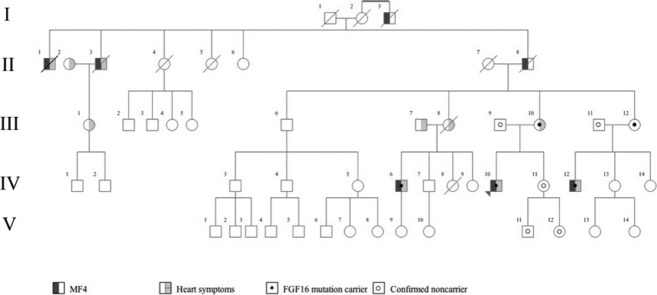
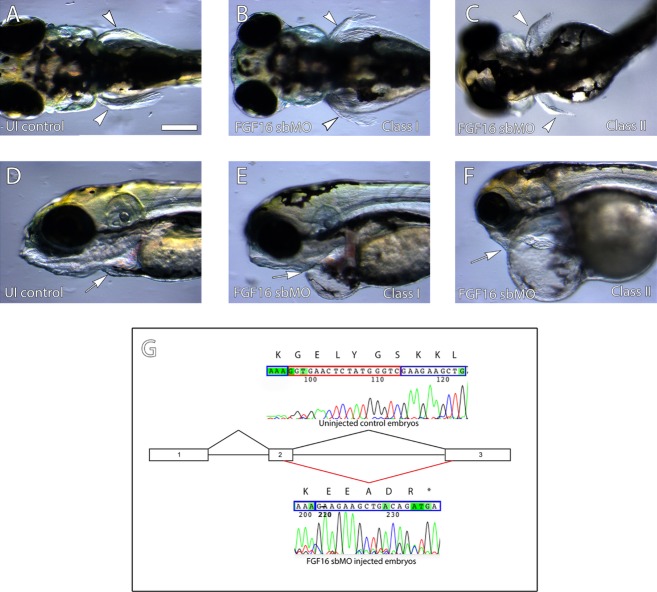
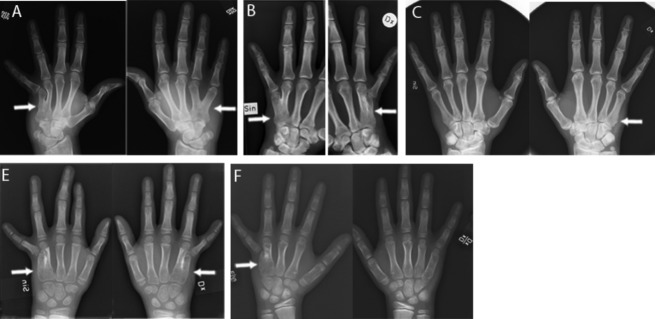
Nonsense mutations in FGF16 have recently been linked to X-linked recessive hand malformations with fusion between the fourth and the fifth metacarpals and hypoplasia of the fifth digit (MF4; MIM#309630). The purpose of this study was to perform careful clinical phenotyping and to define molecular mechanisms behind X-linked recessive MF4 in three unrelated families. We performed whole-exome sequencing, and identified three novel mutations in FGF16. The functional impact of FGF16 loss was further studied using morpholino-based suppression of fgf16 in zebrafish. In addition, clinical investigations revealed reduced penetrance and variable expressivity of the MF4 phenotype. Cardiac disorders, including myocardial infarction and atrial fibrillation followed the X-linked FGF16 mutated trait in one large family. Our findings establish that a mutation in exon 1, 2 or 3 of FGF16 results in X-linked recessive MF4 and expand the phenotypic spectrum of FGF16 mutations to include a possible correlation with heart disease.
最近发现,FGF16基因的无义突变与X连锁隐性手部畸形有关,表现为第四和第五掌骨融合以及第五指发育不全(MF4;MIM#309630)。本研究的目的是对三个无血缘关系的家族进行细致的临床表型分析,并确定X连锁隐性MF4背后的分子机制。我们进行了全外显子组测序,在FGF16基因中鉴定出三个新的突变。利用基于吗啉代的方法抑制斑马鱼体内的fgf16,进一步研究了FGF16缺失的功能影响。此外,临床调查显示MF4表型的外显率降低且表现度可变。在一个大家庭中,包括心肌梗死和心房颤动在内的心脏疾病遵循X连锁的FGF16突变特征。我们的研究结果表明,FGF16基因第1、2或3外显子的突变会导致X连锁隐性MF4,并将FGF16突变的表型谱扩展到包括与心脏病的可能关联。