Stevens Martin, Lown Alice E, Denton Alexander M
Centre for Ecology and Conservation, College of Life and Environmental Sciences, University of Exeter, Penryn Campus, Penryn, Cornwall, United Kingdom.
PLoS One. 2014 Oct 15;9(10):e110325. doi: 10.1371/journal.pone.0110325. eCollection 2014.
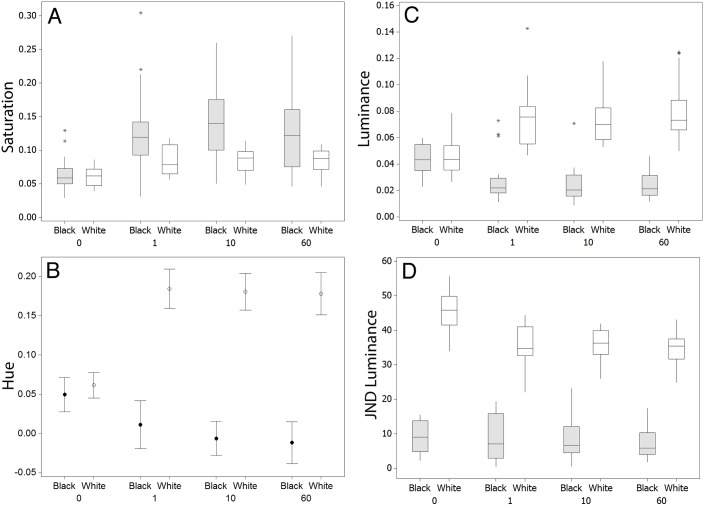
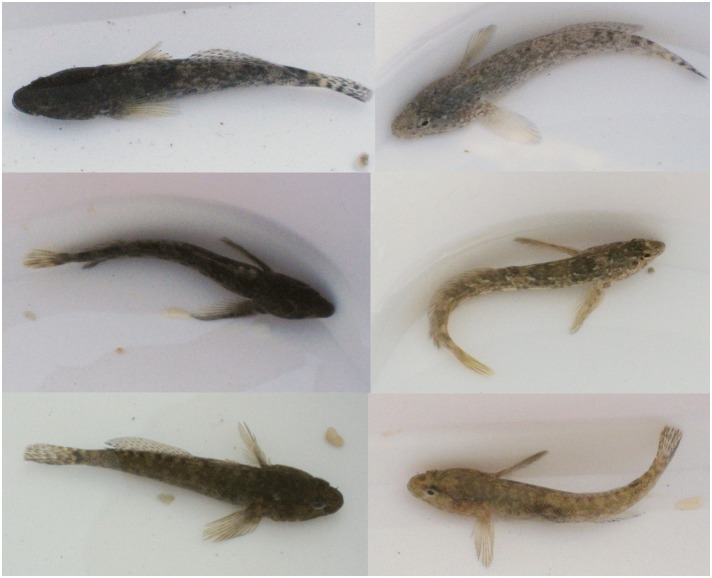
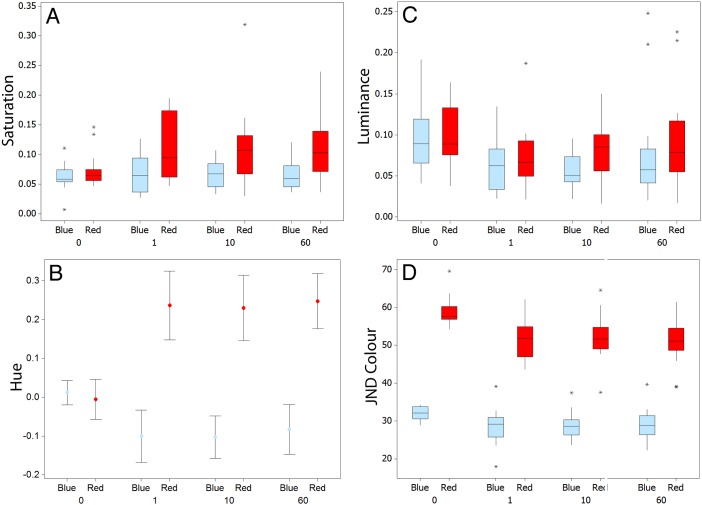
Camouflage is found in a wide range of species living in numerous habitat types, offering protection from visually guided predators. This includes many species from the intertidal zone, which must cope with background types diverse in appearance and with multiple predator groups foraging at high and low tide. Many animals are capable of either relatively slow (hours, days, weeks) or rapid (seconds and minutes) colour change in order to better resemble the background against which they are found, but most work has been restricted to a few species or taxa. It is often suggested that many small intertidal fish are capable of colour change for camouflage, yet little experimental work has addressed this. Here, we test rock gobies (Gobius paganellus) for colour change abilities, and whether they can tune their appearance to match the background. In two experiments, we place gobies on backgrounds of different brightness (black or white), and of different colours (red and blue) and use digital image analysis and modelling of predator (avian) vision to quantify colour and luminance (perceived lightness) changes and camouflage. We find that gobies are capable of rapid colour change (occurring within one minute), and that they can change their luminance on lighter or darker backgrounds. When presented on backgrounds of different colours, gobies also change their colour (hue and saturation) while keeping luminance the same. These changes lead to predicted improvements in camouflage match to the background. Our study shows that small rockpool fish are capable of rapid visual change for concealment, and that this may be an important mechanism in many species to avoid predation, especially in complex heterogeneous environments.
在众多栖息地类型中生活的广泛物种中都能发现伪装现象,它能为动物提供保护,使其免受视觉导向型捕食者的攻击。这包括许多来自潮间带的物种,它们必须应对外观多样的背景类型以及在涨潮和落潮时觅食的多个捕食者群体。许多动物能够进行相对缓慢(数小时、数天、数周)或快速(数秒和数分钟)的颜色变化,以便更好地与它们所处的背景相似,但大多数研究工作都局限于少数物种或分类群。人们常常认为许多小型潮间带鱼类能够通过颜色变化来进行伪装,但很少有实验工作涉及这一点。在这里,我们测试了岩虾虎鱼(Gobius paganellus)的颜色变化能力,以及它们是否能够调整自身外观以匹配背景。在两个实验中,我们将虾虎鱼放置在不同亮度(黑色或白色)以及不同颜色(红色和蓝色)的背景上,并使用数字图像分析和捕食者(鸟类)视觉模型来量化颜色和亮度(感知明度)的变化以及伪装效果。我们发现虾虎鱼能够快速变色(在一分钟内发生),并且它们能够在较亮或较暗的背景上改变亮度。当放置在不同颜色的背景上时,虾虎鱼还会在保持亮度不变的同时改变颜色(色调和饱和度)。这些变化使得它们与背景的伪装匹配度得到了预测性的提高。我们的研究表明,小型岩池鱼类能够进行快速的视觉变化以实现隐蔽,并且这可能是许多物种避免被捕食的重要机制,尤其是在复杂的异质环境中。