Dieltjens Marijke, Vroegop Anneclaire V, Verbruggen Annelies E, Wouters Kristien, Willemen Marc, De Backer Wilfried A, Verbraecken Johan A, Van de Heyning Paul H, Braem Marc J, de Vries Nico, Vanderveken Olivier M
Department of Special Care Dentistry, Antwerp University Hospital (UZA), Wilrijkstraat 10, 2650, Edegem, Belgium,
Sleep Breath. 2015 May;19(2):637-44. doi: 10.1007/s11325-014-1068-8. Epub 2014 Oct 22.
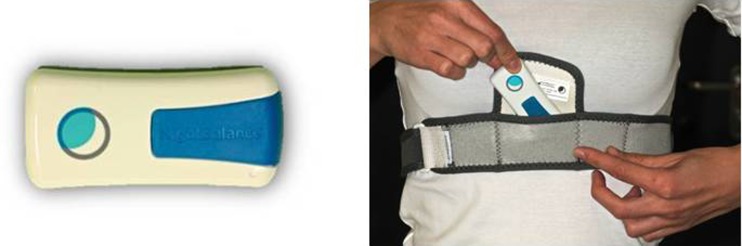
The objective of this randomized controlled trial was to assess the additional effect of a chest-worn sleep position trainer (SPT) in patients with residual supine-dependent obstructive sleep apnea (sdOSA) under mandibular advancement device (MAD) therapy.
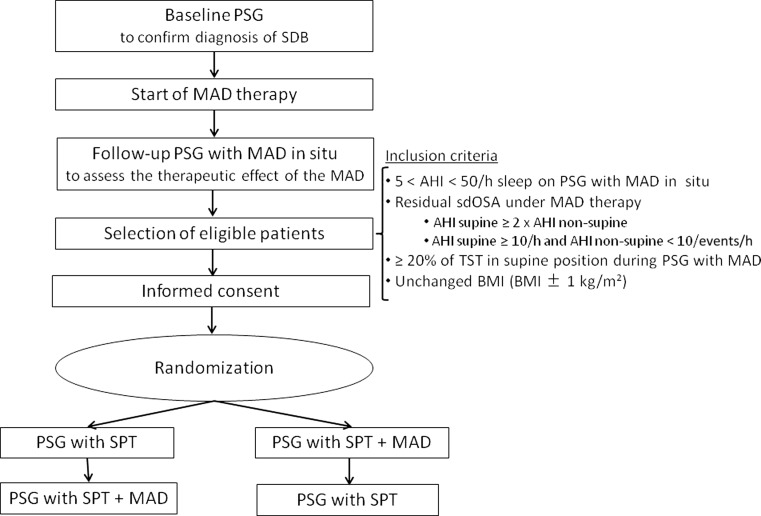
Baseline and follow-up polysomnography with MAD were performed. Twenty patients with sdOSA under MAD therapy underwent two consecutive randomized polysomnographies: one with SPT and one with combination of SPT + MAD. Data are presented as median (quartile 1, quartile 3).
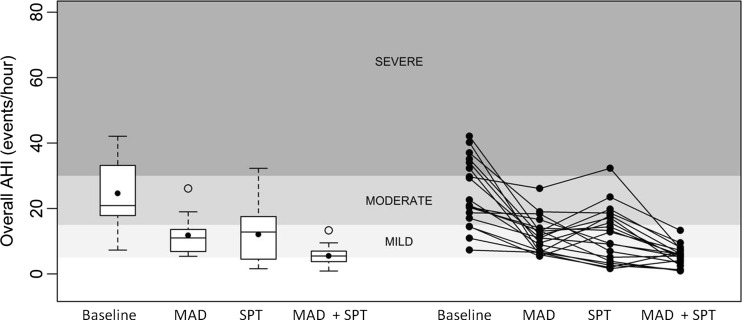
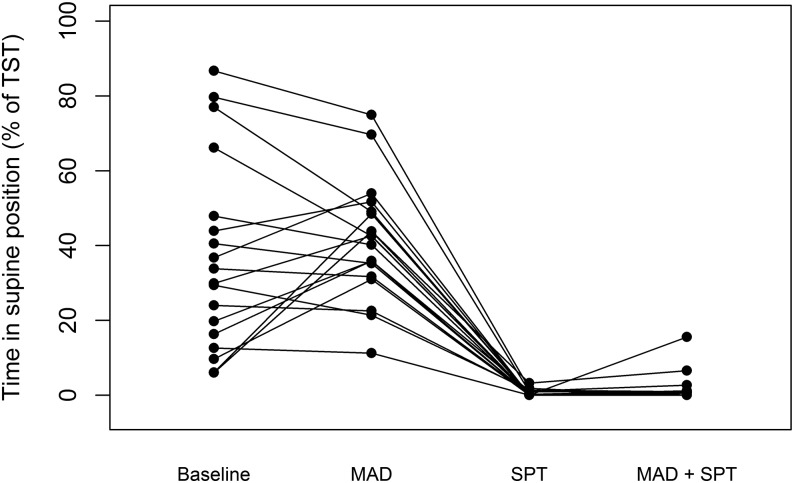
The SPT reduced the time spent in supine sleeping position compared to baseline and MAD therapy. Both MAD and SPT were individually effective in reducing the overall apnea/hypopnea index (AHI) significantly when compared to baseline from 20.8 (15.1; 33.6)/h at baseline to 11.0 (6.7; 13.8)/h and to 11.1 (3.5; 17.7)/h with MAD or SPT, respectively. The combination of SPT + MAD further reduced the overall AHI to 5.7 (3.6; 7.4), which was significantly lower than with MAD alone (p < 0.001) and SPT alone (p < 0.008), respectively.
The results of this study indicate that combination of SPT + MAD leads to a higher therapeutic efficacy in patients with sdOSA under MAD therapy when compared to one of the treatment modalities alone.
本随机对照试验的目的是评估在接受下颌前移装置(MAD)治疗的残余仰卧位依赖性阻塞性睡眠呼吸暂停(sdOSA)患者中,佩戴在胸部的睡眠姿势训练器(SPT)的附加效果。
进行了使用MAD的基线和随访多导睡眠图检查。20例接受MAD治疗的sdOSA患者连续进行了两次随机多导睡眠图检查:一次使用SPT,一次使用SPT + MAD联合治疗。数据以中位数(四分位数1,四分位数3)表示。
与基线和MAD治疗相比,SPT减少了仰卧睡眠姿势的时间。与基线相比,MAD和SPT单独使用时均能显著降低总体呼吸暂停/低通气指数(AHI),从基线时的20.8(15.1;33.6)次/小时分别降至使用MAD时的11.0(6.7;13.8)次/小时和使用SPT时的11.1(3.5;17.7)次/小时。SPT + MAD联合治疗进一步将总体AHI降低至5.7(3.6;7.4),分别显著低于单独使用MAD(p < 0.001)和单独使用SPT(p < 0.008)。
本研究结果表明,与单独使用一种治疗方式相比,SPT + MAD联合治疗在接受MAD治疗的sdOSA患者中具有更高的治疗效果。