Taft Teresa, Lenert Leslie, Sakaguchi Farrant, Stoddard Gregory, Milne Caroline
Department of Biomedical Informatics, University of Utah, Salt Lake City, Utah, USA.
Biomedical Informatics Center, Medical University of South Carolina, Charleston, South Carolina, USA Department of Internal Medicine, Medical University of South Carolina, Charleston, South Carolina, USA.
J Am Med Inform Assoc. 2015 Jan;22(1):192-8. doi: 10.1136/amiajnl-2014-002871. Epub 2014 Oct 21.
The effects of electronic health records (EHRs) on doctor-patient communication are unclear.
To evaluate the effects of EHR use compared with paper chart use, on novice physicians' communication skills.
Within-subjects randomized controlled trial using observed structured clinical examination methods to assess the impact of use of an EHR on communication.
A large academic internal medicine training program.
First-year internal medicine residents.
Residents interviewed, diagnosed, and initiated treatment of simulated patients using a paper chart or an EHR on a laptop computer. Video recordings of interviews were rated by three trained observers using the Four Habits scale.
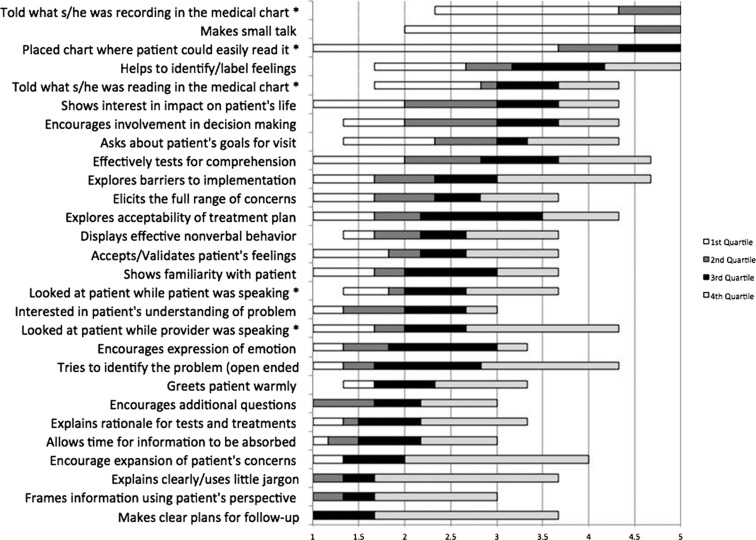
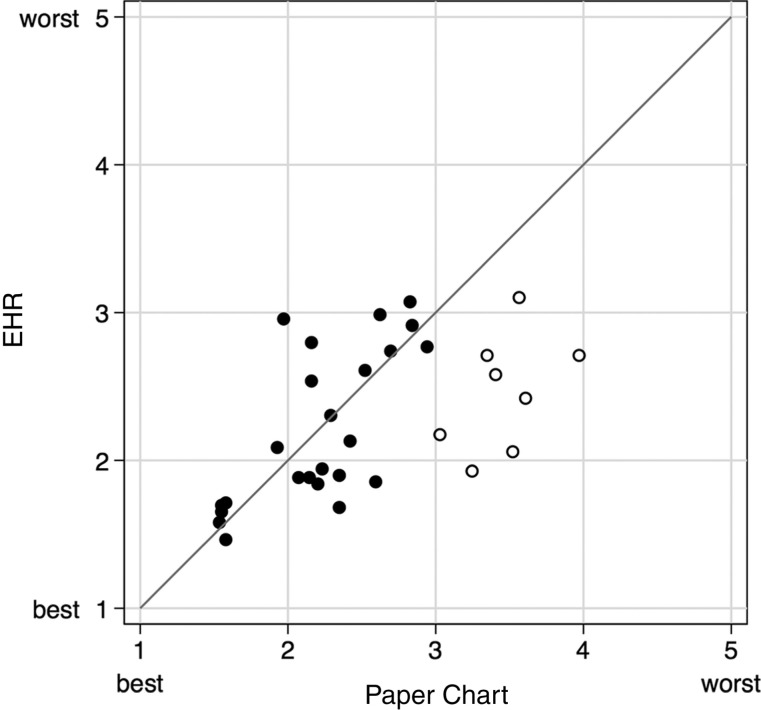
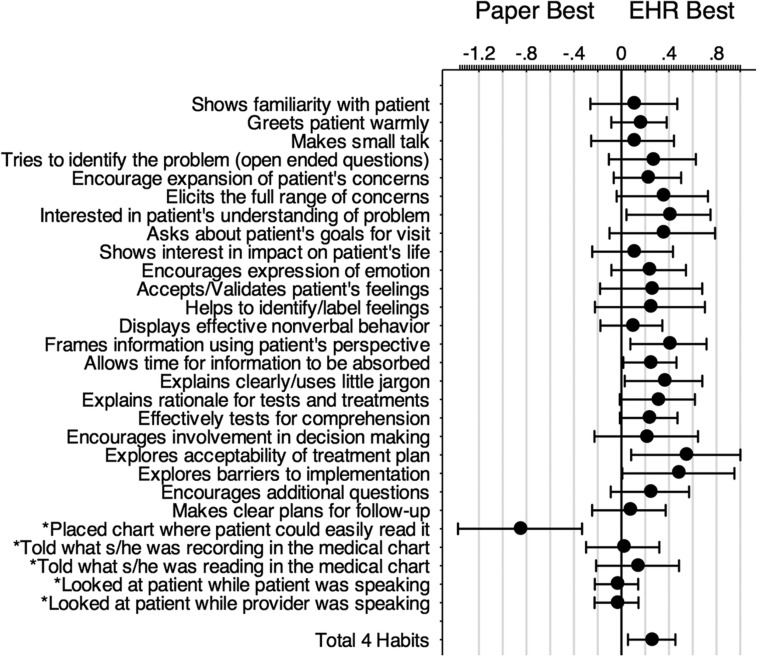
Thirty-two residents completed the study and had data available for review (61.5% of those enrolled in the residency program). In most skill areas in the Four Habits model, residents performed at least as well using the EHR and were statistically better in six of 23 skills areas (p<0.05). The overall average communication score was better when using an EHR: mean difference 0.254 (95% CI 0.05 to 0.45), p = 0.012, Cohen's d of 0.47 (a moderate effect). Residents scoring poorly (>3 average score) with paper methods (n = 8) had clinically important improvement when using the EHR.
This study was conducted in first-year residents in a training environment using simulated patients at a single institution.
Use of an EHR on a laptop computer appears to improve the ability of first-year residents to communicate with patients relative to using a paper chart.
电子健康记录(EHRs)对医患沟通的影响尚不清楚。
评估与使用纸质病历相比,使用电子健康记录对新手医生沟通技巧的影响。
采用观察性结构化临床检查方法的受试者内随机对照试验,以评估使用电子健康记录对沟通的影响。
一个大型学术性内科培训项目。
内科一年级住院医师。
住院医师使用纸质病历或笔记本电脑上的电子健康记录对模拟患者进行访谈、诊断并开始治疗。由三名经过培训的观察员使用“四项习惯”量表对访谈视频进行评分。
32名住院医师完成了研究,并有可供审查的数据(占住院医师培训项目注册人数的61.5%)。在“四项习惯”模型的大多数技能领域中,住院医师使用电子健康记录时的表现至少与使用纸质病历一样好,并且在23项技能领域中的6项上有统计学上的显著优势(p<0.05)。使用电子健康记录时的总体平均沟通得分更高:平均差异为0.254(95%可信区间为0.05至0.45),p = 0.012,科恩d值为0.47(中等效应)。使用纸质方法得分较低(平均得分>3)的住院医师(n = 8)在使用电子健康记录时有临床上重要的改善。
本研究是在单一机构的培训环境中对一年级住院医师使用模拟患者进行的。
与使用纸质病历相比,在笔记本电脑上使用电子健康记录似乎能提高一年级住院医师与患者沟通的能力。