Gitton Yorick, Narboux-Nême Nicolas, Levi Giovanni
Evolution des Régulations Endocriniennes, CNRS, UMR7221, Muséum National d'Histoire Naturelle, Paris, France.
F1000Res. 2013 Nov 28;2:261. doi: 10.12688/f1000research.2-261.v3. eCollection 2013.
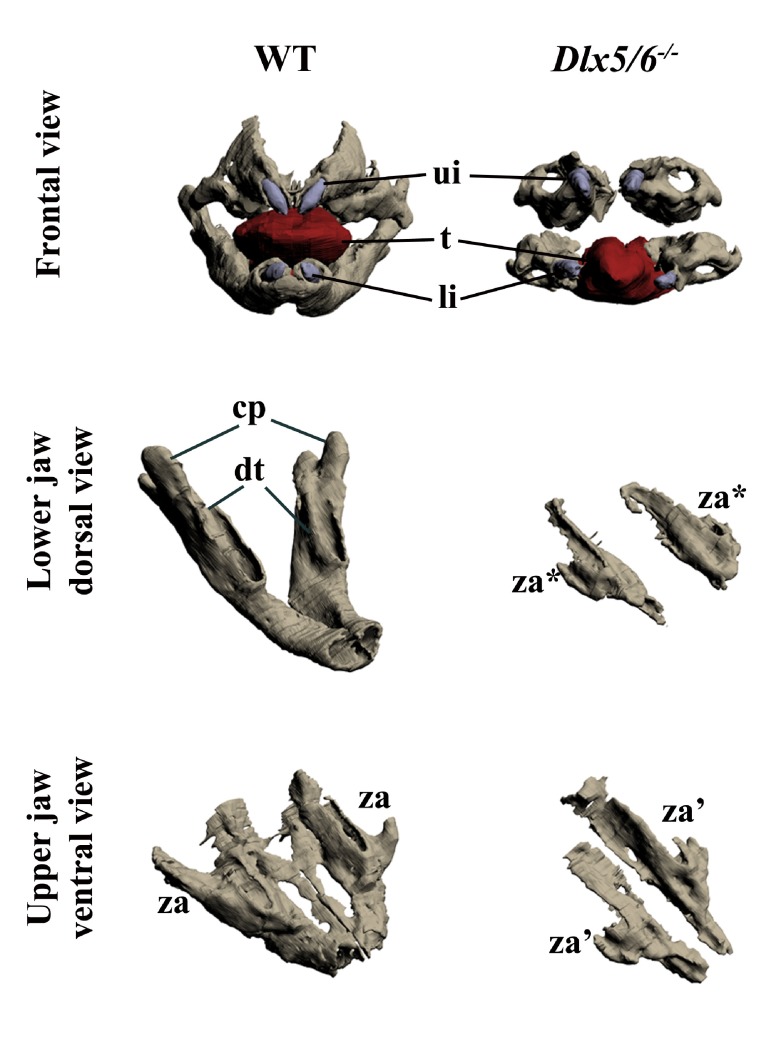
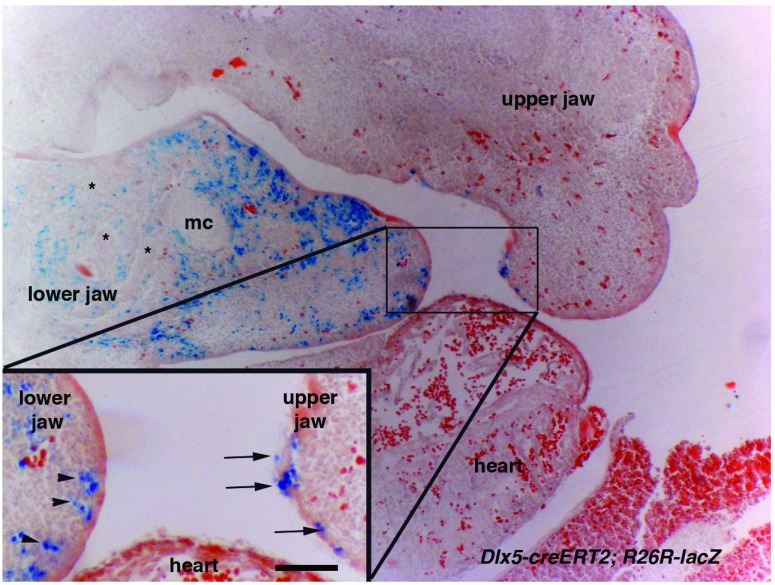
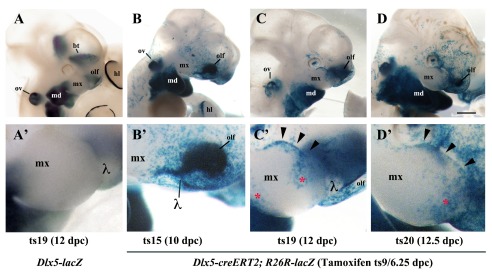
Asymmetric, articulated jaws are characteristic of most vertebrate species; they derive from the first pharyngeal arch (PA1) which generates both maxillary and mandibular components. PA1 is colonized by cranial neural crest cells (CNCCs) which give rise to most bones and tendons of the jaws. The elements formed by different CNCCs contingents are specified by the combinatorial expression of Dlx genes. Dlx5 and Dlx6 are predominantly expressed by mandibular CNCCs. Analysis of the phenotype of Dlx5 and Dlx6 double mutant mice has suggested that they are necessary and sufficient to specify mandibular identity. Here, using 3D reconstruction, we show that inactivation of Dlx5 and Dlx6 does not only affect the mandibular arch, but results in the simultaneous transformation of mandibular and maxillary skeletal elements which assume a similar morphology with gain of symmetry. As Dlx5- and Dlx6-expressing cells are not found in the maxillary bud, we have examined the lineage of Dlx5-expressing progenitors using an in vivo genetic approach. We find that a contingent of cells deriving from epithelial precursors transiently expressing Dlx5 participate in the formation of the maxillary arch. These cells are mostly located in the distal part of the maxillary arch and might derive from its lambdoidal junction with the olfactory pit. Our observations provide the first genetic demonstration of the 'Hinge and Caps' model[1]. We support the notion that 'cap' signals could originate from epithelial derivatives of Dlx5-expressing progenitors which migrate and colonize the maxillary arch epithelium. Our results imply that Dlx5 and Dlx6 control upper and lower jaw morphogenesis through different coordinated mechanisms to generate functional, articulated jaws.
不对称的关节状颌骨是大多数脊椎动物物种的特征;它们源自第一咽弓(PA1),该咽弓产生上颌和下颌部分。PA1由颅神经嵴细胞(CNCCs)定植,这些细胞产生颌骨的大部分骨骼和肌腱。不同CNCCs群体形成的元素由Dlx基因的组合表达指定。Dlx5和Dlx6主要由下颌CNCCs表达。对Dlx5和Dlx6双突变小鼠表型的分析表明,它们对于确定下颌特征是必要且充分的。在这里,我们使用三维重建显示,Dlx5和Dlx6的失活不仅影响下颌弓,还导致下颌和上颌骨骼元素同时发生转变,这些元素呈现出相似的形态并获得了对称性。由于在上颌芽中未发现表达Dlx5和Dlx6的细胞,我们使用体内遗传方法研究了表达Dlx5的祖细胞的谱系。我们发现,一群源自短暂表达Dlx5的上皮前体的细胞参与了上颌弓的形成。这些细胞大多位于上颌弓的远端,可能源自其与嗅窝的人字缝交界处。我们的观察结果首次从遗传学上证明了“铰链和帽”模型[1]。我们支持这样的观点,即“帽”信号可能源自表达Dlx5的祖细胞的上皮衍生物,这些衍生物迁移并定植于上颌弓上皮。我们的结果表明,Dlx5和Dlx6通过不同的协调机制控制上下颌形态发生,以产生功能性的关节状颌骨。