De Vuyst Hugo, Mugo Nelly R, Franceschi Silvia, McKenzie Kevin, Tenet Vanessa, Njoroge Julia, Rana Farzana S, Sakr Samah R, Snijders Peter J F, Chung Michael H
International Agency for Research on Cancer, Lyon, France.
Department of Obstetrics and Gynecology, Kenyatta National Hospital, Nairobi, Kenya.
PLoS One. 2014 Oct 24;9(10):e111037. doi: 10.1371/journal.pone.0111037. eCollection 2014.
To assess residual cervical intraepithelial neoplasia (CIN) 2/3 disease and clearance of high-risk (hr) human papillomavirus (HPV) infections at 6 months after cryotherapy among HIV-positive women.
Follow-up study.
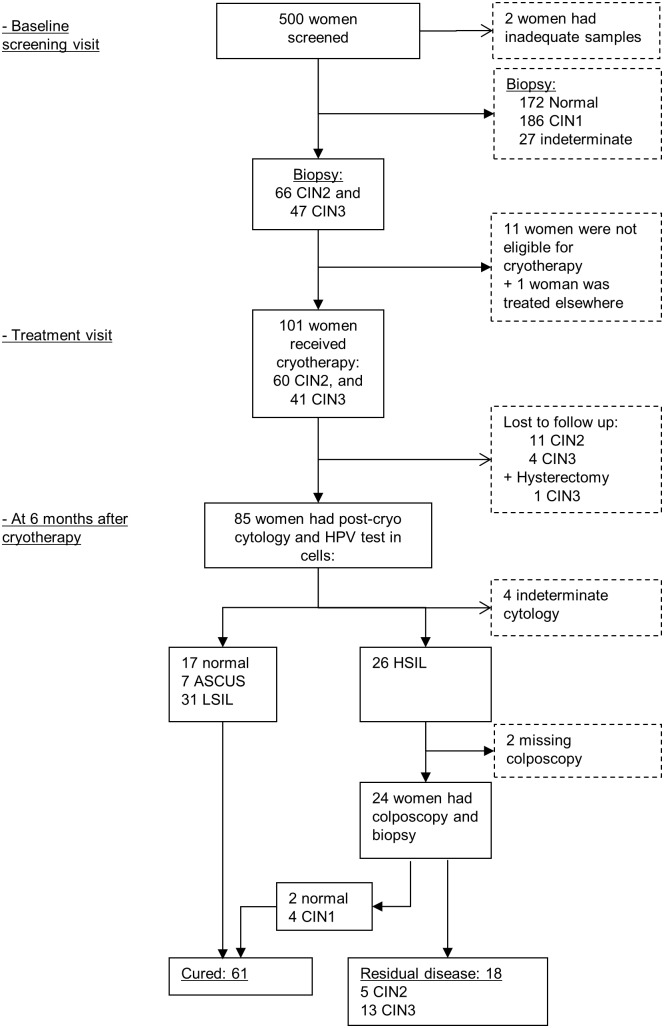
79 HIV-positive women received cryotherapy for CIN2/3 in Nairobi, Kenya, and underwent conventional cytology 6 months later. Biopsies were performed on high grade cytological lesions and hrHPV was assessed before (cervical cells and biopsy) and after cryotherapy (cells).
At 6 months after cryotherapy CIN2/3 had been eliminated in 61 women (77.2%; 95% Confidence Interval, (CI): 66.4-85.9). 18 women (22.8%) had residual CIN2/3, and all these women had hrHPV at baseline. CD4 count and duration of combination antiretroviral therapy (cART) were not associated with residual CIN2/3. CIN3 instead of CIN2 was the only significant risk factor for residual disease (odds ratio, OR vs CIN2 = 4.3; 95% CI: 1.2-15.0) among hrHPV-positive women after adjustment for age and HPV16 infection. Persistence of hrHPV types previously detected in biopsies was found in 77.5% of women and was associated with residual CIN2/3 (OR = 8.1, 95% CI: 0.9-70). The sensitivity, specificity, and negative predictive value of hrHPV test in detecting residual CIN2/3 were 0.94, 0.36, and 0.96 respectively.
Nearly one quarter of HIV-positive women had residual CIN2/3 disease at 6 months after cryotherapy, and the majority had persistent hrHPV. CD4 count and cART use were not associated with residual disease or hrHPV persistence. The value of hrHPV testing in the detection of residual CIN2/3 was hampered by a low specificity.
评估HIV阳性女性冷冻治疗6个月后宫颈上皮内瘤变(CIN)2/3残留疾病及高危(hr)人乳头瘤病毒(HPV)感染的清除情况。
随访研究。
79名HIV阳性女性在肯尼亚内罗毕接受CIN2/3冷冻治疗,6个月后进行传统细胞学检查。对高级别细胞学病变进行活检,并在冷冻治疗前(宫颈细胞和活检)及治疗后(细胞)评估hrHPV。
冷冻治疗6个月后,61名女性(77.2%;95%置信区间(CI):66.4 - 85.9)的CIN2/3已消除。18名女性(22.8%)有CIN2/3残留,所有这些女性在基线时均有hrHPV。CD4细胞计数和联合抗逆转录病毒治疗(cART)的持续时间与CIN2/3残留无关。在调整年龄和HPV16感染后,CIN3而非CIN2是hrHPV阳性女性残留疾病的唯一显著危险因素(优势比,OR与CIN2相比 = 4.3;95% CI:1.2 - 15.0)。在77.5%的女性中发现活检中先前检测到的hrHPV类型持续存在,且与CIN2/3残留相关(OR = 8.1,95% CI:0.9 - 70)。hrHPV检测在检测残留CIN2/3中的敏感性、特异性和阴性预测值分别为0.94、0.36和0.96。
近四分之一的HIV阳性女性在冷冻治疗6个月后有CIN2/3残留疾病,且大多数有持续性hrHPV。CD4细胞计数和使用cART与残留疾病或hrHPV持续存在无关。hrHPV检测在检测残留CIN