Zhang Lu, Han Jianjun, Wu Huiyong, Liang Xiaohong, Zhang Jianxin, Li Jian, Xie Li, Xie Yinfa, Sheng Xiugui, Yu Jinming
Department of Gynecologic Oncology, Shandong Cancer Hospital and Institute, School of Medicine and life Science, University of Jinan-Shandong Academy of Medical Science, Jinan, Shandong, P.R. China.
Department of Cancer Interventional Radiology, Shandong Cancer Hospital and Institute, Jinan, Shandong, P.R. China.
PLoS One. 2014 Oct 30;9(10):e110626. doi: 10.1371/journal.pone.0110626. eCollection 2014.
Hepatocellular carcinoma (HCC) is the fifth most common cancer, and it is the second most common cancer-related mortality globally. The prognostic value of high mobility group box 1 (HMGB1) remains controversial. The purpose of this study is to conduct a meta-analysis and literature review to evaluate the association of HMGB1 expression with the prognosis of patients with HCC.
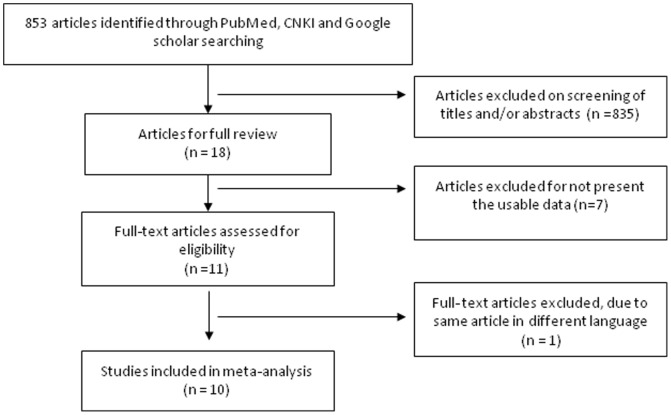
A detailed literature search was made in Medline, Google Scholar and others for related research publications. The data were extracted and assessed by two reviewers independently. Analysis of pooled data were performed, Hazard Ratio (HR) and mean difference with corresponding confidence intervals (CIs) were calculated and summarized respectively.
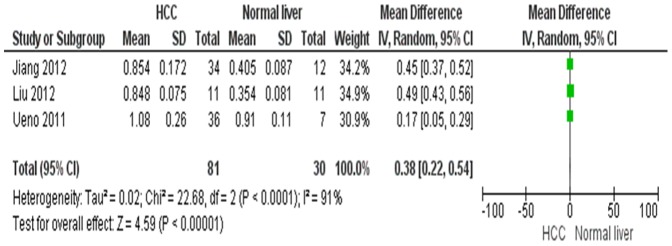
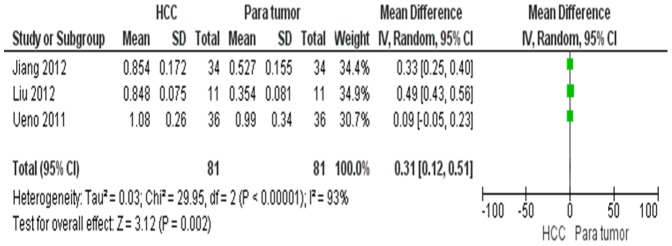
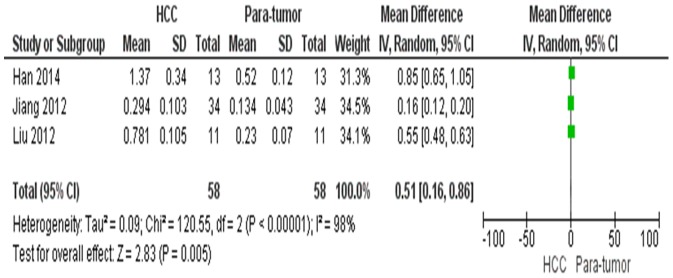
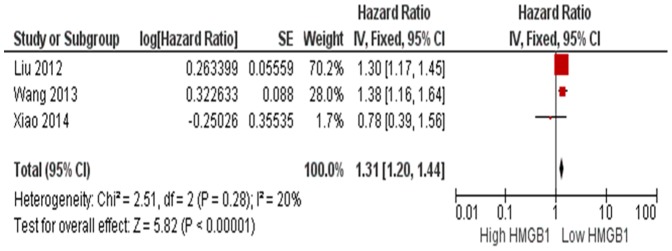
10 relevant articles were included for this meta-analysis study. HMGB1 mRNA levels in HCC were significantly higher than those in normal (p<0.00001) and para-tumor tissues (p = 0.002) respectively. The protein levels of HMGB1 in HCC were significantly higher than those in para-tumor tissues (p = 0.005). Two studies reported the serum HMGB1 levels in patients with HCC of TNM stages, and indicating significantly different between stage I and II, stage II and III, as well as stage III and IV (two studies showed p<0.01 and p<0.001 respectively). The overall survival (OS) was significantly shorter in HCC patients with high HMGB1 expression compared those with low HMGB1 expression and the pooled HR was 1.31 with 95% CI 1.20-1.44, Z = 5.82, p<0.0001. Two additional studies showed that there were higher serum HMGB1 levels in patients with chronic hepatitis than those in healthy people (p<0.05).
The results of this meta-analysis suggest that HMGB1 mRNA and protein tissue levels in the patients with HCC are significantly higher than those in para-tumor and normal liver tissues respectively. Tissue HMGB1 overexpression is a potential biomarker for HCC diagnosis, and it is significantly associated with the prognosis of patients with HCC.
肝细胞癌(HCC)是全球第五大常见癌症,也是癌症相关死亡的第二大常见原因。高迁移率族蛋白B1(HMGB1)的预后价值仍存在争议。本研究的目的是进行一项荟萃分析和文献综述,以评估HMGB1表达与HCC患者预后的相关性。
在Medline、谷歌学术等数据库中进行详细的文献检索,以查找相关研究出版物。由两名审阅者独立提取和评估数据。对汇总数据进行分析,分别计算并汇总风险比(HR)和平均差及其相应的置信区间(CI)。
本荟萃分析研究纳入了10篇相关文章。HCC中HMGB1 mRNA水平分别显著高于正常组织(p<0.00001)和癌旁组织(p = 0.002)。HCC中HMGB1的蛋白水平显著高于癌旁组织(p = 0.005)。两项研究报告了TNM分期的HCC患者血清HMGB1水平,表明I期与II期、II期与III期以及III期与IV期之间存在显著差异(两项研究分别显示p<0.01和p<0.001)。与低HMGB1表达的HCC患者相比,高HMGB1表达的患者总生存期(OS)显著缩短,汇总HR为1.31,95%CI为1.20 - 1.44,Z = 5.82,p<0.0001。另外两项研究表明,慢性肝炎患者血清HMGB1水平高于健康人(p<0.05)。
本荟萃分析结果表明,HCC患者中HMGB1 mRNA和蛋白组织水平分别显著高于癌旁和正常肝组织。组织HMGB1过表达是HCC诊断的潜在生物标志物,并且与HCC患者的预后显著相关。