Park Mi Seul, Bitto Eduard, Kim Kyung Rok, Bingman Craig A, Miller Mitchell D, Kim Hyun-Jung, Han Byung Woo, Phillips George N
Research Institute of Pharmaceutical Sciences, College of Pharmacy, Seoul National University, Seoul, Korea.
Department of Chemistry and Biochemistry, Georgian Court University, Lakewood, New Jersey, United States of America.
PLoS One. 2014 Oct 30;9(10):e111142. doi: 10.1371/journal.pone.0111142. eCollection 2014.
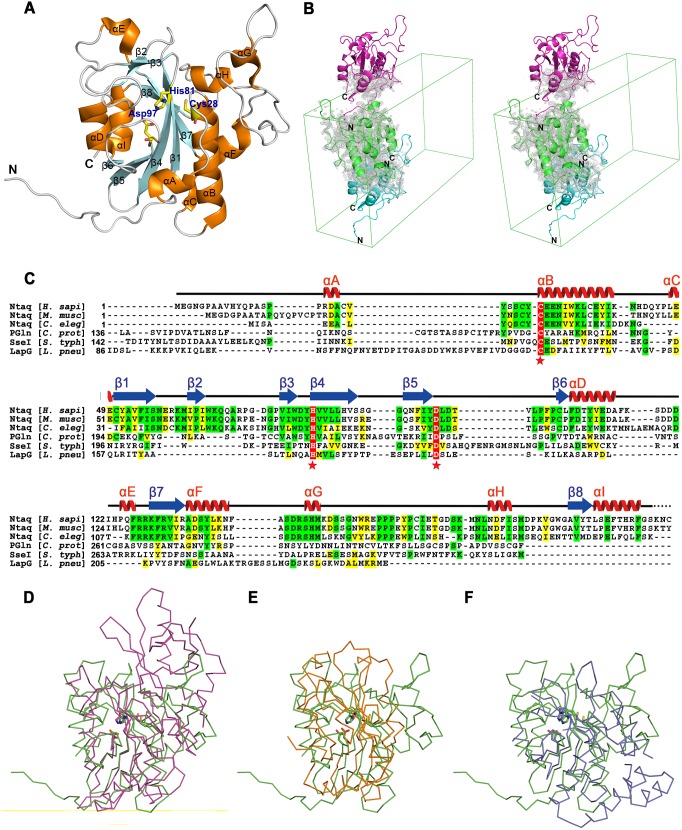
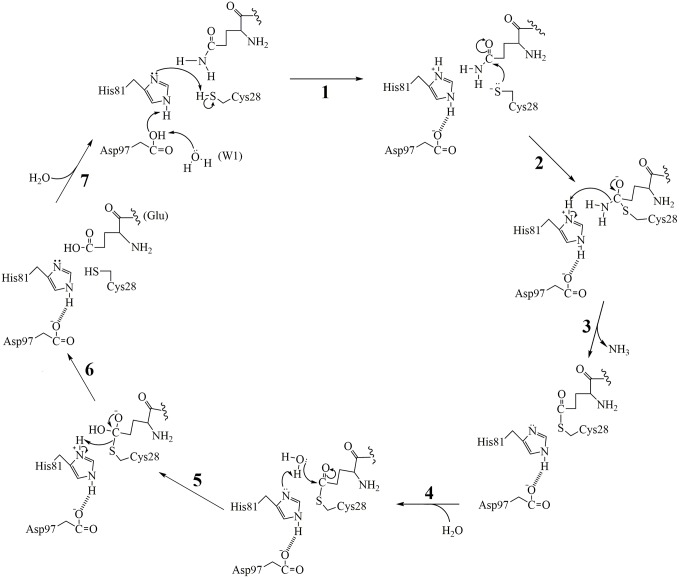
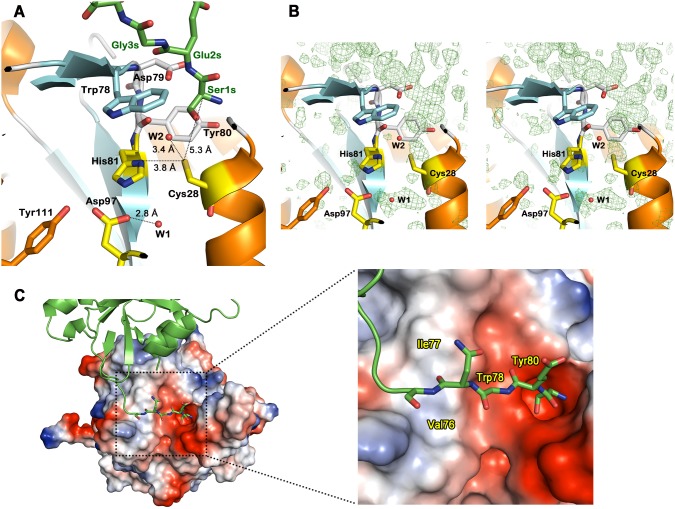
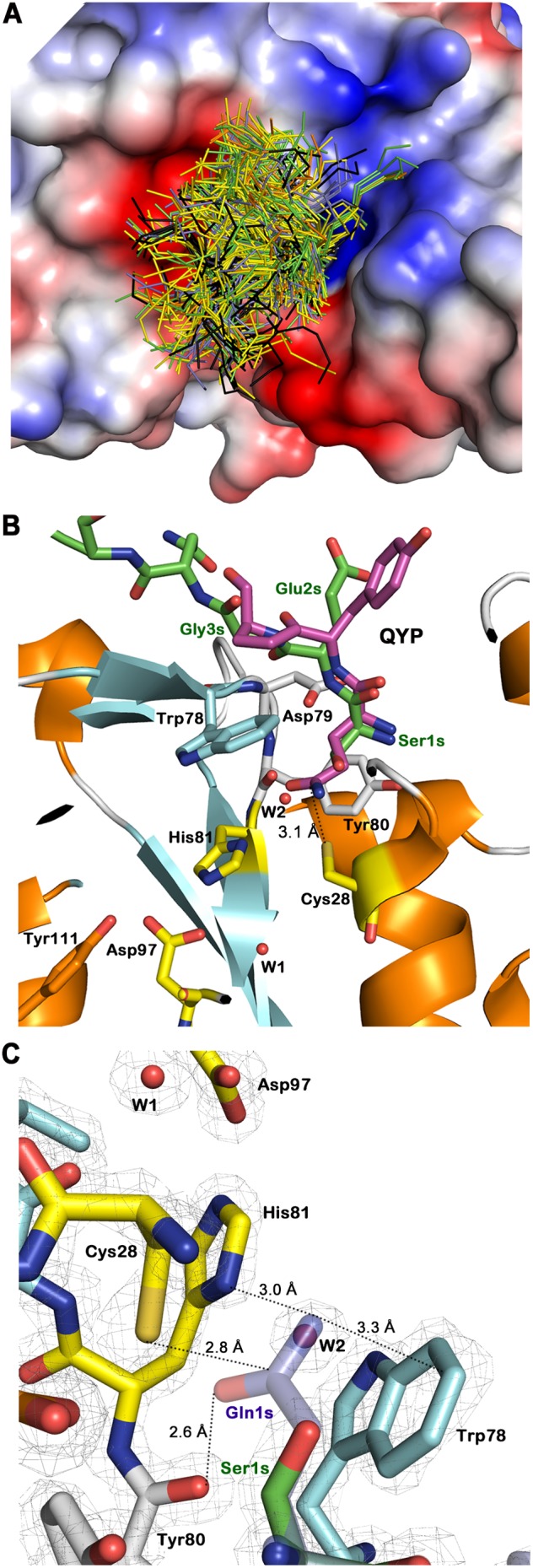
The N-end rule states that half-life of protein is determined by their N-terminal amino acid residue. N-terminal glutamine amidohydrolase (Ntaq) converts N-terminal glutamine to glutamate by eliminating the amine group and plays an essential role in the N-end rule pathway for protein degradation. Here, we report the crystal structure of human Ntaq1 bound with the N-terminus of a symmetry-related Ntaq1 molecule at 1.5 Å resolution. The structure reveals a monomeric globular protein with alpha-beta-alpha three-layer sandwich architecture. The catalytic triad located in the active site, Cys-His-Asp, is highly conserved among Ntaq family and transglutaminases from diverse organisms. The N-terminus of a symmetry-related Ntaq1 molecule bound in the substrate binding cleft and the active site suggest possible substrate binding mode of hNtaq1. Based on our crystal structure of hNtaq1 and docking study with all the tripeptides with N-terminal glutamine, we propose how the peptide backbone recognition patch of hNtaq1 forms nonspecific interactions with N-terminal peptides of substrate proteins. Upon binding of a substrate with N-terminal glutamine, active site catalytic triad mediates the deamination of the N-terminal residue to glutamate by a mechanism analogous to that of cysteine proteases.
N端规则表明,蛋白质的半衰期由其N端氨基酸残基决定。N端谷氨酰胺氨基水解酶(Ntaq)通过去除氨基将N端谷氨酰胺转化为谷氨酸,在蛋白质降解的N端规则途径中起重要作用。在此,我们报告了与对称相关的Ntaq1分子的N端结合的人Ntaq1的晶体结构,分辨率为1.5埃。该结构揭示了一种具有α-β-α三层夹心结构的单体球状蛋白。位于活性位点的催化三联体Cys-His-Asp在Ntaq家族和来自不同生物体的转谷氨酰胺酶中高度保守。结合在底物结合裂隙和活性位点中的对称相关Ntaq1分子的N端表明了hNtaq1可能的底物结合模式。基于我们的hNtaq1晶体结构以及与所有含N端谷氨酰胺的三肽的对接研究,我们提出hNtaq1的肽主链识别区域如何与底物蛋白的N端肽形成非特异性相互作用。当底物与N端谷氨酰胺结合时,活性位点催化三联体通过类似于半胱氨酸蛋白酶的机制介导N端残基脱氨生成谷氨酸。