Jin Jianmin, Liu Xiaofang, Sun Yongchang
Department of Respiratory Medicine, Beijing Tongren Hospital, Capital Medical University, Beijing, China.
Respir Res. 2014 Oct 29;15(1):130. doi: 10.1186/s12931-014-0130-1.
Allergy and Aspergillus hypersensitivity (AH) were shown to be associated with severe symptoms or worse lung function in COPD patients. The prevalence of elevated total IgE (T-IgE) and its association with clinical symptoms and lung function in COPD have not been studied. The prevalence of AH and its correlation with clinical characteristics in a COPD cohort of larger sample size is also lacking.
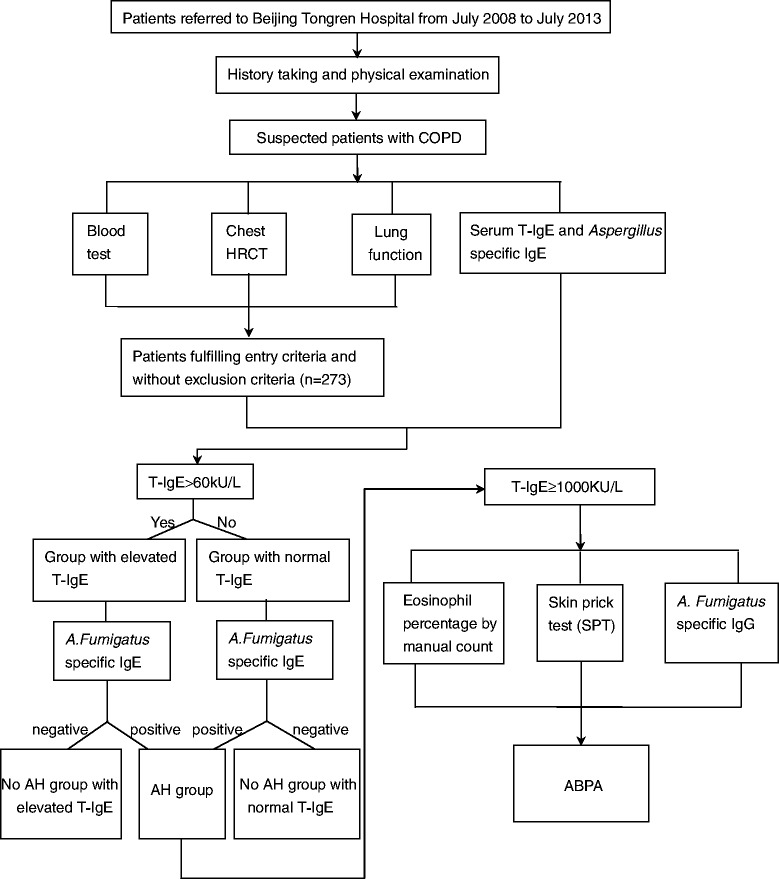
273 patients with COPD were evaluated by respiratory symptoms, blood test, chest HRCT, lung function, serum detection of T-IgE and Aspergillus specific IgE. Patients with T-IgE ≥ 1000 KU/L were further investigated for allergic bronchopulmonary aspergillosis (ABPA).
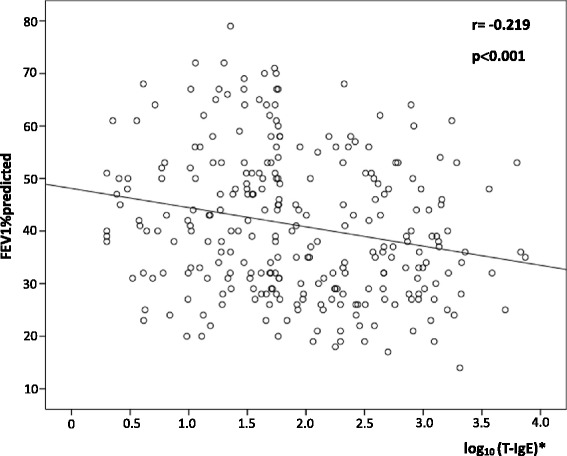
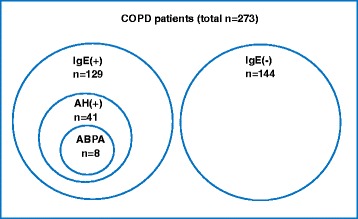
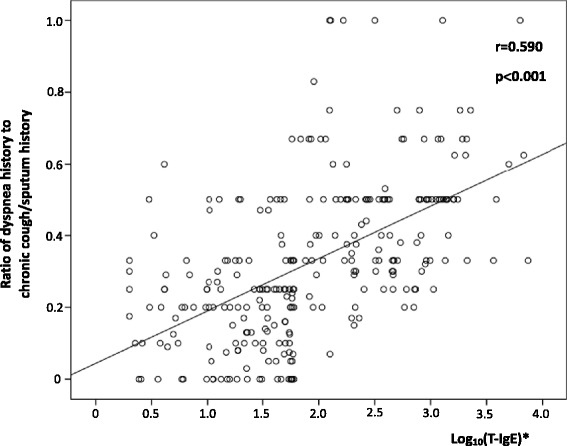
The prevalence of elevated T-IgE and AH in patients with COPD was 47.3% and 15.0%, respectively. Eight patients (2.9%) met the diagnostic criteria for ABPA. Compared with the normal T-IgE group, patients with elevated T-IgE had a longer history of dyspnea (p < 0.01), an earlier onset of dyspnea after chronic cough/expectoration (p < 0.01), and were more likely to wheeze (p < 0.01). They also showed worse lung functions and more severe GOLD staging (p < 0.01). Analysis of the clinical data in male patients with smoking as the risk factor showed the same results. To evaluate the clinical characteristics of COPD with AH, patients with elevated T-IgE were further divided into subgroups with and without AH. When compared with the normal T-IgE group, both the two subgroups showed longer history of dyspnea (p < 0.01), an earlier onset of dyspnea (p < 0.01) and a worse status of lung function (p < 0.05). Correlation analysis demonstrated that T-IgE was correlated positively with the time length of dyspnea (r = 0.401, p < 0.001), and the ratio of duration of dyspnea to that of chronic cough/expectoration (r = 0.59, p < 0.001), but negatively with FEV1/FVC% (r = -0.194, p = 0.001), and FEV1%predicted (r = -0.219, p < 0.001).
There was a high prevalence of elevated serum T-IgE and AH in patients with COPD. Serum T-IgE level was correlated with symptoms such as dyspnea and impairment of lung function. Allergens other than Aspergillus may have similar effects on disease expression or progression of COPD.
过敏和曲霉菌超敏反应(AH)与慢性阻塞性肺疾病(COPD)患者的严重症状或更差的肺功能相关。COPD患者中总IgE(T-IgE)升高的患病率及其与临床症状和肺功能的关系尚未得到研究。大样本量的COPD队列中AH的患病率及其与临床特征的相关性也尚不明确。
对273例COPD患者进行呼吸症状、血液检查、胸部高分辨率CT、肺功能、血清T-IgE及曲霉菌特异性IgE检测。对T-IgE≥1000 KU/L的患者进一步检查是否患有变应性支气管肺曲霉菌病(ABPA)。
COPD患者中T-IgE升高和AH的患病率分别为47.3%和15.0%。8例患者(2.9%)符合ABPA诊断标准。与T-IgE正常组相比,T-IgE升高的患者呼吸困难病史更长(p<0.01),慢性咳嗽/咳痰后出现呼吸困难的时间更早(p<0.01),且更易出现喘息(p<0.01)。他们的肺功能也更差,GOLD分期更严重(p<0.01)。以吸烟为危险因素的男性患者临床数据分析显示结果相同。为评估合并AH的COPD的临床特征,将T-IgE升高的患者进一步分为合并AH和未合并AH的亚组。与T-IgE正常组相比,两个亚组的呼吸困难病史均更长(p<0.01),呼吸困难出现更早(p<0.01),肺功能状况更差(p<0.05)。相关性分析表明,T-IgE与呼吸困难时长(r=0.401,p<0.001)、呼吸困难持续时间与慢性咳嗽/咳痰持续时间的比值(r=0.59,p<0.001)呈正相关,但与FEV1/FVC%(r=-0.194,p=0.001)和预计FEV1%(r=-0.219,p<0.001)呈负相关。
COPD患者血清T-IgE升高和AH的患病率较高。血清T-IgE水平与呼吸困难等症状及肺功能损害相关。除曲霉菌外的过敏原可能对COPD的疾病表现或进展有类似影响。