Ohno Toshiki, Oshiro Yoshiko, Mizumoto Masashi, Numajiri Haruko, Ishikawa Hitoshi, Okumura Toshiyuki, Terunuma Toshiyuki, Sakae Takeji, Sakurai Hideyuki
Departments of Radiation Oncology and Proton Medical Research Center, University of Tsukuba, 1-1-1 Tennoudai, Tsukuba, Ibaraki, 305-8575, Japan
Departments of Radiation Oncology and Proton Medical Research Center, University of Tsukuba, 1-1-1 Tennoudai, Tsukuba, Ibaraki, 305-8575, Japan.
J Radiat Res. 2015 Jan;56(1):128-33. doi: 10.1093/jrr/rru082. Epub 2014 Nov 3.
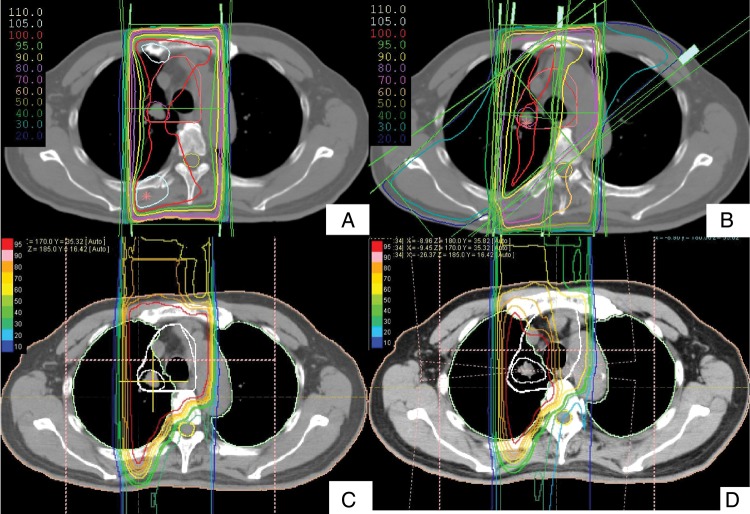
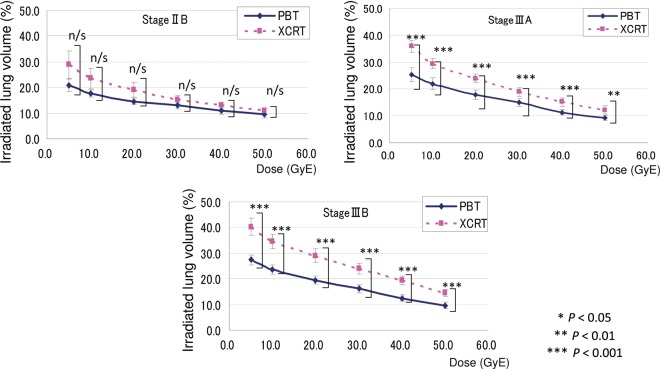
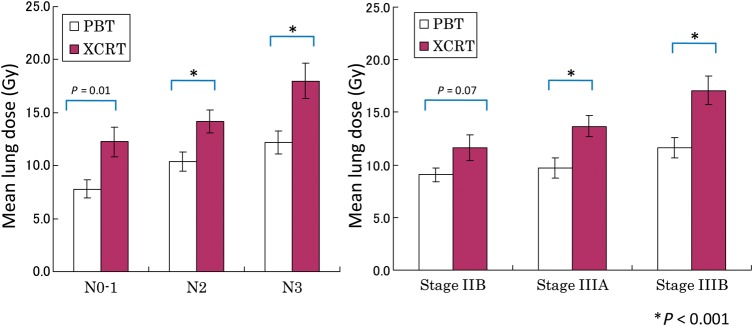
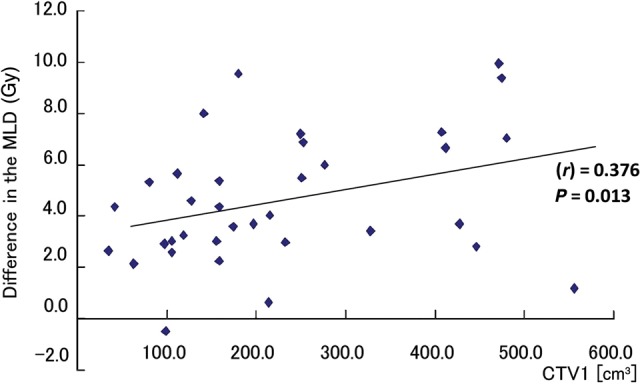
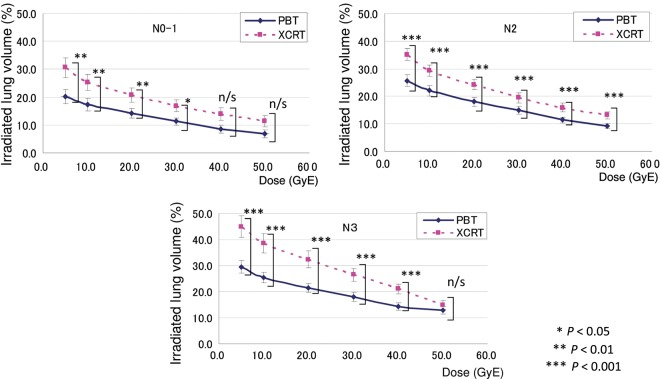
The purpose of this study was to compare the parameters of the dose-volume histogram (DVH) between proton beam therapy (PBT) and X-ray conformal radiotherapy (XCRT) for locally advanced non-small-cell lung cancer (NSCLC), according to the tumor conditions. A total of 35 patients having NSCLC treated with PBT were enrolled in this analysis. The numbers of TNM stage and lymph node status were IIB (n = 3), IIIA (n = 15) and IIIB (n = 17), and N0 (n = 2), N1 (n = 4), N2 (n = 17) and N3 (n = 12), respectively. Plans for XCRT were simulated based on the same CT, and the same clinical target volume (CTV) was used based on the actual PBT plan. The treatment dose was 74 Gy-equivalent dose (GyE) for the primary site and 66 GyE for positive lymph nodes. The parameters were then calculated according to the normal lung dose, and the irradiation volumes of the doses (Vx) were compared. We also evaluated the feasibility of both plans according to criteria: V5 ≥ 42%, V20 ≥ 25%, mean lung dose ≥ 20 Gy. The mean normal lung dose and V5 to V50 were significantly lower in PBT than in XCRT. The differences were greater with the more advanced nodal status and with the larger CTV. Furthermore, 45.7% of the X-ray plans were classified as inadequate according to the criteria, whereas 17.1% of the proton plans were considered unsuitable. The number of inadequate X-ray plans increased in cases with advanced nodal stage. This study indicated that some patients who cannot receive photon radiotherapy may be able to be treated using PBT.
本研究的目的是根据肿瘤情况,比较局部晚期非小细胞肺癌(NSCLC)质子束治疗(PBT)与X线适形放疗(XCRT)的剂量体积直方图(DVH)参数。本分析纳入了35例接受PBT治疗的NSCLC患者。TNM分期和淋巴结状态的例数分别为IIB期(n = 3)、IIIA期(n = 15)和IIIB期(n = 17),以及N0(n = 2)、N1(n = 4)、N2(n = 17)和N3(n = 12)。基于相同的CT模拟XCRT计划,并根据实际的PBT计划使用相同的临床靶体积(CTV)。原发部位的治疗剂量为74 Gy等效剂量(GyE),阳性淋巴结的治疗剂量为66 GyE。然后根据正常肺剂量计算参数,并比较剂量的照射体积(Vx)。我们还根据以下标准评估了两种计划的可行性:V5≥42%、V20≥25%、平均肺剂量≥20 Gy。PBT组的平均正常肺剂量和V5至V50显著低于XCRT组。随着淋巴结状态越晚期和CTV越大,差异越大。此外,根据该标准,45.7%的X线计划被归类为不充分,而17.1%的质子计划被认为不合适。不充分的X线计划数量在淋巴结晚期病例中增加。本研究表明,一些无法接受光子放疗的患者可能能够接受PBT治疗。