Sadeghi Saeed, Olevsky Olga, Hurvitz Sara A
Division of Hematology & Oncology, David Geffen School of Medicine, University of California, Los Angeles, CA, USA.
Pharmgenomics Pers Med. 2014 Oct 15;7:329-38. doi: 10.2147/PGPM.S47524. eCollection 2014.
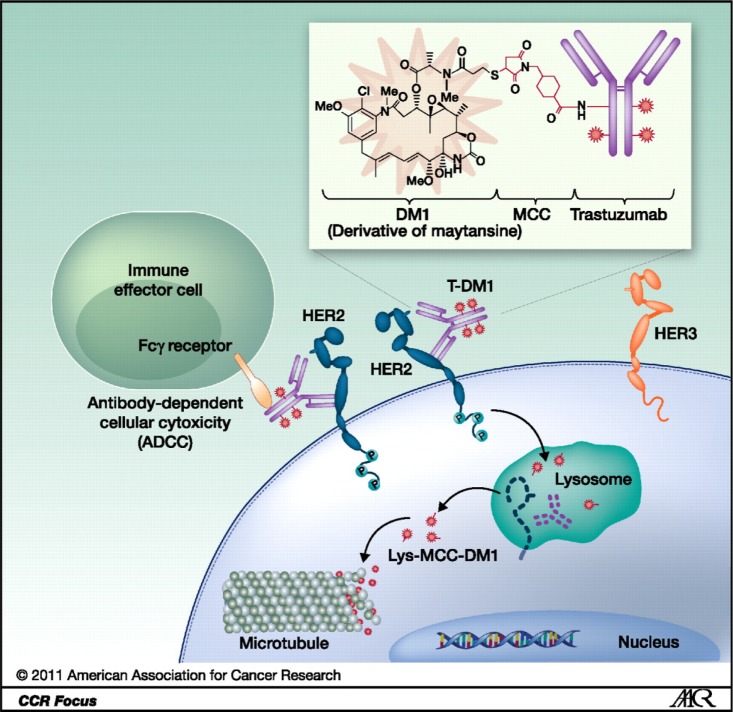
This article reviews the mechanism of action of trastuzumab emtansine (T-DM1), existing clinical data relating to its use for human growth factor receptor 2 (HER2)-positive breast cancer, potential pathways of resistance, and ongoing studies evaluating this novel agent.
The development of HER2-targeted therapies has dramatically improved clinical outcomes for patients with any stage of HER2-positive breast cancer. Although the positive effect of these treatments cannot be overstated, treatment resistance develops in the vast majority of those diagnosed with stage IV HER2-positive breast cancer. Moreover, HER2-directed therapies are most effective when combined with cytotoxic chemotherapy. The need for chemotherapy leads to significant adverse effects and a clear decrease in quality of life for those dealing with a chronic incurable disease. T-DM1 is a recently developed, novel antibody-drug conjugate in which highly potent maytanisinoid chemotherapy is stably linked to the HER2-targeted monoclonal antibody, trastuzumab.
Preclinical and phase 1-3 clinical data support the significant antitumor activity of T-DM1. Importantly, several randomized studies also now demonstrate its clear superiority in terms of tolerability compared with standard chemotherapy-containing regimens. Its role in the treatment of trastuzumab-resistant metastatic breast cancer has now been established on the basis of the results of two phase 3 randomized studies, EMILIA (An Open-label Study of Trastuzumab Emtansine (T-DM1) vs Capecitabine + Lapatinib in Patients With HER2-positive Locally Advanced or Metastatic Breast Cancer) and TH3RESA (A Study of Trastuzumab Emtansine in Comparison With Treatment of Physician's Choice in Patients With HER2-positive Breast Cancer Who Have Received at Least Two Prior Regimens of HER2-directed Therapy). The most common toxicities seen with T-DM1 are thrombocytopenia and an elevation in liver transaminases. Significant cardiac toxicity has not been demonstrated. Both in vitro cell line-based studies as well as exploratory analyses of archived tumor samples from the clinical trials are seeking to understand potential mechanisms of resistance to T-DM1. Ongoing studies are also evaluating the use of T-DM1 in the first-line metastatic, neoadjuvant, and adjuvant settings, as well as in combination with other targeted therapies.
T-DM1 represents the first successfully developed antibody drug conjugate for the treatment of HER2-positive advanced breast cancer.
本文综述了曲妥珠单抗 emtansine(T-DM1)的作用机制、其用于人类生长因子受体 2(HER2)阳性乳腺癌的现有临床数据、潜在的耐药途径以及评估这种新型药物的正在进行的研究。
HER2 靶向治疗的发展显著改善了各阶段 HER2 阳性乳腺癌患者的临床结局。尽管这些治疗的积极作用不容小觑,但绝大多数诊断为 IV 期 HER2 阳性乳腺癌的患者会出现治疗耐药。此外,HER2 导向治疗与细胞毒性化疗联合使用时最为有效。化疗的需求导致了显著的不良反应,对于患有慢性不治之症的患者,生活质量明显下降。T-DM1 是一种最近开发的新型抗体药物偶联物,其中强效的美登素类化疗药物与 HER2 靶向单克隆抗体曲妥珠单抗稳定连接。
临床前和 1-3 期临床数据支持 T-DM1 具有显著的抗肿瘤活性。重要的是,几项随机研究现在也证明,与含标准化疗方案相比,其在耐受性方面具有明显优势。基于两项 3 期随机研究 EMILIA(曲妥珠单抗 emtansine(T-DM1)与卡培他滨 + 拉帕替尼治疗 HER2 阳性局部晚期或转移性乳腺癌患者的开放标签研究)和 TH3RESA(曲妥珠单抗 emtansine 与医生选择的治疗方案对比研究,针对至少接受过两种先前 HER2 导向治疗方案的 HER2 阳性乳腺癌患者)的结果,其在治疗曲妥珠单抗耐药转移性乳腺癌中的作用现已确立。T-DM1 最常见的毒性是血小板减少和肝转氨酶升高。尚未证实有显著的心脏毒性。基于体外细胞系的研究以及对临床试验存档肿瘤样本的探索性分析都在试图了解对 T-DM1 的潜在耐药机制。正在进行的研究也在评估 T-DM1 在一线转移性、新辅助和辅助治疗中的应用,以及与其他靶向治疗联合使用的情况。
T-DM1 是首个成功开发的用于治疗 HER2 阳性晚期乳腺癌的抗体药物偶联物。