Zhang Ge, Gomes-Giacoia Evan, Dai Yunfeng, Lawton Adrienne, Miyake Makito, Furuya Hideki, Goodison Steve, Rosser Charles J
MD Anderson Cancer Center Orlando, Cancer Research Institute, Orlando, Florida, USA.
Department of Biostatistics, The University of Florida, Gainesville, Florida, USA.
Diagn Pathol. 2014 Nov 12;9:200. doi: 10.1186/s13000-014-0200-1.
To validate the expression of a urine-based bladder cancer associated diagnostic signature comprised of 10 targets; ANG, CA9, MMP9, MMP10, SERPINA1, APOE, SDC1, VEGFA, SERPINE1 and IL8 in bladder tumor tissues.
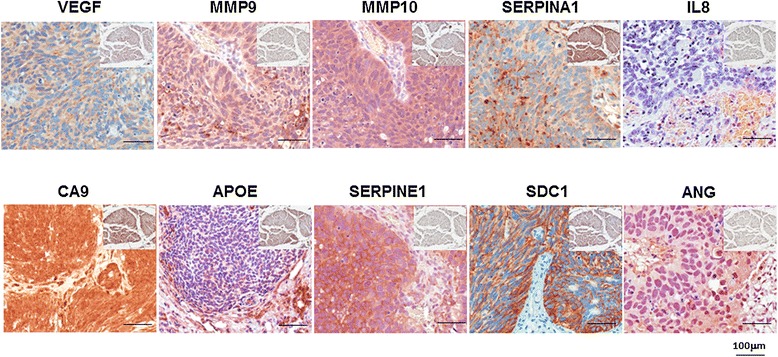
Immunohistochemical analyses were performed on tumor specimens from 213 bladder cancer patients (transitional cell carcinoma only) and 74 controls. Staining patterns were digitally captured and quantitated (Aperio, Vista, CA), and expression was correlated with tumor stage, tumor grade and outcome measures.
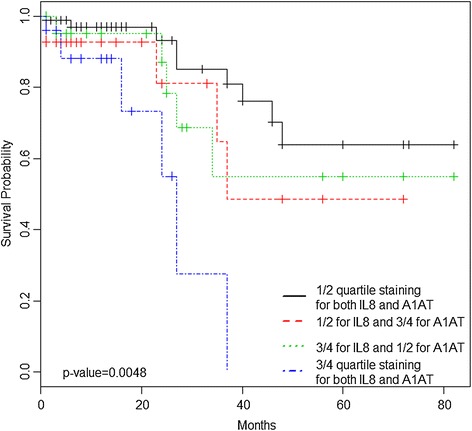
We revealed a positive association of 9 of the 10 proteins (excluding VEGF) in bladder cancer. Relative to control cases, a reduction in SDC1 and overexpression of MMP9, MMP10, SERPINE1, IL8, APOE, SERPINA1, ANG were associated with high stage bladder cancer. Reduced VEGF and increased SERPINA1 were associated with high-grade bladder cancer. Disease-specific survival was significantly reduced in tumors with high expression of SERPINE1 and/or IL8.
These findings confirm that the proteins in a urine-based diagnostic signature are aberrantly expressed in bladder tumor tissues, and support the potential additional utility of selected biomarkers for the clinicopathological evaluation of excised tissue or biopsy material.
The virtual slide(s) for this article can be found here: http://www.diagnosticpathology.diagnomx.eu/vs/13000_2014_200.
验证由10个靶点组成的基于尿液的膀胱癌相关诊断标志物在膀胱肿瘤组织中的表达;这10个靶点分别为血管生成素(ANG)、碳酸酐酶9(CA9)、基质金属蛋白酶9(MMP9)、基质金属蛋白酶10(MMP10)、丝氨酸蛋白酶抑制剂A1(SERPINA1)、载脂蛋白E(APOE)、硫酸乙酰肝素蛋白聚糖1(SDC1)、血管内皮生长因子A(VEGFA)、丝氨酸蛋白酶抑制剂E1(SERPINE1)和白细胞介素8(IL8)。
对213例膀胱癌患者(仅为移行细胞癌)的肿瘤标本和74例对照进行免疫组织化学分析。采用数字图像采集和定量分析(Aperio公司,Vista,加利福尼亚州),并将表达情况与肿瘤分期、肿瘤分级和预后指标进行关联分析。
我们发现10种蛋白中的9种(不包括VEGF)在膀胱癌中呈正相关。与对照病例相比,SDC1表达降低以及MMP9、MMP10、SERPINE1、IL8、APOE、SERPINA1、ANG表达上调与高分期膀胱癌相关。VEGF表达降低和SERPINA1表达增加与高级别膀胱癌相关。SERPINE1和/或IL8高表达的肿瘤患者疾病特异性生存率显著降低。
这些发现证实了基于尿液的诊断标志物中的蛋白在膀胱肿瘤组织中异常表达,并支持所选生物标志物在切除组织或活检材料临床病理评估中的潜在额外应用价值。
本文的虚拟切片可在此处找到:http://www.diagnosticpathology.diagnomx.eu/vs/13000_2014_200 。