Hu Bo, Du Zhaohui, Kang Yan, Zang Bin, Cui Wei, Qin Bingyu, Fang Qiang, Qiu Haibo, Li Jianguo
BMC Infect Dis. 2014 Nov 13;14:594. doi: 10.1186/s12879-014-0594-0.
In patients hospitalized in intensive care units (ICU), Candida infections are associated with increased morbidity, mortality and costs. However, previous studies reported confused risk factors for catheter-related Candida bloodstream infection (CRCBSI). The objective was to describe the risk factors, microbiology, management and outcomes of CRCBSI in the China-SCAN population.
Patients with ≥1 Candida-positive peripheral blood culture were selected from the China-SCAN study. Peripheral and catheter blood samples were collected for Candida isolation. Patients with the same strain of Candida in peripheral and catheter blood samples were considered as being with CRCBSI, while patients with Candida-positive peripheral blood cultures only or different strains were considered as non-CRCBSI. Data were collected from the China-SCAN study.
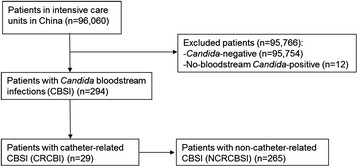
CRCBSI incidence in ICU was 0.03% (29/96,060), accounting for 9.86% of all candidemia observed in ICU (29/294). The proportion of CRCBSI due to Candida parapsilosis reached 33.3%, more than that of Candida albicans (28.6%). In univariate analyses, older age (P=0.028) and lower body weight (P=0.037) were associated with CRCBSI. Multivariate analysis showed that the sequential organ failure assessment (SOFA) score was independently associated with CRCBSI (odds ratio (OR)=1.142, 95% confidence interval = 1.049-1.244, P=0.002). Catheter removal and immune enhancement therapy were often used for CRCBSI treatment.
In China, CRCBSI was more likely to occur in old patients with low body weight. SOFA score was independently associated with CRCBSI. Candida parapsilosis accounted for a high proportion of CRCBSI, but the difference from non-CRCBSI was not significant.
在重症监护病房(ICU)住院的患者中,念珠菌感染与发病率、死亡率增加及成本上升相关。然而,既往研究报道的导管相关念珠菌血流感染(CRCBSI)的危险因素并不明确。目的是描述中国重症监护病房感染监测(China-SCAN)人群中CRCBSI的危险因素、微生物学特征、管理措施及结局。
从China-SCAN研究中选取外周血培养念珠菌阳性≥1次的患者。采集外周血和导管血样本进行念珠菌分离培养。外周血和导管血样本中念珠菌菌株相同的患者被视为患有CRCBSI,而仅外周血培养念珠菌阳性或菌株不同的患者被视为非CRCBSI。数据来自China-SCAN研究。
ICU中CRCBSI的发病率为0.03%(29/96,060),占ICU中所有念珠菌血症的9.86%(29/294)。近平滑念珠菌所致CRCBSI的比例达33.3%,高于白色念珠菌(28.6%)。单因素分析显示,年龄较大(P=0.028)和体重较低(P=0.037)与CRCBSI相关。多因素分析表明,序贯器官衰竭评估(SOFA)评分与CRCBSI独立相关(比值比(OR)=1.142,95%置信区间=1.049-1.244,P=0.002)。CRCBSI治疗常采用拔除导管和免疫增强治疗。
在中国,CRCBSI更易发生于体重低的老年患者。SOFA评分与CRCBSI独立相关。近平滑念珠菌在CRCBSI中占比高,但与非CRCBSI的差异不显著。