Lim Nam Kyu, Kang Dong Hee, Oh Sang Ah, Gu Ja Hea
Department of Plastic and Reconstructive Surgery, Dankook University Hospital, Dankook University College of Medicine, Cheonan, Korea.
Arch Plast Surg. 2014 Nov;41(6):686-92. doi: 10.5999/aps.2014.41.6.686. Epub 2014 Nov 3.
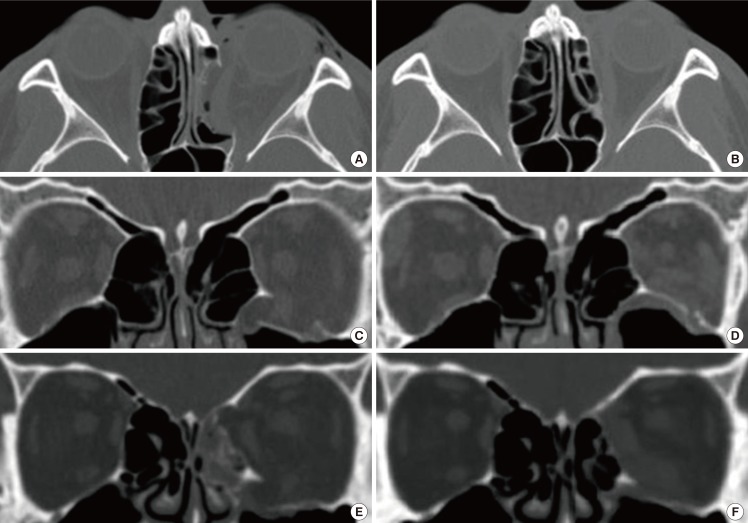
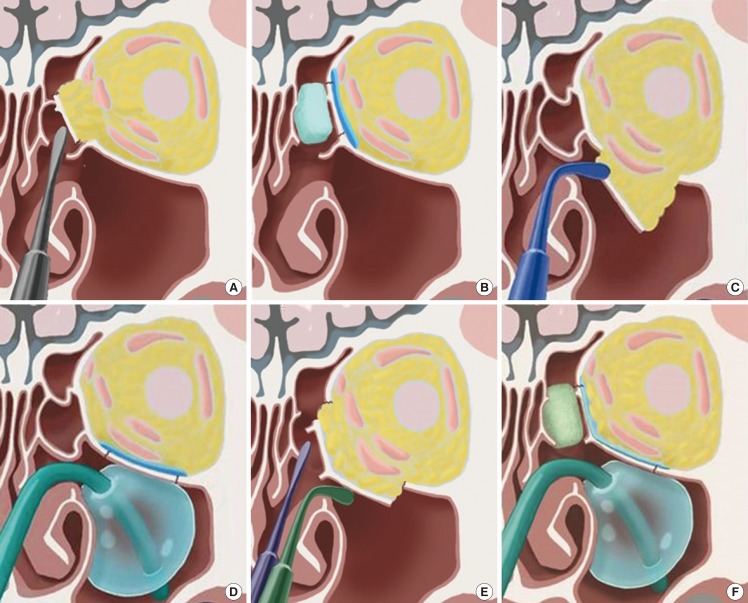
Restoring orbital volume in large blowout fractures is still a technically challenge to the orbital surgeon. In this study, we restored the orbital wall using the combination of transorbital and transnasal approach with additional supports from the paranasal sinuses, and we compared the surgical outcome to that of a conventional transorbital method.
A retrospective review of all patients with pure unilateral blowout fractures between March 2007 and March 2013 was conducted. 150 patients were classified into two groups according to the surgical method: conventional transorbital method (group A, 75 patients, control group), and the combination of transorbital and transnasal approach with additional supports from the paranasal sinuses (group B, 75 patients, experimental group). Each group was subdivided depending on fracture location: group I (inferior wall), group IM (inferomedial wall), and group M (medial wall). The surgical results were assessed by the Hertel scale and a comparison of preoperative and postoperative orbital volume ratio (OVR) values.
In the volumetric analysis, the OVR decreased more by the experimental groups than each corresponding control groups (P<0.05). Upon ophthalmic examination, neither the differences among the groups in the perioperative Hertel scale nor the preoperative and postoperative Hertel scales were statistically significant (P>0.05).
Our surgical results suggest that orbital volume was more effectively restored by the combination of transorbital and transnasal approach with additional supports from the paranasal sinuses than the conventional method, regardless of the type of fracture.
对于眼眶外科医生而言,修复大型爆裂性骨折的眼眶容积仍是一项技术挑战。在本研究中,我们采用经眶和经鼻联合入路并借助鼻窦提供额外支撑来修复眶壁,并将手术结果与传统经眶方法进行比较。
对2007年3月至2013年3月期间所有单纯单侧爆裂性骨折患者进行回顾性研究。150例患者根据手术方法分为两组:传统经眶方法(A组,75例患者,对照组),以及经眶和经鼻联合入路并借助鼻窦提供额外支撑(B组,75例患者,试验组)。每组再根据骨折部位细分:I组(下壁)、IM组(下内侧壁)和M组(内侧壁)。通过Hertel量表以及术前和术后眼眶容积比(OVR)值的比较来评估手术结果。
在容积分析中,试验组的OVR下降幅度比相应对照组更大(P<0.05)。眼科检查时,各组围手术期Hertel量表差异以及术前和术后Hertel量表差异均无统计学意义(P>0.05)。
我们的手术结果表明,无论骨折类型如何,经眶和经鼻联合入路并借助鼻窦提供额外支撑比传统方法能更有效地恢复眼眶容积。