Miao Yuan, Wang Liang, Zhang Xiupeng, Xu Xiaohan, Jiang Guiyang, Fan Chuifeng, Liu Yang, Lin Xuyong, Yu Juanhan, Zhang Yong, Wang Enhua
Department of Pathology, The First Hospital and College of Basic Medical Sciences of China Medical University, Shenyang, China.
96K Seven-year Program of Medicine, China Medical University, Shenyang, China.
PLoS One. 2014 Nov 14;9(11):e112258. doi: 10.1371/journal.pone.0112258. eCollection 2014.
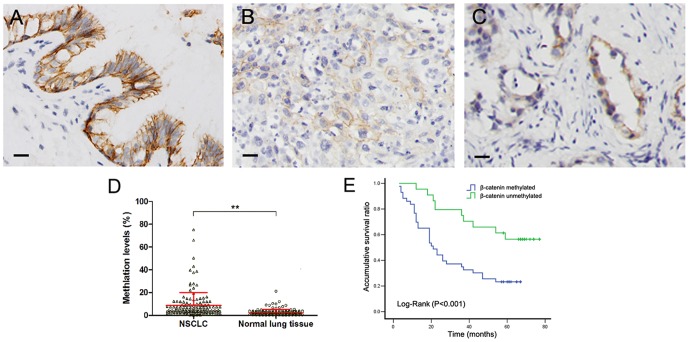
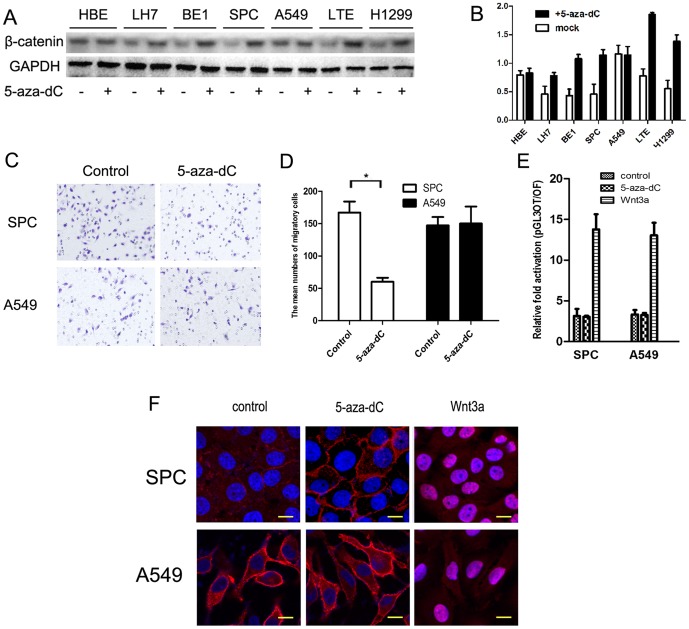
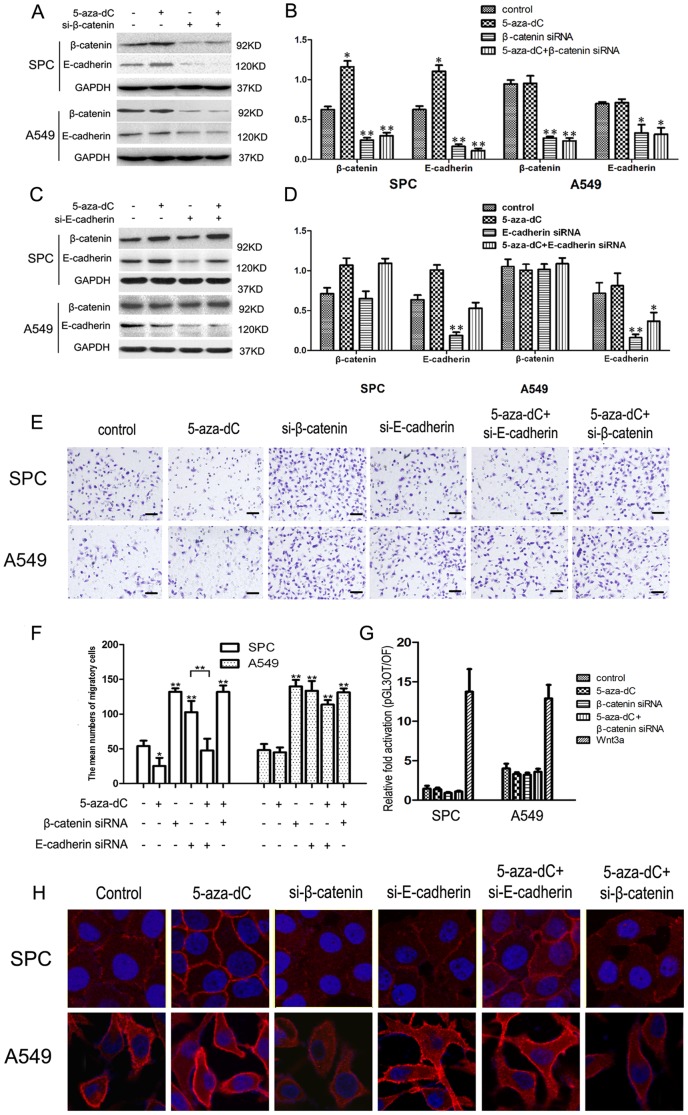
β-Catenin plays dual role in adhesion complex formation and the Wnt signaling pathway. Although β-catenin expression appears to be upregulated and Wnt signaling pathway is activated in the majority of cancers, its expression level seems to be lost in non-small cell lung cancer (NSCLC). We previously reported that the promoter of β-catenin was hypermethylated in two NSCLC cell lines. In the current study, we expanded our analysis for the methylation status of β-catenin promoter region and its protein expression in seven NSCLC cell lines and a series of 143 cases of primary human lung cancer with adjacent non-neoplastic tissues. Quantitative methylation specific PCR (qMSP) analysis showed methylation of β-catenin promoter region in five NSCLC cell lines, with increased β-catenin protein levels upon 5'-Aza-2'-deoxycytidine (5-aza-dC) treatment. The methylation status in SPC (methylated) and A549 (unmethylated) was confirmed by bisulfite sequencing PCR. 5-Aza-dC treatment inhibited invasiveness of SPC but not A549. Immunofluorescence analysis showed membranous β-catenin expression was lost in SPC and could be re-established by 5-aza-dC, while Wnt3a treatment led to nuclear translocation of β-catenin in both SPC and A549. Dual-luciferase assays indicated that 5-aza-dC treatment caused no significant increase in Wnt signaling activity compared with Wnt3a treatment. The effect of demethylation agent in SPC can be reversed by β-catenin depletion but not E-cadherin depletion which indicated that the methylation mediated β-catenin silencing might enhance NSCLC invasion and metastasis in an E-cadherin independent manner. Subsequent immunohistochemistry results further confirmed that β-catenin promoter hypermethylation correlated with loss of immunoreactive protein expression, positive lymph node metastasis, high TNM stage and poor prognosis. The present study implicates β-catenin promoter hypermethylation in the mechanism of epigenetic changes underlying NSCLC metastasis and progression, thus indicating the potential of β-catenin as a novel epigenetic target for the treatment of NSCLC patients.
β-连环蛋白在黏附复合物形成和Wnt信号通路中发挥双重作用。尽管在大多数癌症中β-连环蛋白表达似乎上调且Wnt信号通路被激活,但其表达水平在非小细胞肺癌(NSCLC)中似乎缺失。我们之前报道过β-连环蛋白的启动子在两种NSCLC细胞系中发生了高甲基化。在当前研究中,我们扩大了对β-连环蛋白启动子区域甲基化状态及其在七种NSCLC细胞系以及143例原发性人肺癌及其相邻非肿瘤组织中的蛋白质表达的分析。定量甲基化特异性PCR(qMSP)分析显示五种NSCLC细胞系中β-连环蛋白启动子区域存在甲基化,用5'-氮杂-2'-脱氧胞苷(5-aza-dC)处理后β-连环蛋白水平升高。通过亚硫酸氢盐测序PCR证实了SPC(甲基化)和A549(未甲基化)中的甲基化状态。5-aza-dC处理抑制了SPC的侵袭性,但未抑制A549的侵袭性。免疫荧光分析显示SPC中膜性β-连环蛋白表达缺失,且5-aza-dC可使其重新建立,而Wnt3a处理导致SPC和A549中β-连环蛋白核转位。双荧光素酶测定表明,与Wnt3a处理相比,5-aza-dC处理未导致Wnt信号活性显著增加。SPC中去甲基化剂的作用可通过β-连环蛋白缺失逆转,但不能通过E-钙黏蛋白缺失逆转,这表明甲基化介导的β-连环蛋白沉默可能以E-钙黏蛋白非依赖的方式增强NSCLC的侵袭和转移。随后的免疫组织化学结果进一步证实,β-连环蛋白启动子高甲基化与免疫反应性蛋白表达缺失、阳性淋巴结转移、高TNM分期和不良预后相关。本研究表明β-连环蛋白启动子高甲基化参与了NSCLC转移和进展的表观遗传变化机制,从而表明β-连环蛋白作为治疗NSCLC患者的新型表观遗传靶点的潜力。