
全血转录谱分析揭示骨髓纤维化及相关肿瘤中氧化和抗氧化防御基因的失调。Nrf2下调对基因组不稳定和疾病进展的潜在影响。
Whole blood transcriptional profiling reveals deregulation of oxidative and antioxidative defence genes in myelofibrosis and related neoplasms. Potential implications of downregulation of Nrf2 for genomic instability and disease progression.
作者信息
Hasselbalch Hans Carl, Thomassen Mads, Riley Caroline Hasselbalch, Kjær Lasse, Larsen Thomas Stauffer, Jensen Morten K, Bjerrum Ole Weis, Kruse Torben A, Skov Vibe
机构信息
Department of Hematology, Roskilde Hospital, University of Copenhagen, Roskilde, Denmark.
Department of Clinical Genetics, Odense University Hospital, Odense, Denmark.
出版信息
PLoS One. 2014 Nov 14;9(11):e112786. doi: 10.1371/journal.pone.0112786. eCollection 2014.
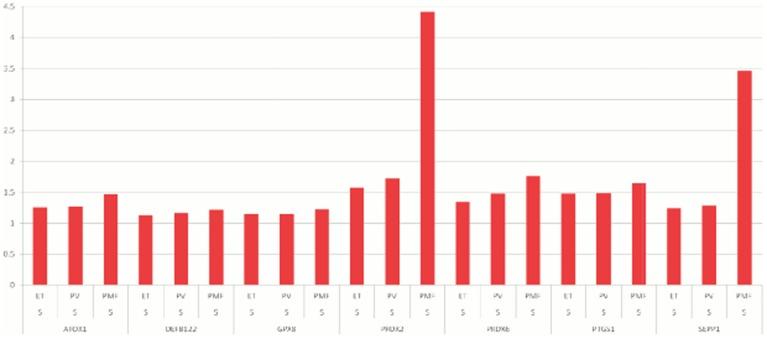
The Philadelphia-negative chronic myeloproliferative neoplasms - essential thrombocythemia (ET), polycythemia vera (PV), and myelofibrosis (MF) (MPNs) - have recently been shown to be associated with chronic inflammation, oxidative stress and accumulation of reactive oxygen species (ROS). Using whole blood transcriptional profiling, we report that several oxidative stress and anti-oxidative stress genes are significantly deregulated in MPNs. Among the twenty most up- and downregulated genes, ATOX1, DEFB122, GPX8, PRDX2, PRDX6, PTGS1, and SEPP1 were progressively upregulated from ET over PV to PMF, whereas AKR1B1, CYBA, SIRT2, TTN, and UCP2 were progressively downregulated in ET, PV and PMF (all FDR <0.05). The gene Nrf2, encoding the transcription factor nuclear factor erythroid 2-related factor 2 (NFE2L2 or Nrf2) was significantly downregulated in all MPNs. Nrf2 has a key role in the regulation of the oxidative stress response and modulates both migration and retention of hematopoietic stem cells (HSCs) in their niche. The patogenetic importance of Nrf2 depletion in the context of expansion of the hematopoietic progenitor pool in MPNs is discussed with particular focus upon the implications of concomitant downregulation of Nrf2 and CXCR4 for stem cell mobilization.
费城染色体阴性的慢性骨髓增殖性肿瘤——原发性血小板增多症(ET)、真性红细胞增多症(PV)和骨髓纤维化(MF)(MPNs)——最近已被证明与慢性炎症、氧化应激和活性氧(ROS)积累有关。通过全血转录谱分析,我们报告了几种氧化应激和抗氧化应激基因在MPNs中显著失调。在上调和下调幅度最大的20个基因中,ATOX1、DEFB122、GPX8、PRDX2、PRDX6、PTGS1和SEPP1从ET到PV再到PMF呈逐渐上调趋势,而AKR1B1、CYBA、SIRT2、TTN和UCP2在ET、PV和PMF中呈逐渐下调趋势(所有FDR<0.05)。编码转录因子核因子红细胞2相关因子2(NFE2L2或Nrf2)的基因Nrf2在所有MPNs中均显著下调。Nrf2在氧化应激反应调节中起关键作用,并调节造血干细胞(HSCs)在其微环境中的迁移和滞留。本文讨论了Nrf2缺失在MPNs造血祖细胞池扩张背景下的致病重要性,特别关注Nrf2和CXCR4同时下调对干细胞动员的影响。

 Zotero 插件