Bartels Hanni, Goldenberger Daniel, Reuthebuch Oliver, Vosbeck Juerg, Weisser Maja, Frei Reno, Bättig Veronika
Division of Infectious Diseases and Hospital Epidemiology, University Hospital Basel, Petersgraben 4, 4031, Basel, Switzerland.
Division of Clinical Microbiology, University Hospital Basel, Petersgraben 4, 4031, Basel, Switzerland.
BMC Infect Dis. 2014 Nov 18;14:586. doi: 10.1186/s12879-014-0586-0.
Up to 20% of all infective endocarditis are blood culture-negative and therefore a diagnostic challenge. Here we present the case of an infective endocarditis due to Helicobacter cinaedi finally diagnosed using different molecular methods. This highly fastidious gram-negative spiral rod is increasingly recognized as a human pathogen, above all in immunocompromised patients. So far H. cinaedi has been associated with bacteremia, cellulitis, arthritis and meningitis.
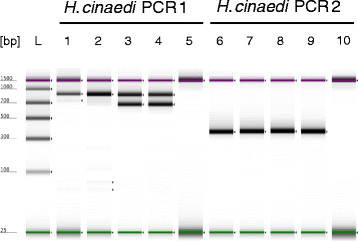
A 71-year-old man presented with fever and progressive dyspnea for weeks. He was immunocompromised by long-term steroid therapy. As one major and two minor Duke's criteria (vegetation, fever and aortic valve stenosis as predisposition) were present, an infective endocarditis was suspected and an empiric therapy with amoxicillin/clavulanic acid and gentamicin was established. The persistent severe aortic regurgitation resulted in a valve replacement. Histological evaluation of the aortic valve showed a polypous-ulcerative endocarditis. Gram stain and culture remained negative. Broad-range bacterial PCR targeting the 16S rRNA gene on the biopsy of the aortic valve identified H. cinaedi as the causative agent. The antibiotic therapy was simplified accordingly to ceftriaxone and gentamicin with a recommended duration of 6 weeks. Ten days after valve replacement the patient was discharged. To complete our molecular finding, we sequenced nearly the complete 16S rRNA gene (accession number KF914917) resulting in 99.9% identity with H. cinaedi reference sequences. Based on this result, 2 species-specific PCR tests amplifying part of the ctd gene were established and applied to the valve specimen. The 2 PCRs confirmed H. cinaedi. In addition, we analyzed stool, urine and saliva from the patient using H. cinaedi PCR. The fecal and urine specimen showed a positive signal, saliva was PCR-negative.
We identified H. cinaedi as causative agent of a culture-negative endocarditis in an immunocompromised patient using broad-range and specific PCR. In addition to 2 cases from Japan presented on international meetings in 2010 and 2013, our case report shows that H. cinaedi should be recognized as additional causative organism of infective endocarditis. The use of molecular diagnostic techniques proved to be a powerful complement for the detection of blood culture-negative infective endocarditis.
高达20%的感染性心内膜炎血培养呈阴性,因此是一项诊断挑战。在此,我们报告一例最终通过不同分子方法确诊的嗜沫栖热菌所致感染性心内膜炎病例。这种高度苛求的革兰氏阴性螺旋杆菌越来越被认为是一种人类病原体,尤其是在免疫功能低下的患者中。迄今为止,嗜沫栖热菌已与菌血症、蜂窝织炎、关节炎和脑膜炎有关。
一名71岁男性数周来出现发热和进行性呼吸困难。他因长期接受类固醇治疗而免疫功能低下。由于存在一项主要和两项次要的杜克标准(赘生物、发热以及主动脉瓣狭窄作为易患因素),怀疑为感染性心内膜炎,并开始使用阿莫西林/克拉维酸和庆大霉素进行经验性治疗。持续存在的严重主动脉瓣反流导致进行瓣膜置换。主动脉瓣的组织学评估显示为息肉溃疡性心内膜炎。革兰氏染色和培养均为阴性。针对主动脉瓣活检组织中16S rRNA基因的广谱细菌PCR鉴定嗜沫栖热菌为病原体。抗生素治疗相应简化为头孢曲松和庆大霉素,推荐疗程为6周。瓣膜置换术后10天患者出院。为完善我们的分子检测结果,我们对几乎完整的16S rRNA基因进行了测序(登录号KF914917),结果显示与嗜沫栖热菌参考序列的同源性为99.9%。基于这一结果,建立了两种扩增ctd基因部分片段的种特异性PCR检测方法,并应用于瓣膜标本。这两种PCR检测均证实为嗜沫栖热菌。此外,我们还使用嗜沫栖热菌PCR对患者的粪便、尿液和唾液进行了分析。粪便和尿液标本呈阳性信号,唾液PCR检测为阴性。
我们使用广谱和特异性PCR在一名免疫功能低下的患者中鉴定出嗜沫栖热菌为培养阴性的心内膜炎病原体。除了2010年和2013年在国际会议上报告的来自日本的2例病例外,我们的病例报告表明嗜沫栖热菌应被视为感染性心内膜炎的又一病原体。分子诊断技术的应用被证明是检测血培养阴性感染性心内膜炎的有力补充。