Gawade Prasad L, Hudson Melissa M, Kaste Sue C, Neglia Joseph P, Wasilewski-Masker Karen, Constine Louis S, Robison Leslie L, Ness Kirsten K
Department of Epidemiology and Cancer Control MSN 735, S-6013, St Jude Children's Research Hospital, 262 Danny Thomas Place, Memphis, TN 38105-3678, USA.
Curr Pediatr Rev. 2014;10(4):249-62. doi: 10.2174/1573400510666141114223827.
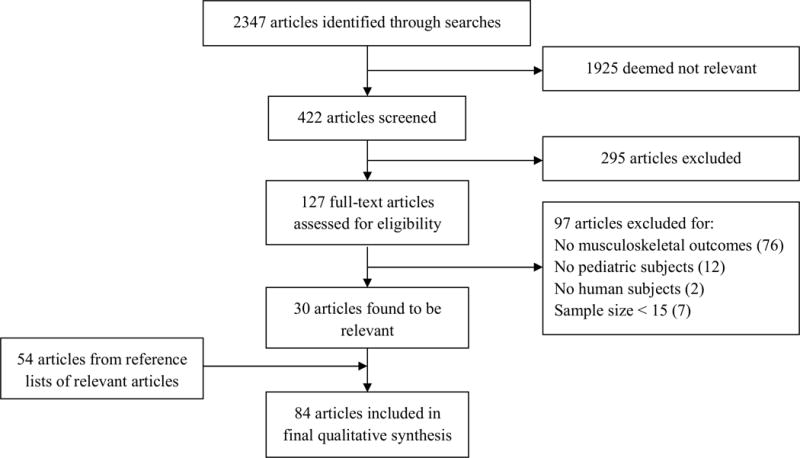
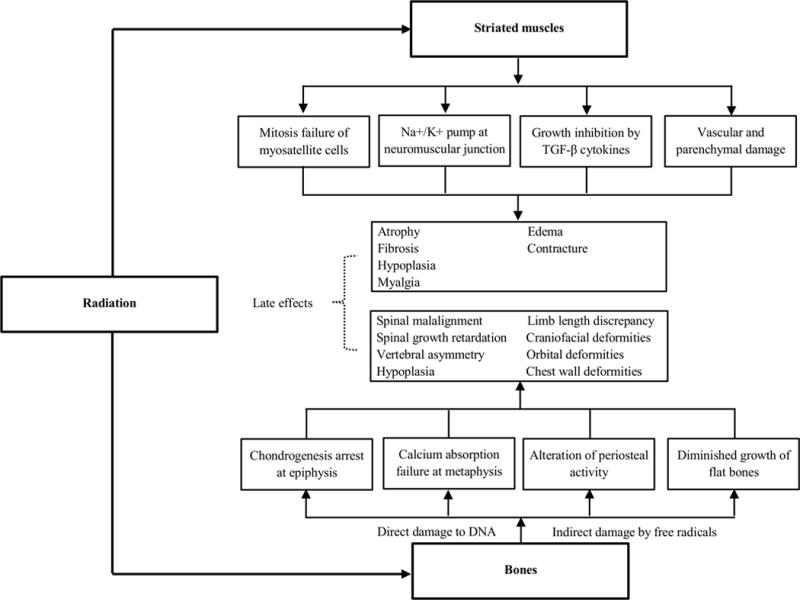
Survivors of childhood cancer are at risk for treatment-related musculoskeletal late effects. Early detection and orthopedic intervention can help ameliorate musculoskeletal late effects and prevent subsequent complications. This systematic review summarizes the literature describing associations between cancer, its treatment, and musculoskeletal late effects. We searched PubMed and Web of Science for English language articles published between January 1970 and December 2012. The search was limited to investigations with at least 15 participants and conducted at least 2 years after completion of therapy for childhood, adolescent, or young adult cancer. Some late skeletal effects, including low bone mineral density, osteonecrosis, slipped capital femoral epiphyses, oncogenic rickets, and hormonerelated growth disturbances have been previously reviewed and were excluded, as were outcomes following amputation and limb-salvage procedures. Of 2347 references identified, 30 met inclusion criteria and were retained. An additional 54 studies that met inclusion criteria were found in reference lists of retained studies. Of 84 studies, 60 focused on associations between radiotherapy, six between chemotherapy, and 18 between surgery and musculoskeletal late effects. We found that younger age, higher radiation dosage, and asymmetric or partial bone radiation volume influences the effects of radiation on the musculoskeletal system. Methotrexate and vincristine are associated with long-term muscular strength and flexibility deficits. Laminectomy and chest wall resection are associated with spinal malalignment, and enucleation is associated with orbital deformities among survivors. Radiotherapy, chemotherapy, and surgery are associated with musculoskeletal late effects independently and additively. Associations are additionally influenced by host and treatment characteristics.
儿童癌症幸存者面临与治疗相关的肌肉骨骼晚期效应风险。早期检测和骨科干预有助于改善肌肉骨骼晚期效应并预防后续并发症。本系统评价总结了描述癌症及其治疗与肌肉骨骼晚期效应之间关联的文献。我们在PubMed和科学网中检索了1970年1月至2012年12月发表的英文文章。检索仅限于至少有15名参与者且在儿童、青少年或青年癌症治疗完成后至少2年进行的研究。一些晚期骨骼效应,包括低骨密度、骨坏死、股骨头骨骺滑脱、致癌性佝偻病和激素相关生长障碍此前已被综述,故予以排除,截肢和保肢手术后的结果也被排除。在识别出的2347篇参考文献中,30篇符合纳入标准并被保留。在保留研究的参考文献列表中又发现了54篇符合纳入标准的研究。在这84项研究中,60项关注放疗之间的关联,6项关注化疗之间的关联,18项关注手术与肌肉骨骼晚期效应之间的关联。我们发现,年龄较小、辐射剂量较高以及不对称或部分骨辐射体积会影响辐射对肌肉骨骼系统的影响。甲氨蝶呤和长春新碱与长期肌肉力量和灵活性缺陷有关。椎板切除术和胸壁切除术与脊柱排列不齐有关,眼球摘除术与幸存者眼眶畸形有关。放疗、化疗和手术分别独立且累加地与肌肉骨骼晚期效应相关。这些关联还受到宿主和治疗特征的影响。