Bullich Gemma, Trujillano Daniel, Santín Sheila, Ossowski Stephan, Mendizábal Santiago, Fraga Gloria, Madrid Álvaro, Ariceta Gema, Ballarín José, Torra Roser, Estivill Xavier, Ars Elisabet
1] Molecular Biology Laboratory, Fundació Puigvert, Instituto de Investigaciones Biomédicas Sant Pau (IIB-Sant Pau), Universitat Autònoma de Barcelona, REDinREN, Instituto de Investigación Carlos III, Barcelona, Catalonia, Spain [2] Nephrology Department, Fundació Puigvert, Instituto de Investigaciones Biomédicas Sant Pau (IIB-Sant Pau), Universitat Autònoma de Barcelona, REDinREN, Instituto de Investigación Carlos III, Barcelona, Catalonia, Spain.
1] Genomics and Disease Group, Bioinformatics and Genomics Programme, Centre for Genomic Regulation (CRG), Barcelona, Catalonia, Spain [2] Department of Experimental and Health Sciences, Universitat Pompeu Fabra, Barcelona, Catalonia, Spain [3] Hospital del Mar Medical Research Institute (IMIM), Barcelona, Catalonia, Spain [4] CIBER in Epidemiology and Public Health (CIBERESP), Barcelona, Catalonia, Spain.
Eur J Hum Genet. 2015 Sep;23(9):1192-9. doi: 10.1038/ejhg.2014.252. Epub 2014 Nov 19.
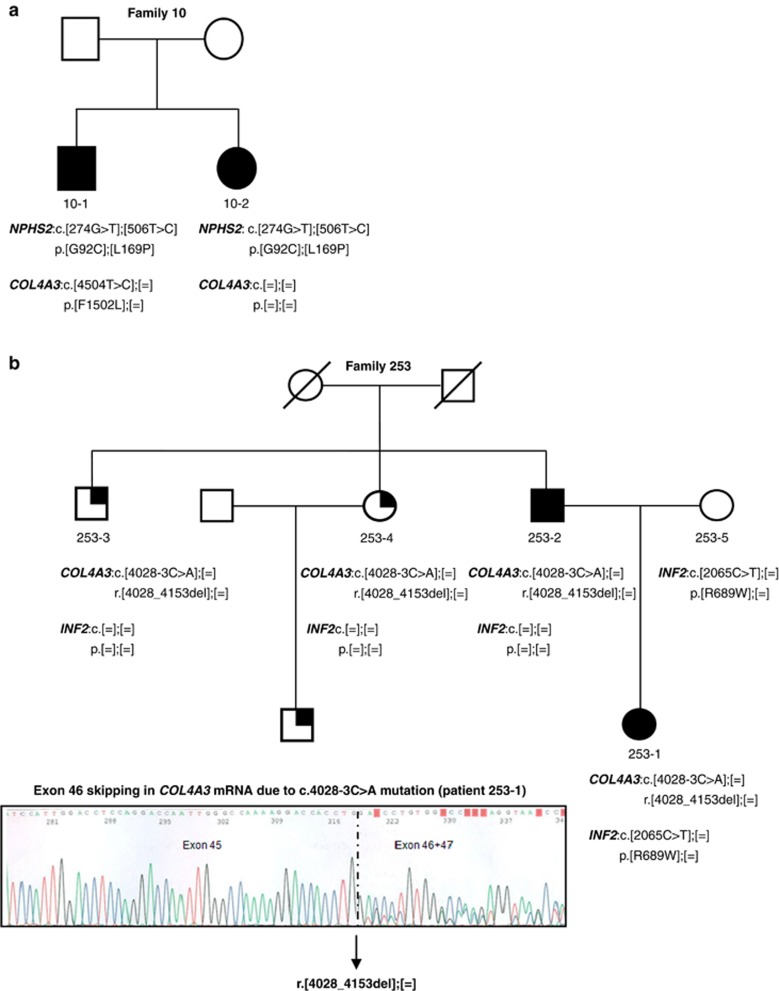
Genetic diagnosis of steroid-resistant nephrotic syndrome (SRNS) using Sanger sequencing is complicated by the high genetic heterogeneity and phenotypic variability of this disease. We aimed to improve the genetic diagnosis of SRNS by simultaneously sequencing 26 glomerular genes using massive parallel sequencing and to study whether mutations in multiple genes increase disease severity. High-throughput mutation analysis was performed in 50 SRNS and/or focal segmental glomerulosclerosis (FSGS) patients, a validation cohort of 25 patients with known pathogenic mutations, and a discovery cohort of 25 uncharacterized patients with probable genetic etiology. In the validation cohort, we identified the 42 previously known pathogenic mutations across NPHS1, NPHS2, WT1, TRPC6, and INF2 genes. In the discovery cohort, disease-causing mutations in SRNS/FSGS genes were found in nine patients. We detected three patients with mutations in an SRNS/FSGS gene and COL4A3. Two of them were familial cases and presented a more severe phenotype than family members with mutation in only one gene. In conclusion, our results show that massive parallel sequencing is feasible and robust for genetic diagnosis of SRNS/FSGS. Our results indicate that patients carrying mutations in an SRNS/FSGS gene and also in COL4A3 gene have increased disease severity.
使用桑格测序法对激素抵抗型肾病综合征(SRNS)进行基因诊断,因该疾病高度的基因异质性和表型变异性而变得复杂。我们旨在通过使用大规模平行测序同时对26个肾小球基因进行测序,来改善SRNS的基因诊断,并研究多个基因的突变是否会增加疾病的严重程度。对50例SRNS和/或局灶节段性肾小球硬化(FSGS)患者、一个由25例已知致病突变患者组成的验证队列以及一个由25例病因可能为遗传但尚未明确的患者组成的发现队列进行了高通量突变分析。在验证队列中,我们在NPHS1、NPHS2、WT1、TRPC6和INF2基因中鉴定出了42个先前已知的致病突变。在发现队列中,在9例患者中发现了SRNS/FSGS基因的致病突变。我们检测到3例患者在SRNS/FSGS基因和COL4A3中有突变。其中2例为家族性病例,其表型比仅在一个基因中有突变的家庭成员更为严重。总之,我们的结果表明,大规模平行测序对于SRNS/FSGS的基因诊断是可行且可靠的。我们的结果表明,在SRNS/FSGS基因以及COL4A3基因中携带突变的患者,疾病严重程度增加。