Perera Gayan, Khondoker Mizanur, Broadbent Matthew, Breen Gerome, Stewart Robert
King's College London (Institute of Psychiatry), London, United Kingdom.
South London and Maudsley NHS Foundation Trust, London, United Kingdom.
PLoS One. 2014 Nov 20;9(11):e109484. doi: 10.1371/journal.pone.0109484. eCollection 2014.
Acetylcholinesterase inhibitors (AChEIs) are widely used to delay cognitive decline in Alzheimer's disease. Observational studies in routine clinical practice have shown cognitive improvement in some groups of patients receiving these agents but longitudinal trajectories before and after AChEI initiation have not previously been considered.
To compare trajectories of cognitive function before and after AChEI initiation and investigate predictors of these differences.
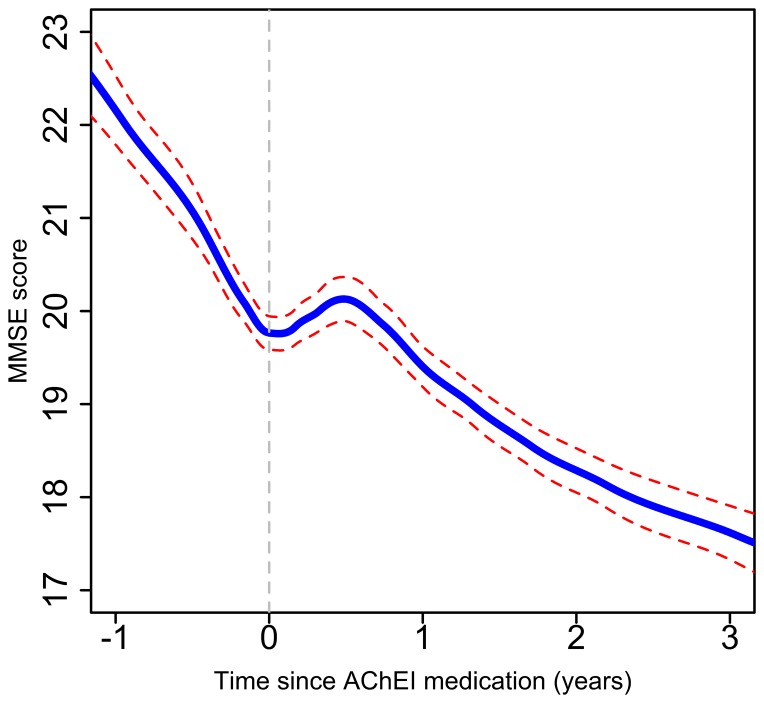
A retrospective longitudinal study was constructed using data from 2460 patients who received AChEIs and who had routine data on cognitive function (Mini-Mental State Examination; MMSE) before and after AChEI initiation. Longitudinal MMSE change was modelled using three-piece linear mixed models with the following segments: 0-12 months prior to AChEI initiation, 0-6 months and 6-36 months after initiation.
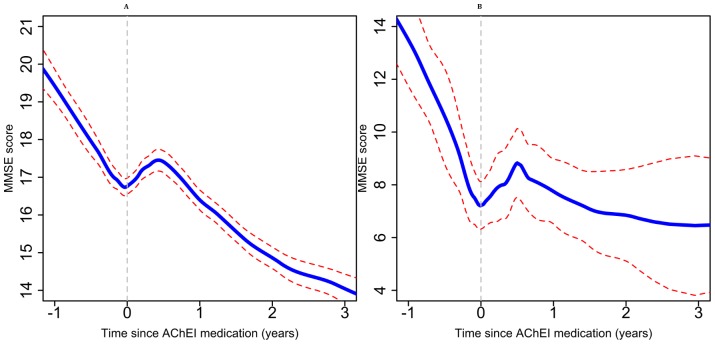
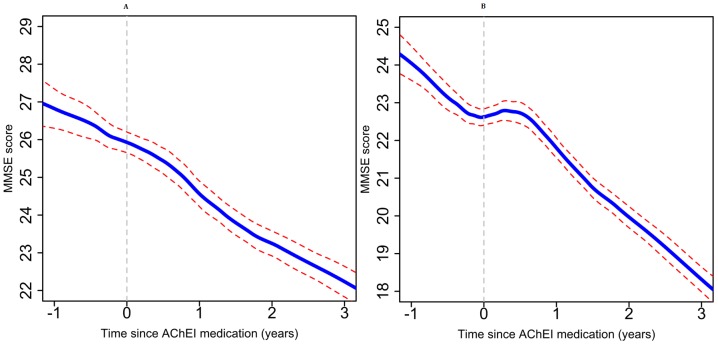
MMSE decline was reversed (in that the slope was improved by an average 4.2 units per year, 95% CI 3.5-4.8) during the 6-month period following AChEI initiation compared with the slope in the one year period before AChEI initiation. The slope in the period from 6-36 months following AChEI initiation returned to the pre-initiation downward trajectory. The differences in slopes in the 1 year period prior to AChEI initiation and in the 6 months after initiation were smaller among those with higher MMSE scores at the time of AChEI initiation, among those who received a vascular dementia diagnosis at any point, and among those receiving antipsychotic agents.
In this naturalistic observational study, changes in cognitive trajectories around AChEI initiation were similar to those reported in randomised controlled trials. The magnitude of the difference in slopes between the 1 year period prior to AChEI initiation and the 6 month period after AChEI initiation was related to level of cognitive function at treatment initiation, vascular comorbidity and antipsychotic use.
乙酰胆碱酯酶抑制剂(AChEIs)被广泛用于延缓阿尔茨海默病患者的认知衰退。常规临床实践中的观察性研究显示,部分接受这些药物治疗的患者认知功能有所改善,但此前尚未考虑AChEI开始使用前后的纵向轨迹。
比较AChEI开始使用前后的认知功能轨迹,并调查这些差异的预测因素。
采用回顾性纵向研究,数据来自2460例接受AChEIs治疗且在AChEI开始使用前后有认知功能常规数据(简易精神状态检查表;MMSE)的患者。纵向MMSE变化采用三段线性混合模型进行建模,包括以下阶段:AChEI开始使用前0至12个月、开始使用后0至6个月以及6至36个月。
与AChEI开始使用前一年的斜率相比,AChEI开始使用后的6个月内MMSE下降得到逆转(即斜率平均每年改善4.2个单位,95%CI为3.5至4.8)。AChEI开始使用后6至