
疟原虫配子体中与翻译阻遏物结合的mRNA的全基因组RIP-Chip分析。
Genome-wide RIP-Chip analysis of translational repressor-bound mRNAs in the Plasmodium gametocyte.
作者信息
Guerreiro Ana, Deligianni Elena, Santos Jorge M, Silva Patricia A G C, Louis Christos, Pain Arnab, Janse Chris J, Franke-Fayard Blandine, Carret Celine K, Siden-Kiamos Inga, Mair Gunnar R
出版信息
Genome Biol. 2014 Nov 3;15(11):493. doi: 10.1186/s13059-014-0493-0.
BACKGROUND
Following fertilization, the early proteomes of metazoans are defined by the translation of stored but repressed transcripts; further embryonic development relies on de novo transcription of the zygotic genome. During sexual development of Plasmodium berghei, a rodent model for human malaria species including P. falciparum, the stability of repressed mRNAs requires the translational repressors DOZI and CITH. When these repressors are absent, Plasmodium zygote development and transmission to the mosquito vector is halted, as hundreds of transcripts become destabilized. However, which mRNAs are direct targets of these RNA binding proteins, and thus subject to translational repression, is unknown.
RESULTS
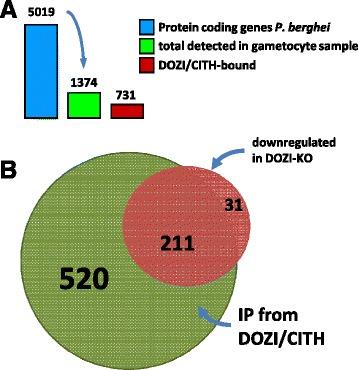
We identify the maternal mRNA contribution to post-fertilization development of P. berghei using RNA immunoprecipitation and microarray analysis. We find that 731 mRNAs, approximately 50% of the transcriptome, are associated with DOZI and CITH, allowing zygote development to proceed in the absence of RNA polymerase II transcription. Using GFP-tagging, we validate the repression phenotype of selected genes and identify mRNAs relying on the 5' untranslated region for translational control. Gene deletion reveals a novel protein located in the ookinete crystalloid with an essential function for sporozoite development.
CONCLUSIONS
Our study details for the first time the P. berghei maternal repressome. This mRNA population provides the developing ookinete with coding potential for key molecules required for life-cycle progression, and that are likely to be critical for the transmission of the malaria parasite from the rodent and the human host to the mosquito vector.
背景
受精后,后生动物的早期蛋白质组由储存但被抑制的转录本的翻译所定义;进一步的胚胎发育依赖于合子基因组的从头转录。在伯氏疟原虫(一种包括恶性疟原虫在内的人类疟原虫的啮齿动物模型)的有性发育过程中,被抑制的mRNA的稳定性需要翻译抑制因子DOZI和CITH。当这些抑制因子缺失时,疟原虫合子发育以及向蚊媒的传播就会停止,因为数百种转录本会变得不稳定。然而,哪些mRNA是这些RNA结合蛋白的直接靶标,因而受到翻译抑制,尚不清楚。
结果
我们使用RNA免疫沉淀和微阵列分析确定了母源mRNA对伯氏疟原虫受精后发育的贡献。我们发现731种mRNA(约占转录组的50%)与DOZI和CITH相关联,这使得合子发育在没有RNA聚合酶II转录的情况下仍能进行。通过绿色荧光蛋白标记,我们验证了所选基因的抑制表型,并确定了依赖于5'非翻译区进行翻译控制的mRNA。基因缺失揭示了一种位于动合子晶状体中的新型蛋白质,它对子孢子发育具有重要功能。
结论
我们的研究首次详细阐述了伯氏疟原虫的母源抑制复合物。这一mRNA群体为发育中的动合子提供了编码生命周期进展所需关键分子的潜力,而这些分子可能对于疟原虫从啮齿动物和人类宿主传播到蚊媒至关重要。


 Zotero 插件