Rios Kelly T, McGee James P, Sebastian Aswathy, Gedara Sanjaya Aththawala, Moritz Robert L, Feric Marina, Absalon Sabrina, Swearingen Kristian E, Lindner Scott E
Department of Biochemistry and Molecular Biology, Pennsylvania State University, University Park, Pennsylvania, United States of America.
Center for Eukaryotic Gene Regulation, Pennsylvania State University, University Park, Pennsylvania, United States of America.
PLoS Pathog. 2025 Jan 8;21(1):e1012823. doi: 10.1371/journal.ppat.1012823. eCollection 2025 Jan.
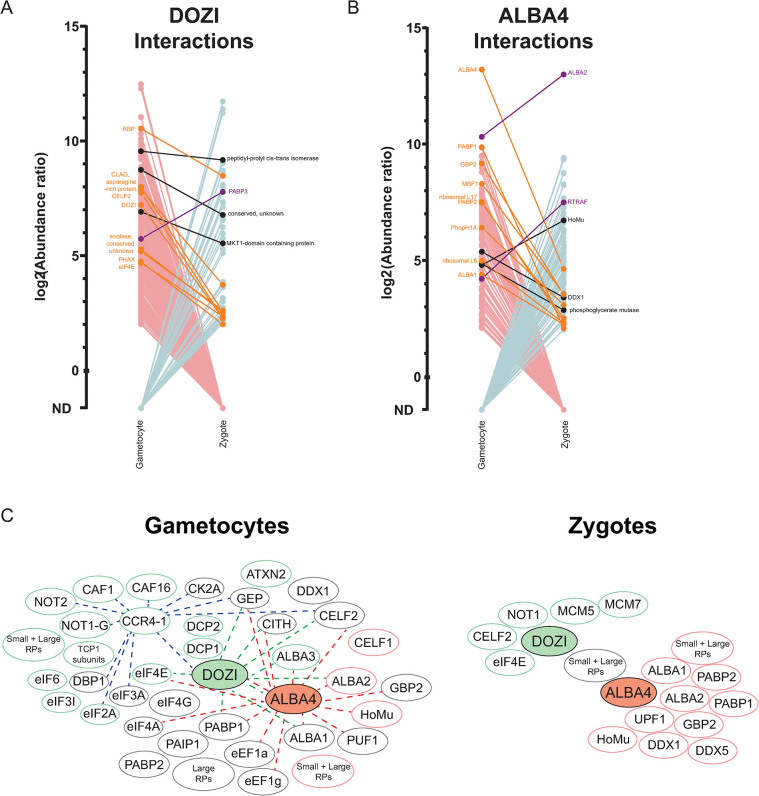
Malaria parasites must respond quickly to environmental changes, including during their transmission between mammalian and mosquito hosts. Therefore, female gametocytes proactively produce and translationally repress mRNAs that encode essential proteins that the zygote requires to establish a new infection. While the release of translational repression of individual mRNAs has been documented, the details of the global release of translational repression have not. Moreover, changes in the spatial arrangement and composition of the DOZI/CITH/ALBA complex that contribute to translational control are also not known. Therefore, we have conducted the first quantitative, comparative transcriptomics and DIA-MS proteomics of Plasmodium parasites across the host-to-vector transmission event to document the global release of translational repression. Using female gametocytes and zygotes of P. yoelii, we found that ~200 transcripts are released for translation soon after fertilization, including those encoding essential functions. Moreover, we identified that many transcripts remain repressed beyond this point. TurboID-based proximity proteomics of the DOZI/CITH/ALBA regulatory complex revealed substantial spatial and/or compositional changes across this transmission event, which are consistent with recent, paradigm-shifting models of translational control. Together, these data provide a model for the essential translational control mechanisms that promote Plasmodium's efficient transmission from mammalian host to mosquito vector.
疟原虫必须迅速应对环境变化,包括在其在哺乳动物宿主和蚊子宿主之间传播的过程中。因此,雌性配子体主动产生并翻译抑制编码合子建立新感染所需必需蛋白质的mRNA。虽然单个mRNA翻译抑制的释放已有记录,但全局翻译抑制释放的细节尚未可知。此外,有助于翻译控制的DOZI/CITH/ALBA复合体的空间排列和组成变化也不清楚。因此,我们首次对疟原虫在宿主到媒介传播过程中进行了定量、比较转录组学和DIA-MS蛋白质组学研究,以记录翻译抑制的全局释放。使用约氏疟原虫的雌性配子体和合子,我们发现约200个转录本在受精后不久就被释放用于翻译,包括那些编码基本功能的转录本。此外,我们还发现许多转录本在此之后仍处于抑制状态。基于TurboID的DOZI/CITH/ALBA调控复合体的邻近蛋白质组学揭示了整个传播过程中大量的空间和/或组成变化,这与最近的、范式转变的翻译控制模型一致。总之,这些数据提供了一个促进疟原虫从哺乳动物宿主高效传播到蚊子媒介的基本翻译控制机制模型。