Huber F, Montani M, Sulser T, Jaggi R, Wild P, Moch H, Gevensleben H, Schmid M, Wyder S, Kristiansen G
Institute of Surgical Pathology, University Hospital Zurich, Zurich, Switzerland.
Institute of Surgical Pathology, University of Bern, Bern, Switzerland.
Br J Cancer. 2015 Jan 6;112(1):140-8. doi: 10.1038/bjc.2014.588. Epub 2014 Nov 25.
Treatment planning of localised prostate cancer remains challenging. Besides conventional parameters, a wealth of prognostic biomarkers has been proposed so far. None of which, however, have successfully been implemented in a routine setting so far. The aim of our study was to systematically verify a set of published prognostic markers for prostate cancer.
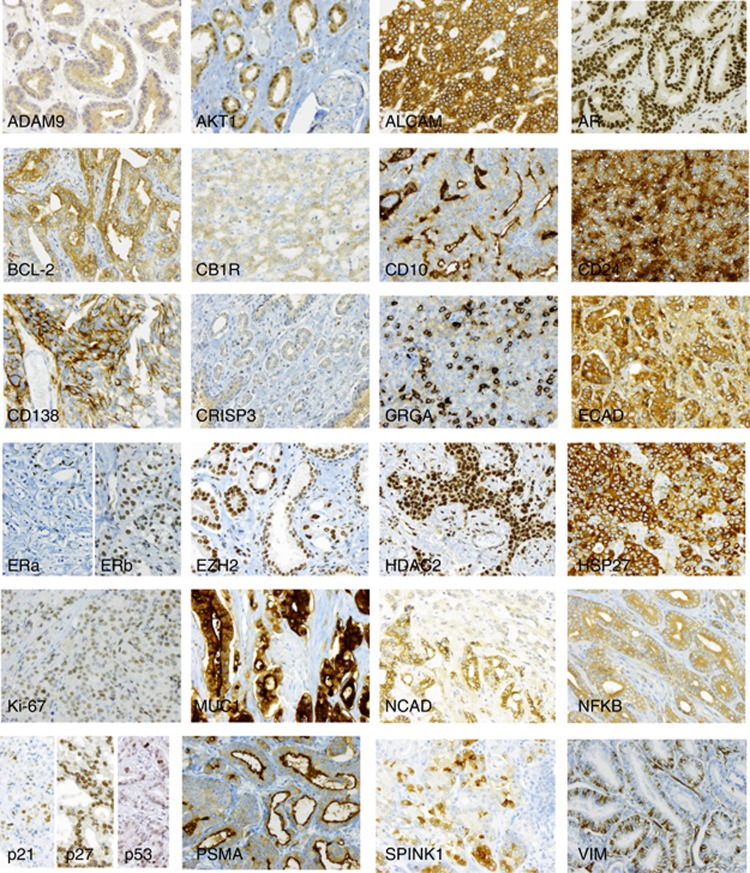
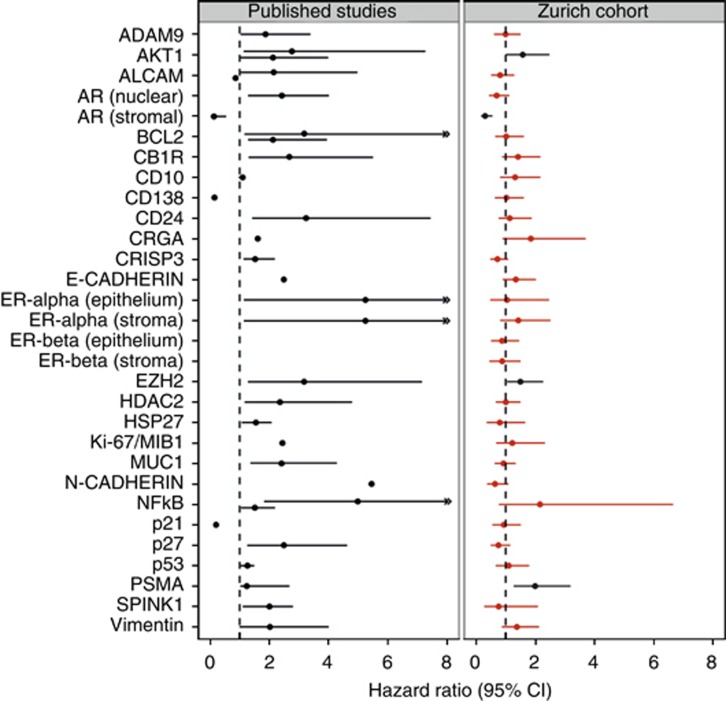
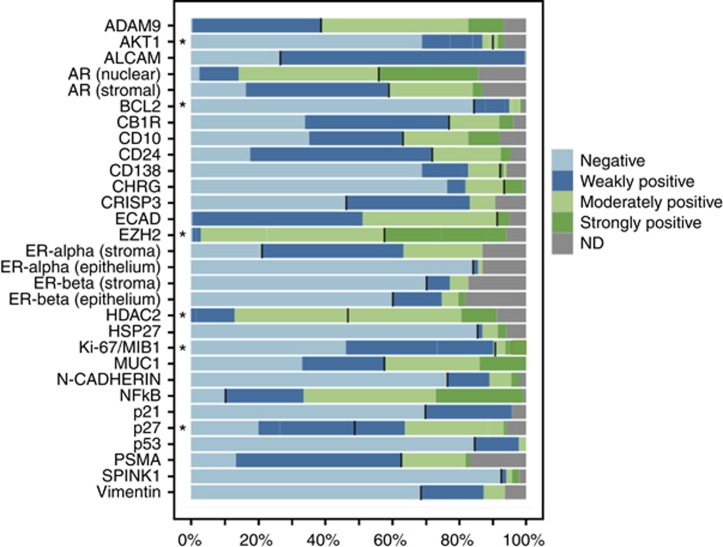
Following an in-depth PubMed search, 28 markers were selected that have been proposed as multivariate prognostic markers for primary prostate cancer. Their prognostic validity was examined in a radical prostatectomy cohort of 238 patients with a median follow-up of 60 months and biochemical progression as endpoint of the analysis. Immunohistochemical evaluation was performed using previously published cut-off values, but allowing for optimisation if necessary. Univariate and multivariate Cox regression were used to determine the prognostic value of biomarkers included in this study.
Despite the application of various cut-offs in the analysis, only four (14%) markers were verified as independently prognostic (AKT1, stromal AR, EZH2, and PSMA) for PSA relapse following radical prostatectomy.
Apparently, many immunohistochemistry-based studies on prognostic markers seem to be over-optimistic. Codes of best practice, such as the REMARK guidelines, may facilitate the performance of conclusive and transparent future studies.
局限性前列腺癌的治疗规划仍然具有挑战性。除了传统参数外,迄今为止已经提出了大量的预后生物标志物。然而,到目前为止,这些标志物均未在常规临床中成功应用。我们研究的目的是系统地验证一组已发表的前列腺癌预后标志物。
在对PubMed进行深入检索后,选择了28个已被提议作为原发性前列腺癌多变量预后标志物的指标。在一个包含238例患者的前列腺癌根治术队列中对它们的预后有效性进行了检查,以生化进展作为分析终点,中位随访时间为60个月。免疫组化评估使用先前发表的临界值进行,但必要时允许进行优化。采用单变量和多变量Cox回归来确定本研究中纳入的生物标志物的预后价值。
尽管在分析中应用了各种临界值,但只有四个(14%)标志物被证实为前列腺癌根治术后PSA复发的独立预后因素(AKT1、基质雄激素受体、EZH2和前列腺特异性膜抗原)。
显然,许多基于免疫组化的预后标志物研究似乎过于乐观。诸如REMARK指南等最佳实践规范可能有助于未来开展具有结论性和透明度的研究。