Katabi Nora, Ghossein Ronald, Ho Alan, Dogan Snjezana, Zhang Lei, Sung Yun-Shao, Antonescu Cristina R
Department of Pathology, Memorial Sloan-Kettering Cancer Center, New York, NY, 10065.
Department of Pathology, Memorial Sloan-Kettering Cancer Center, New York, NY, 10065.
Hum Pathol. 2015 Jan;46(1):26-33. doi: 10.1016/j.humpath.2014.08.017. Epub 2014 Sep 7.
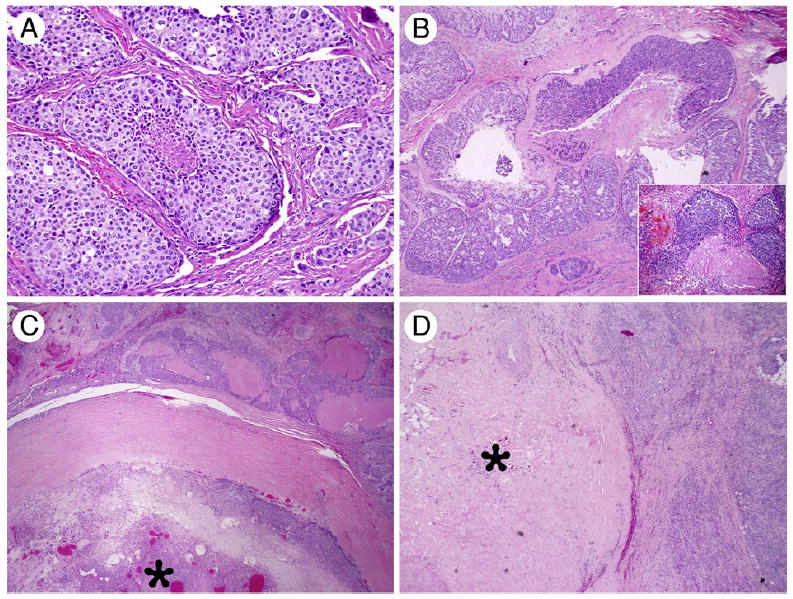
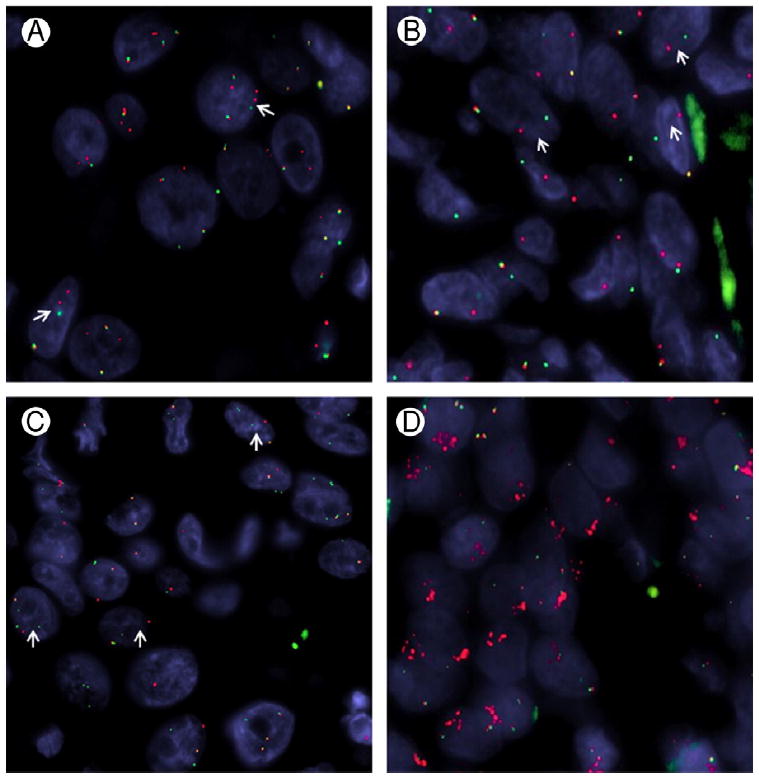
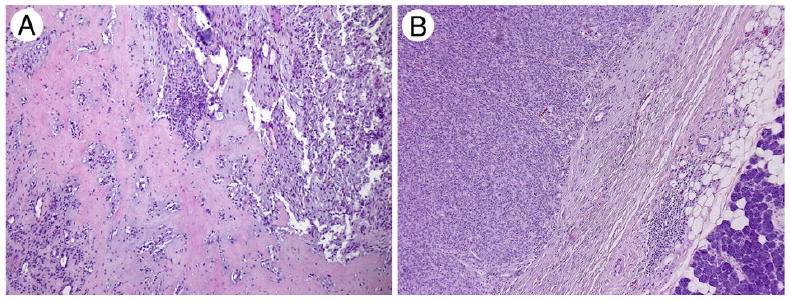
Carcinoma ex-pleomorphic adenoma (CA ex-PA) is a malignant salivary gland tumor that arises in association with pleomorphic adenoma (PA). Both PA and CA ex-PA have a broad spectrum of histology, and distinction from their histologic mimics may be difficult based on morphology alone. PLAG1 and HMGA2 abnormalities are the most common genetic events in both PA and CA ex-PA; however, the use of PLAG1 and HMGA2 as adjunct molecular tests has not been well established. Fluorescence in situ hybridization for PLAG1 and HMGA2 was performed on 22 CA ex-PA (10 myoepithelial carcinomas [MECAs], 10 salivary duct carcinomas [SDCs], 1 carcinoma with squamoglandular features, and 1 mixed MECA-adenocarcinoma not otherwise specified), 20 de novo carcinomas (11 MECAs and 9 SDCs), 16 PAs, and 11 PA-histologic mimics. All except 3 CAs ex-PA (86%) were positive for PLAG1 or HMGA2 rearrangements/amplifications. In contrast, 18 (90%) of 20 de novo carcinomas lacked abnormalities in PLAG1 or HMGA2 (P < .01). PLAG1 or HMGA2 rearrangements were identified in 6 (67%) of 9 hypocellular myxoid PAs and in 2 (29%) of 7 cellular PAs. Furthermore, all morphologic mimics of PA were negative for PLAG1 or HMGA2. PLAG1 and HMGA2 rearrangements are the most common genetic events in CA ex-PA regardless of the histologic subtype. Unlike CA ex-PA, de novo carcinomas were negative for PLAG1 and HMGA2. Interestingly, rearrangements of PLAG1/HMGA2 were identified in most hypocellular PAs but only in a small subset of cellular PAs. Fluorescence in situ hybridization for PLAG1 or HMGA2 can be used to distinguish between PA and CA ex-PA and their morphologic mimics.
多形性腺瘤恶变(CA ex-PA)是一种与多形性腺瘤(PA)相关的恶性涎腺肿瘤。PA和CA ex-PA均具有广泛的组织学表现,仅基于形态学将其与组织学上的相似病变区分开来可能存在困难。PLAG1和HMGA2异常是PA和CA ex-PA中最常见的基因事件;然而,将PLAG1和HMGA2用作辅助分子检测方法尚未得到充分确立。对22例CA ex-PA(10例肌上皮癌[MECAs]、10例涎腺导管癌[SDCs]、1例具有鳞腺特征的癌和1例未另行指定的混合性MECA-腺癌)、20例原发性癌(11例MECAs和9例SDCs)、16例PAs以及11例PA组织学相似病变进行了PLAG1和HMGA2的荧光原位杂交检测。除3例CA ex-PA外(86%),所有病例的PLAG1或HMGA2重排/扩增均为阳性。相比之下,20例原发性癌中有18例(90%)PLAG1或HMGA2无异常(P <.01)。在9例细胞少的黏液样PA中有6例(67%)检测到PLAG1或HMGA2重排,在7例细胞性PA中有2例(29%)检测到。此外,所有PA的形态学相似病变PLAG1或HMGA2均为阴性。无论组织学亚型如何,PLAG1和HMGA2重排都是CA ex-PA中最常见的基因事件。与CA ex-PA不同,原发性癌PLAG1和HMGA2为阴性。有趣的是,在大多数细胞少的PA中检测到PLAG1/HMGA2重排,但仅在一小部分细胞性PA中检测到。PLAG1或HMGA2的荧光原位杂交可用于区分PA和CA ex-PA及其形态学相似病变。