González Hugo, Pacheco Rodrigo
J Neuroinflammation. 2014 Dec 2;11:201. doi: 10.1186/s12974-014-0201-8.
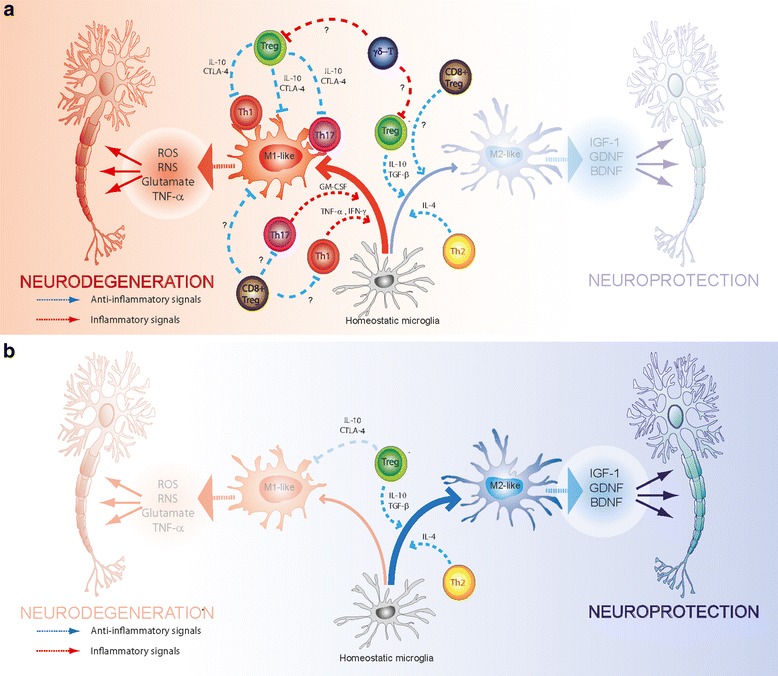
Neuroinflammation is involved in several neurodegenerative disorders and emerging evidence indicates that it constitutes a critical process that is required for the progression of neurodegeneration. Microglial activation constitutes a central event in neuroinflammation. Furthermore, microglia can not only be activated with an inflammatory and neurotoxic phenotype (M1-like phenotype), but they also can acquire a neurosupportive functional phenotype (M2-like phenotype) characterised by the production of anti-inflammatory mediators and neurotrophic factors. Importantly, during the past decade, several studies have shown that CD4(+) T-cells infiltrate the central nervous system (CNS) in many neurodegenerative disorders, in which their participation has a critical influence on the outcome of microglial activation and consequent neurodegeneration. In this review, we focus on the analysis of the interplay of the different sub-populations of CD4(+) T-cells infiltrating the CNS and how they participate in regulating the outcome of neuroinflammation and neurodegeneration in the context of Parkinson's disease, Alzheimer's disease, amyotrophic lateral sclerosis and multiple sclerosis. In this regard, encephalitogenic inflammatory CD4(+) T-cells, such as Th1, Th17, GM-CSF-producer CD4(+) T-cells and γδT-cells, strongly contribute to chronic neuroinflammation, thus perpetuating neurodegenerative processes. In contrast, encephalitogenic or meningeal Tregs and Th2 cells decrease inflammatory functions in microglial cells and promote a neurosupportive microenvironment. Moreover, whereas some neurodegenerative disorders such as multiple sclerosis, Parkinson's disease and Alzheimer's disease involve the participation of inflammatory CD4(+) T-cells 'naturally', the physiopathology of other neurodegenerative diseases, such as amyotrophic lateral sclerosis, is associated with the participation of anti-inflammatory CD4(+) T-cells that delay the neurodegenerative process. Thus, current evidence supports the hypothesis that the involvement of CD4(+) T-cells against CNS antigens constitutes a key component in regulating the progression of the neurodegenerative process.
神经炎症与多种神经退行性疾病相关,新出现的证据表明,它构成了神经退行性变进展所需的关键过程。小胶质细胞激活是神经炎症的核心事件。此外,小胶质细胞不仅可以被激活为具有炎症和神经毒性表型(M1样表型),还可以获得以产生抗炎介质和神经营养因子为特征的神经支持性功能表型(M2样表型)。重要的是,在过去十年中,多项研究表明,CD4(+) T细胞在许多神经退行性疾病中浸润中枢神经系统(CNS),它们的参与对小胶质细胞激活及随之而来的神经退行性变的结果具有关键影响。在这篇综述中,我们重点分析浸润中枢神经系统的不同亚群CD4(+) T细胞之间的相互作用,以及它们在帕金森病、阿尔茨海默病、肌萎缩侧索硬化症和多发性硬化症背景下如何参与调节神经炎症和神经退行性变的结果。在这方面,致脑炎炎性CD4(+) T细胞,如Th1、Th17、粒细胞-巨噬细胞集落刺激因子产生型CD4(+) T细胞和γδT细胞,强烈促进慢性神经炎症,从而使神经退行性过程持续存在。相比之下,致脑炎或脑膜调节性T细胞(Tregs)和Th2细胞可降低小胶质细胞的炎症功能,并促进神经支持性微环境。此外,虽然某些神经退行性疾病,如多发性硬化症、帕金森病和阿尔茨海默病“自然地”涉及炎性CD4(+) T细胞的参与,但其他神经退行性疾病,如肌萎缩侧索硬化症的病理生理学与抗炎性CD4(+) T细胞的参与相关,这些细胞可延缓神经退行性过程。因此,目前的证据支持这样一种假说,即CD4(+) T细胞针对中枢神经系统抗原的参与是调节神经退行性过程进展的关键组成部分。