Trivellin Giampaolo, Daly Adrian F, Faucz Fabio R, Yuan Bo, Rostomyan Liliya, Larco Darwin O, Schernthaner-Reiter Marie Helene, Szarek Eva, Leal Letícia F, Caberg Jean-Hubert, Castermans Emilie, Villa Chiara, Dimopoulos Aggeliki, Chittiboina Prashant, Xekouki Paraskevi, Shah Nalini, Metzger Daniel, Lysy Philippe A, Ferrante Emanuele, Strebkova Natalia, Mazerkina Nadia, Zatelli Maria Chiara, Lodish Maya, Horvath Anelia, de Alexandre Rodrigo Bertollo, Manning Allison D, Levy Isaac, Keil Margaret F, Sierra Maria de la Luz, Palmeira Leonor, Coppieters Wouter, Georges Michel, Naves Luciana A, Jamar Mauricette, Bours Vincent, Wu T John, Choong Catherine S, Bertherat Jerome, Chanson Philippe, Kamenický Peter, Farrell William E, Barlier Anne, Quezado Martha, Bjelobaba Ivana, Stojilkovic Stanko S, Wess Jurgen, Costanzi Stefano, Liu Pengfei, Lupski James R, Beckers Albert, Stratakis Constantine A
The authors' affiliations are listed in the Appendix.
N Engl J Med. 2014 Dec 18;371(25):2363-74. doi: 10.1056/NEJMoa1408028. Epub 2014 Dec 3.
Increased secretion of growth hormone leads to gigantism in children and acromegaly in adults; the genetic causes of gigantism and acromegaly are poorly understood.
We performed clinical and genetic studies of samples obtained from 43 patients with gigantism and then sequenced an implicated gene in samples from 248 patients with acromegaly.
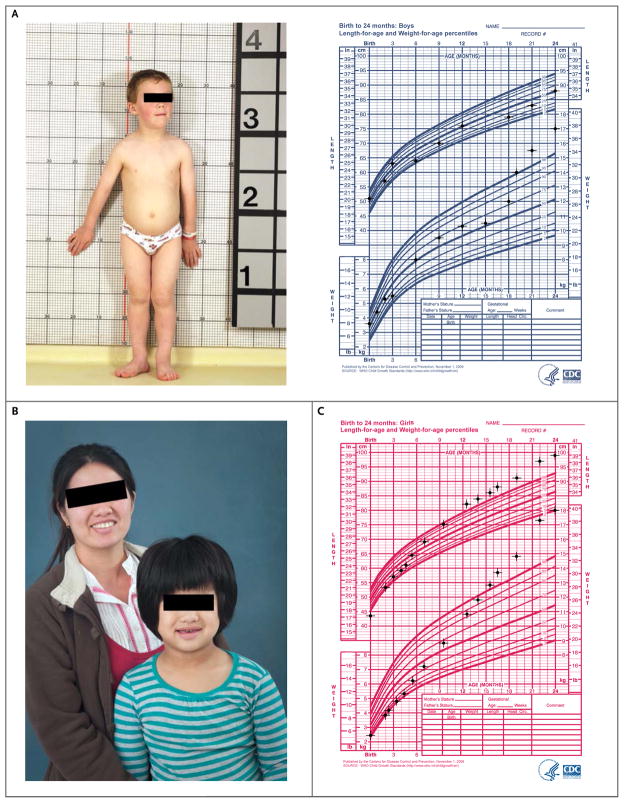
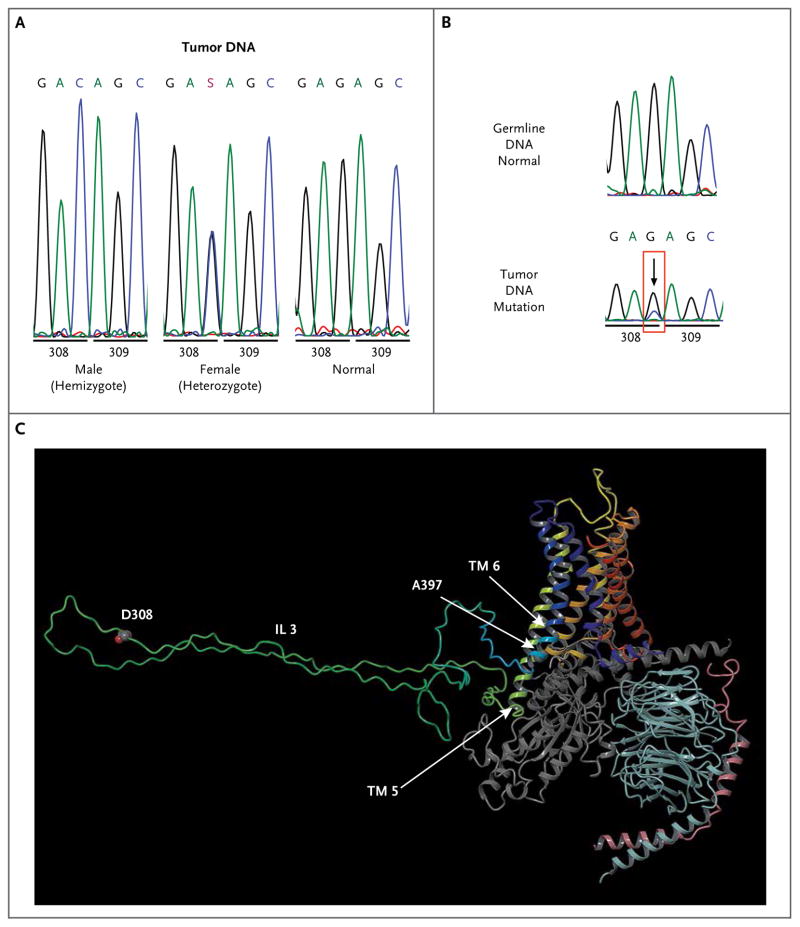
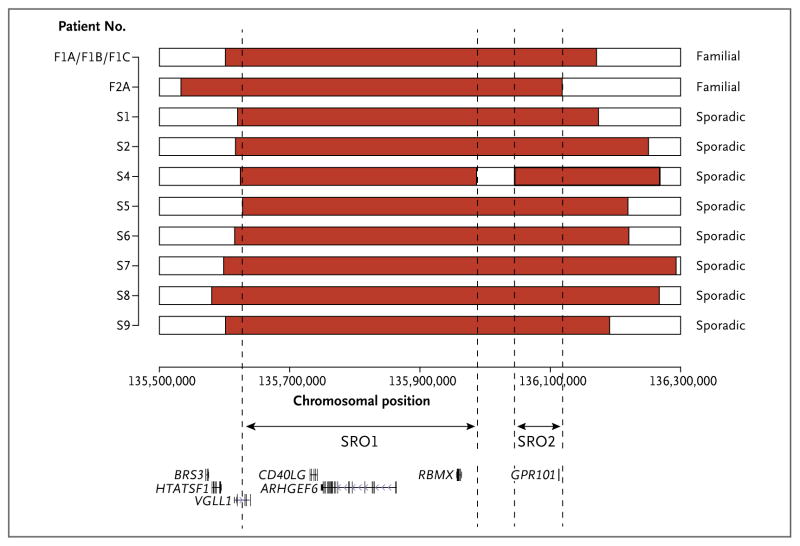
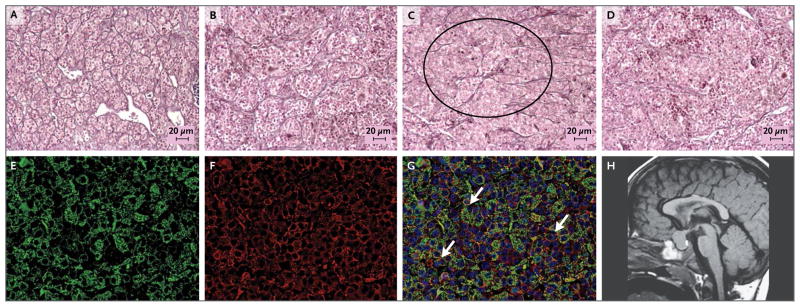
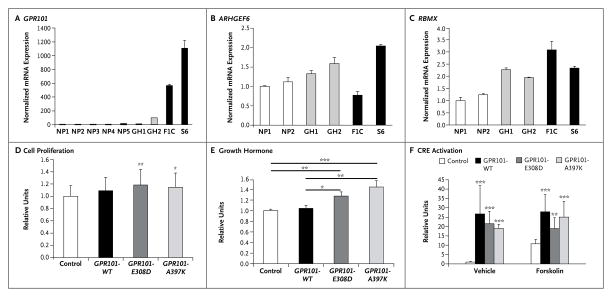
We observed microduplication on chromosome Xq26.3 in samples from 13 patients with gigantism; of these samples, 4 were obtained from members of two unrelated kindreds, and 9 were from patients with sporadic cases. All the patients had disease onset during early childhood. Of the patients with gigantism who did not carry an Xq26.3 microduplication, none presented before the age of 5 years. Genomic characterization of the Xq26.3 region suggests that the microduplications are generated during chromosome replication and that they contain four protein-coding genes. Only one of these genes, GPR101, which encodes a G-protein-coupled receptor, was overexpressed in patients' pituitary lesions. We identified a recurrent GPR101 mutation (p.E308D) in 11 of 248 patients with acromegaly, with the mutation found mostly in tumors. When the mutation was transfected into rat GH3 cells, it led to increased release of growth hormone and proliferation of growth hormone-producing cells.
We describe a pediatric disorder (which we have termed X-linked acrogigantism [X-LAG]) that is caused by an Xq26.3 genomic duplication and is characterized by early-onset gigantism resulting from an excess of growth hormone. Duplication of GPR101 probably causes X-LAG. We also found a recurrent mutation in GPR101 in some adults with acromegaly. (Funded by the Eunice Kennedy Shriver National Institute of Child Health and Human Development and others.).
生长激素分泌增加会导致儿童患巨人症,成人患肢端肥大症;巨人症和肢端肥大症的遗传病因目前了解甚少。
我们对43例巨人症患者的样本进行了临床和遗传学研究,然后对248例肢端肥大症患者的样本中的一个相关基因进行了测序。
我们在13例巨人症患者的样本中观察到Xq26.3染色体微重复;其中4个样本来自两个无亲缘关系的家族成员,9个样本来自散发病例患者。所有患者均在幼儿期发病。在未携带Xq26.3微重复的巨人症患者中,没有一例在5岁前发病。Xq26.3区域的基因组特征表明,微重复是在染色体复制过程中产生的,并且它们包含四个蛋白质编码基因。这些基因中只有一个GPR101(编码一种G蛋白偶联受体)在患者的垂体病变中过度表达。我们在248例肢端肥大症患者中的11例中发现了一个反复出现的GPR101突变(p.E308D),该突变主要在肿瘤中发现。当该突变转染到大鼠GH3细胞中时,会导致生长激素释放增加和生长激素产生细胞增殖。
我们描述了一种儿童疾病(我们称之为X连锁肢端肥大症[X-LAG]),它由Xq26.3基因组重复引起,其特征是由于生长激素过多导致的早发性巨人症。GPR101的重复可能导致X-LAG。我们还在一些成年肢端肥大症患者中发现了GPR101的反复突变。(由尤妮斯·肯尼迪·施赖弗国家儿童健康与人类发展研究所及其他机构资助。)