Moon Jin Chang, Kim Seong Hun, Kim In Hee, Lee Chang Hun, Kim Sang Wook, Lee Seung Ok, Lee Soo Teik, Kim Dae-Ghon
Department of Internal Medicine, Research Institute of Clinical Medicine, Chonbuk National University Hospital, Chonbuk National University Medical School, Jeonju, Korea.
Gut Liver. 2015 May 23;9(3):395-404. doi: 10.5009/gnl14170.
BACKGROUND/AIMS: We investigated factors associated with the disease progression and development of hepatocellular carcinoma (HCC) in chronic hepatitis B (CHB) patients during long-term oral nucleos(t)ide analog (NA) therapy.
This retrospective study included 524 naive CHB patients who received oral NA therapy for more than 48 weeks between January 2003 and December 2007. The primary outcome was 5-year cumulative probability of disease progression and HCC development. Disease progression was defined as cirrhosis development, cirrhotic complications, HCC or liver-related mortality.
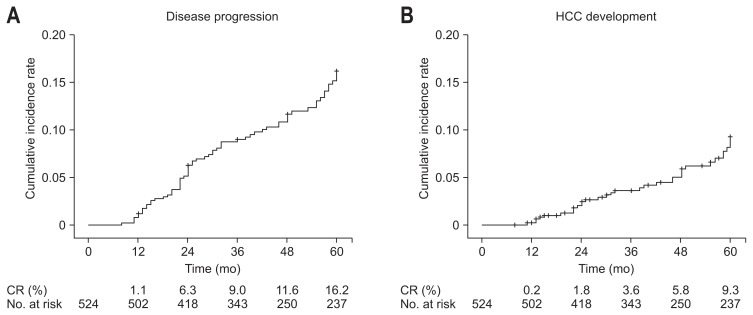
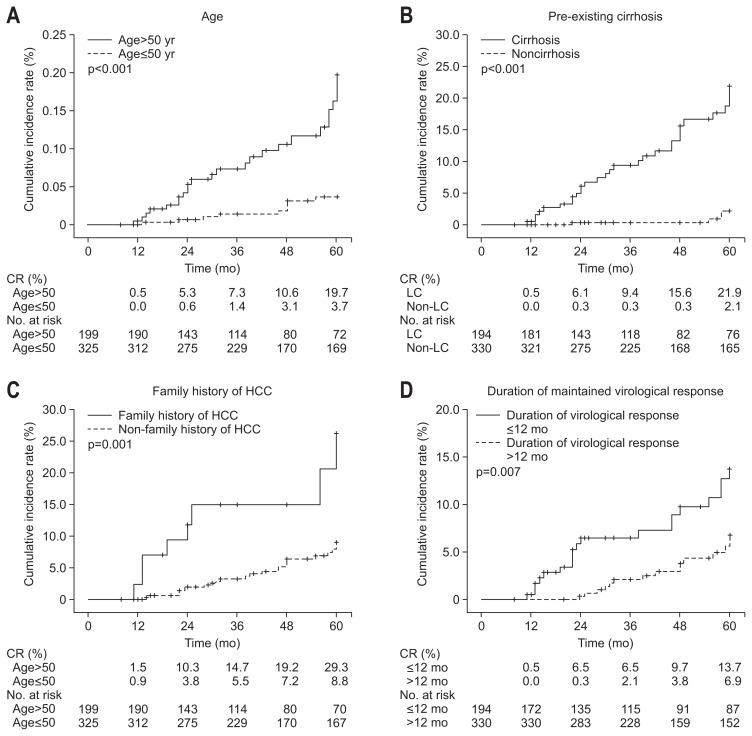
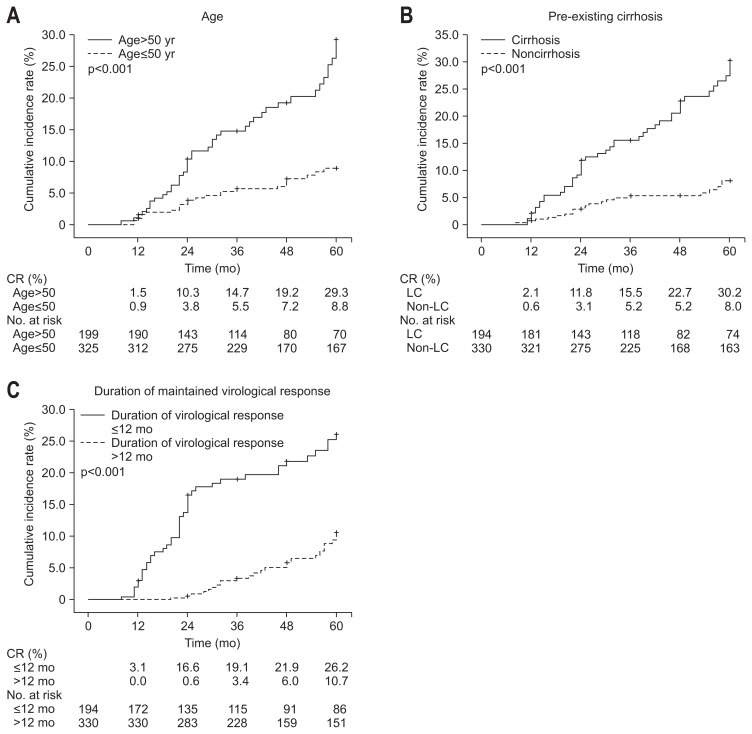
For the 524 patients, the cumulative probabilities of disease progression and HCC development at 1, 2, 3, 4 and 5 years were 1.1%, 6.3%, 9.0%, 11.6%, and 16.2% and 0.2%, 1.8%, 3.6%, 5.8%, and 9.3%, respectively. In multivariate analysis, age >50 years (hazard ratio [HR], 1.05) and cirrhosis (HR, 2.95) were significant factors for disease progression. Similarly, age >50 years (HR, 1.05), family history of HCC (HR, 5.48), and cirrhosis (HR, 17.16) were significant factors for HCC development. Importantly, longer duration (>12 months) of maintained virological response (<20 IU/mL) reduced the risks of disease progression (HR, 0.19) and HCC development (HR, 0.09).
Longer duration of maintained virological response significantly reduces the risk of disease progression or HCC development in CHB patients undergoing long-term oral NA therapy.
背景/目的:我们研究了慢性乙型肝炎(CHB)患者在长期口服核苷(酸)类似物(NA)治疗期间与疾病进展及肝细胞癌(HCC)发生相关的因素。
这项回顾性研究纳入了524例初治CHB患者,这些患者在2003年1月至2007年12月期间接受了超过48周的口服NA治疗。主要结局是疾病进展和HCC发生的5年累积概率。疾病进展定义为肝硬化形成、肝硬化并发症、HCC或肝脏相关死亡。
对于这524例患者,1年、2年、3年、4年和5年时疾病进展和HCC发生的累积概率分别为1.1%、6.3%、9.0%、11.6%和16.2%以及0.2%、1.8%、3.6%、5.8%和9.3%。多因素分析中,年龄>50岁(风险比[HR],1.05)和肝硬化(HR,2.95)是疾病进展的显著因素。同样,年龄>50岁(HR,1.05)、HCC家族史(HR,5.48)和肝硬化(HR,17.16)是HCC发生的显著因素。重要的是,持续病毒学应答(<20 IU/mL)持续时间较长(>12个月)可降低疾病进展(HR,0.19)和HCC发生(HR,0.09)的风险。
持续病毒学应答持续时间较长可显著降低接受长期口服NA治疗的CHB患者疾病进展或HCC发生的风险。