Division of Gastroenterology, Department of Internal Medicine, Faculty of Medicine, College of Medicine, Kaohsiung, Taiwan ; Department of Internal Medicine, Faculty of Medicine, College of Medicine, Kaohsiung Municipal Hsiao-Kang Hospital, Kaohsiung, Taiwan.
Department of Emergency Medicine, Kaohsiung Municipal Hsiao-Kang Hospital, Kaohsiung, Taiwan ; Graduate Institute of Clinical Medicine, College of Medicine, Kaohsiung Medical University Hospital, Kaohsiung, Taiwan ; Division of Gastroenterology and General Surgery, Department of Surgery, Kaohsiung Medical University Hospital, Kaohsiung, Taiwan.
Onco Targets Ther. 2014 Nov 21;7:2143-6. doi: 10.2147/OTT.S69774. eCollection 2014.
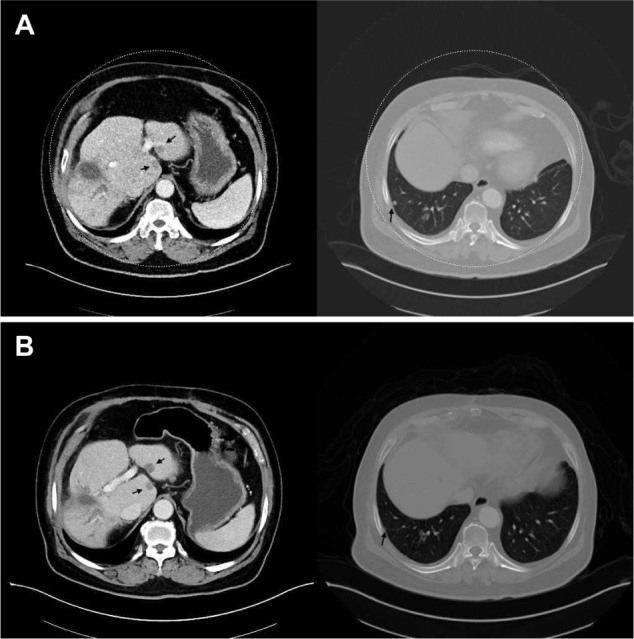
Here we report a case of metastatic colon cancer treated with 5-fluorouracil, leucovorin, and escalated doses of irinotecan (FOLFIRI) combined with regorafenib in the fourth-line setting after uridine diphosphate glucuronosyltransferase (UGT)1A1 genotyping analysis. A 66-year-old male was initially diagnosed with Union Internationale Contre le Cancer stage III descending colon cancer and underwent curative surgery. He received postoperative adjuvant chemotherapy; however, liver metastasis developed and a partial hepatectomy was performed thereafter. Unfortunately, pulmonary metastases and recurrent liver tumors were found despite a series of systemic treatments with multiple combinations of cytotoxic and biologic agents. Recently, a novel multikinase inhibitor, regorafenib, was approved for the treatment of metastatic colorectal cancer refractory to other therapeutic modalities. As further treatment, we combined regorafenib with FOLFIRI, which included dose escalations of irinotecan, after UGT1A1 genotyping analysis. The therapeutic results were promising, with the improvement in liver and pulmonary metastases being classified as stable disease and partial response, respectively. Moreover, the progression-free survival was over 6 months. FOLFIRI, with dose escalation of irinotecan according to UGT1A1 genotyping plus regorafenib appears to be a promising salvage therapy for patients with refractory metastatic colorectal cancer.
在这里,我们报告了一例转移性结肠癌病例,该患者在 UGT1A1 基因分型分析后,在四线治疗中接受了氟尿嘧啶、亚叶酸钙和伊立替康(FOLFIRI)联合瑞戈非尼治疗。一名 66 岁男性最初被诊断为国际抗癌联盟(UICC)III 期降结肠癌,并接受了根治性手术。他接受了术后辅助化疗;然而,此后出现了肝转移,并进行了部分肝切除术。不幸的是,尽管采用了多种细胞毒性和生物制剂的联合方案进行了一系列全身治疗,但仍发现了肺转移和复发性肝肿瘤。最近,一种新型多激酶抑制剂瑞戈非尼被批准用于治疗其他治疗方法耐药的转移性结直肠癌。作为进一步的治疗,我们在 UGT1A1 基因分型分析后,将瑞戈非尼与 FOLFIRI 联合使用,其中包括伊立替康剂量的增加。治疗结果令人鼓舞,肝和肺转移的改善分别被归类为稳定疾病和部分缓解。此外,无进展生存期超过 6 个月。根据 UGT1A1 基因分型增加伊立替康剂量的 FOLFIRI 联合瑞戈非尼似乎是治疗难治性转移性结直肠癌患者的一种有前途的挽救疗法。