Brameyer Sophie, Kresovic Darko, Bode Helge B, Heermann Ralf
Bereich Mikrobiologie, Biozentrum, Ludwig-Maximilians-Universität München München, Germany.
Fachbereich Biowissenschaften, Merck Stiftungsprofessur für Molekulare Biotechnologie, Goethe-Universität Frankfurt Frankfurt am Main, Germany.
Front Cell Infect Microbiol. 2014 Nov 18;4:166. doi: 10.3389/fcimb.2014.00166. eCollection 2014.
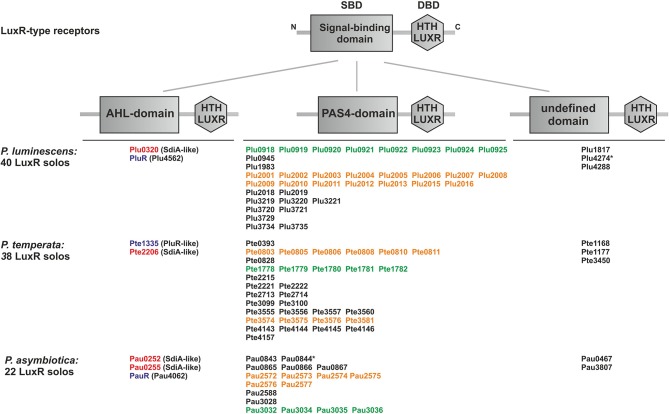
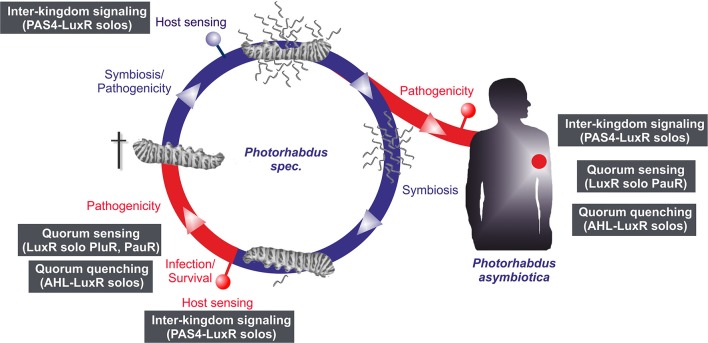
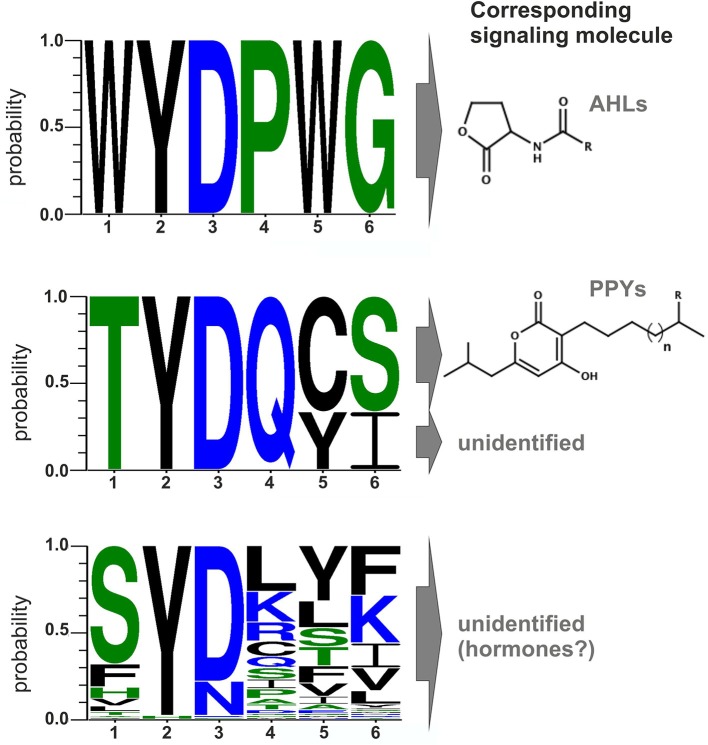
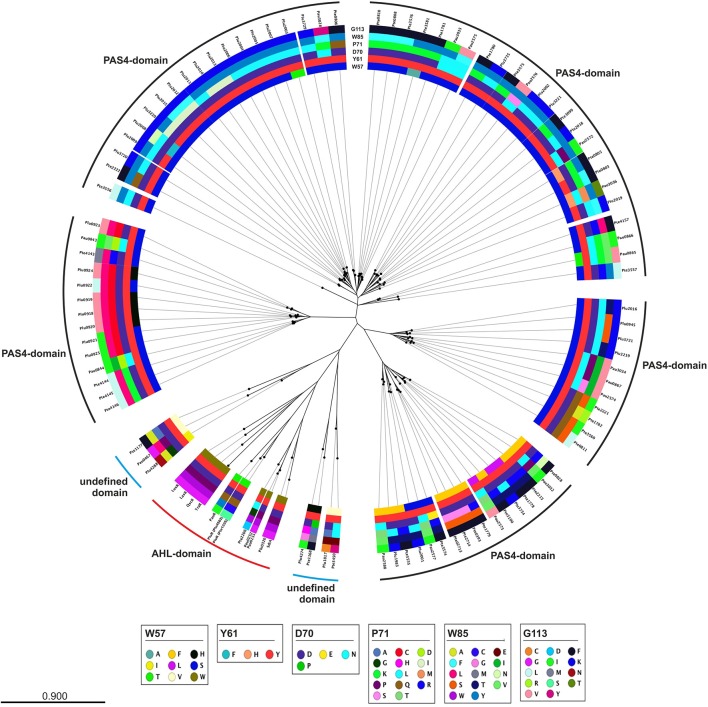
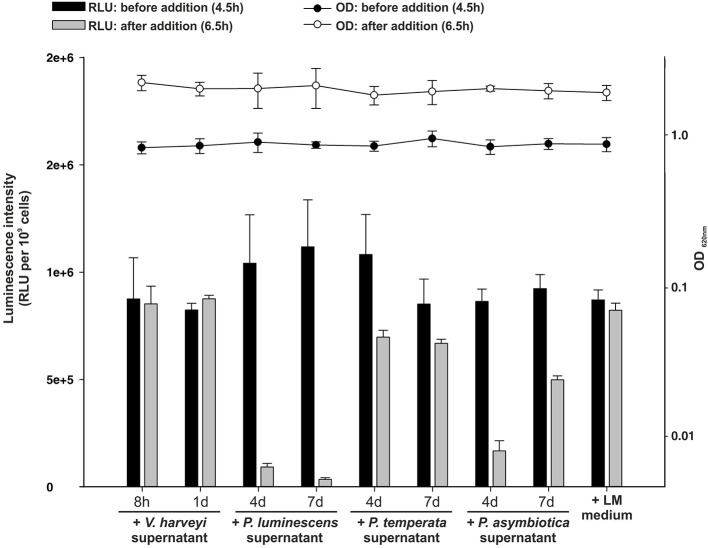
Bacteria communicate via small diffusible molecules to mediate group-coordinated behavior, a process designated as quorum sensing. The basic molecular quorum sensing system of Gram-negative bacteria consists of a LuxI-type autoinducer synthase producing acyl-homoserine lactones (AHLs) as signaling molecules, and a LuxR-type receptor detecting the AHLs to control expression of specific genes. However, many proteobacteria possess one or more unpaired LuxR-type receptors that lack a cognate LuxI-like synthase, referred to as LuxR solos. The enteric and insect pathogenic bacteria of the genus Photorhabdus harbor an extraordinarily high number of LuxR solos, more than any other known bacteria, and all lack a LuxI-like synthase. Here, we focus on the presence and the different types of LuxR solos in the three known Photorhabdus species using bioinformatics analyses. Generally, the N-terminal signal-binding domain (SBD) of LuxR-type receptors sensing AHLs have a motif of six conserved amino acids that is important for binding and specificity of the signaling molecule. However, this motif is altered in the majority of the Photorhabdus-specific LuxR solos, suggesting the use of other signaling molecules than AHLs. Furthermore, all Photorhabdus species contain at least one LuxR solo with an intact AHL-binding motif, which might allow the ability to sense AHLs of other bacteria. Moreover, all three species have high AHL-degrading activity caused by the presence of different AHL-lactonases and AHL-acylases, revealing a high quorum quenching activity against other bacteria. However, the majority of the other LuxR solos in Photorhabdus have a N-terminal so-called PAS4-domain instead of an AHL-binding domain, containing different amino acid motifs than the AHL-sensors, which potentially allows the recognition of a highly variable range of signaling molecules that can be sensed apart from AHLs. These PAS4-LuxR solos are proposed to be involved in host sensing, and therefore in inter-kingdom signaling. Overall, Photorhabdus species are perfect model organisms to study bacterial communication via LuxR solos and their role for a symbiotic and pathogenic life style.
细菌通过可扩散的小分子进行通讯,以介导群体协调行为,这一过程被称为群体感应。革兰氏阴性菌的基本分子群体感应系统由产生酰基高丝氨酸内酯(AHLs)作为信号分子的LuxI型自诱导物合酶和检测AHLs以控制特定基因表达的LuxR型受体组成。然而,许多变形菌拥有一个或多个没有同源LuxI样合酶的未配对LuxR型受体,称为孤独型LuxR。发光杆菌属的肠道和昆虫致病细菌含有数量异常多的孤独型LuxR,比任何其他已知细菌都多,并且都缺乏LuxI样合酶。在这里,我们使用生物信息学分析,重点研究三种已知发光杆菌物种中孤独型LuxR的存在情况和不同类型。一般来说,感应AHLs的LuxR型受体的N端信号结合结构域(SBD)有一个由六个保守氨基酸组成的基序,这对于信号分子的结合和特异性很重要。然而,在大多数发光杆菌属特异性孤独型LuxR中,这个基序发生了改变,这表明它们使用的信号分子不是AHLs。此外,所有发光杆菌物种都至少含有一个具有完整AHL结合基序的孤独型LuxR,这可能使其能够感应其他细菌的AHLs。此外,所有这三个物种都因存在不同的AHL内酯酶和AHL酰基酶而具有较高的AHL降解活性,这表明它们对其他细菌具有较高的群体猝灭活性。然而,发光杆菌中大多数其他孤独型LuxR具有N端所谓的PAS4结构域,而不是AHL结合结构域,其包含与AHL传感器不同的氨基酸基序,这可能允许识别除AHLs之外的高度可变范围的信号分子。这些PAS4-孤独型LuxR被认为参与宿主感应,因此参与跨王国信号传导。总体而言,发光杆菌物种是研究通过孤独型LuxR进行细菌通讯及其在共生和致病生活方式中作用的完美模式生物。