Gill Kamraan Z, Iwamoto Fabio, Allen Ashleigh, Hoehn Daniela, Murty Vundavalli V, Alobeid Bachir, Bhagat Govind
Department of Pathology and Cell Biology, Columbia University Medical Center, New York, NY, 10032, United States of America.
Department of Neurology, Columbia University Medical Center, New York, NY, 10032, United States of America.
PLoS One. 2014 Dec 5;9(12):e114398. doi: 10.1371/journal.pone.0114398. eCollection 2014.
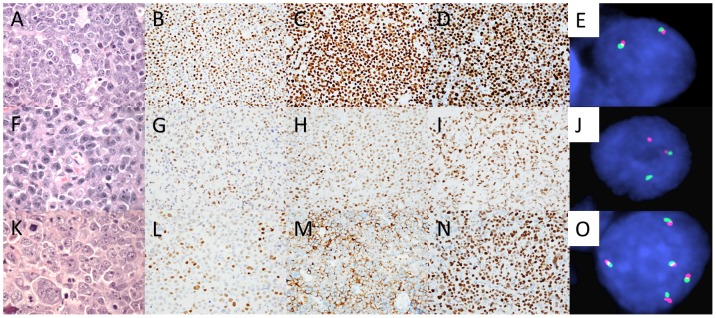
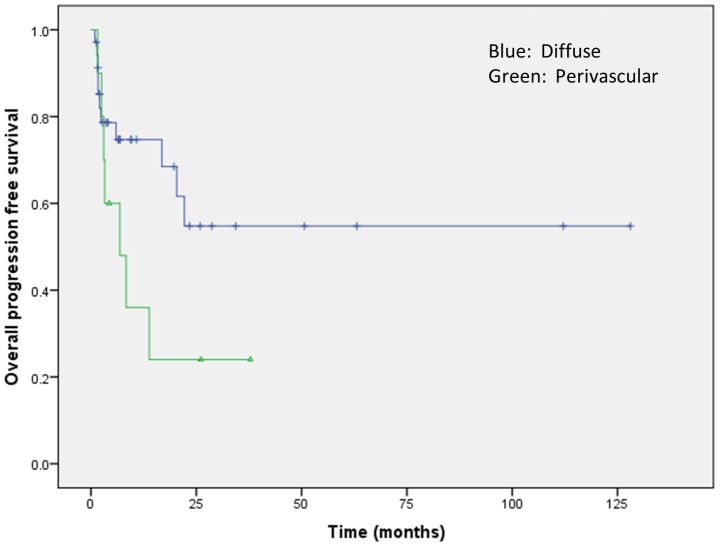
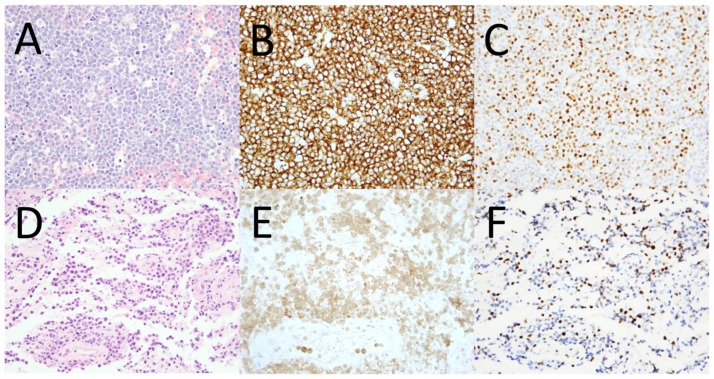
Primary diffuse large B-cell lymphoma of the central nervous system (CNS DLBCL) is a rare, aggressive subtype of DLBCL, the biology of which is poorly understood. Recent studies have suggested a prognostic role of MYC protein expression in systemic DLBCL, but little is known about the frequency and significance of MYC protein expression in CNS DLBCL. Hence, we investigated MYC protein expression profiles of CNS DLBCL and assessed the relationship between MYC expression and a variety of histopathologic, immunophenotypic, genetic, and clinical features. Fifty-nine CNS DLBCL diagnosed at our institution over the past 13 years were evaluated. The majority of cases (80%) showed centroblastic morphology, and 12 (20%) displayed a perivascular pattern of infiltration. According to the Hans criteria, 41 (69%) cases had a non-germinal center B-cell and 18 (31%) had a germinal center B-cell cell-of-origin (COO) phenotype. Mean MYC protein expression was 50% (median: 50%, range: 10-80%). Forty-three cases (73%) showed MYC overexpression (≥ 40%), and 35 (60%) showed MYC/BCL2 coexpression. MYC overexpression was seen in the single case harboring MYC translocation and in the cases showing increased copies of MYC (27%); however, no significant difference in mean MYC expression was seen between groups harboring or lacking MYC aberrations. In our series, age was associated with a significantly increased risk of death, and the perivascular pattern of infiltration was associated with a significantly increased risk of disease progression. Neither MYC expression (with or without BCL2 coexpression) nor other variables, including COO subtype were predictive of clinical outcome. Our findings indicate that the proportion of CNS DLBCL overexpressing MYC is higher compared to systemic DLBCL, and MYC overexpression appears to be independent of genetic MYC abnormalities. Thus, MYC expression and other immunophenotypic markers used for prognostication of systemic DLBCL might not apply to CNS DLBCL due to differences in disease biology.
原发性中枢神经系统弥漫性大B细胞淋巴瘤(CNS DLBCL)是弥漫性大B细胞淋巴瘤(DLBCL)中一种罕见的侵袭性亚型,其生物学特性尚不清楚。最近的研究表明MYC蛋白表达在系统性DLBCL中具有预后作用,但对于CNS DLBCL中MYC蛋白表达的频率和意义知之甚少。因此,我们研究了CNS DLBCL的MYC蛋白表达谱,并评估了MYC表达与各种组织病理学、免疫表型、遗传学和临床特征之间的关系。对过去13年在我们机构诊断的59例CNS DLBCL进行了评估。大多数病例(80%)表现为中心母细胞形态,12例(20%)表现为血管周围浸润模式。根据汉斯标准,41例(69%)病例具有非生发中心B细胞,18例(31%)具有生发中心B细胞起源(COO)表型。MYC蛋白平均表达为50%(中位数:50%,范围:10 - 80%)。43例(73%)显示MYC过表达(≥40%),35例(60%)显示MYC/BCL2共表达。在携带MYC易位的单个病例和显示MYC拷贝数增加的病例(27%)中观察到MYC过表达;然而,在携带或不携带MYC异常的组之间,MYC平均表达没有显著差异。在我们的系列研究中,年龄与死亡风险显著增加相关,血管周围浸润模式与疾病进展风险显著增加相关。MYC表达(无论有无BCL2共表达)以及其他变量,包括COO亚型,均不能预测临床结局。我们的研究结果表明,与系统性DLBCL相比,CNS DLBCL中过表达MYC的比例更高,并且MYC过表达似乎独立于MYC基因异常。因此,由于疾病生物学的差异,用于系统性DLBCL预后评估的MYC表达和其他免疫表型标志物可能不适用于CNS DLBCL。