Pusuroglu Hamdi, Akgul Ozgur, Cakmak Huseyin Altug, Erturk Mehmet, Surgit Ozgur, Celik Omer, Ozturk Derya, Uzun Fatih, Akkaya Emre, Yildirim Aydın
Department of Cardiology, Mehmet Akif Ersoy Thoracic and Cardiovascular Surgery Training and Research Hospital, Istanbul, Turkey.
Postepy Kardiol Interwencyjnej. 2014;10(3):166-74. doi: 10.5114/pwki.2014.45143. Epub 2014 Sep 11.
Many studies have reported the diagnostic and prognostic value of haemoglobin A1c (HbA1c) levels in patients with acute coronary syndrome. However, the short- and long-term prognostic value of HbA1c level in patients with ST elevation myocardial infarction (STEMI) undergoing percutaneous coronary intervention (PCI) is controversial.
To investigate whether admission HbA1c level has a prognostic value for in-hospital, short-, and long-term cardiovascular (CV) mortality and major adverse cardiovascular events in patients with STEMI undergoing primary PCI.
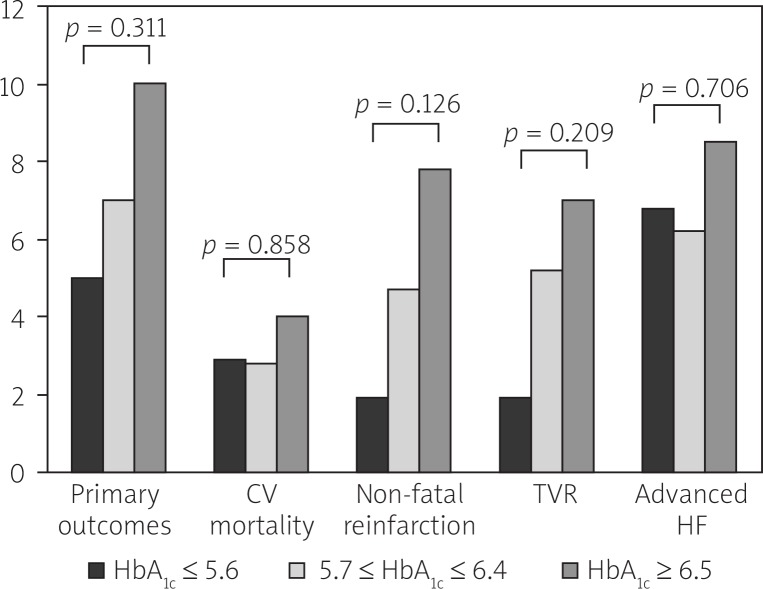
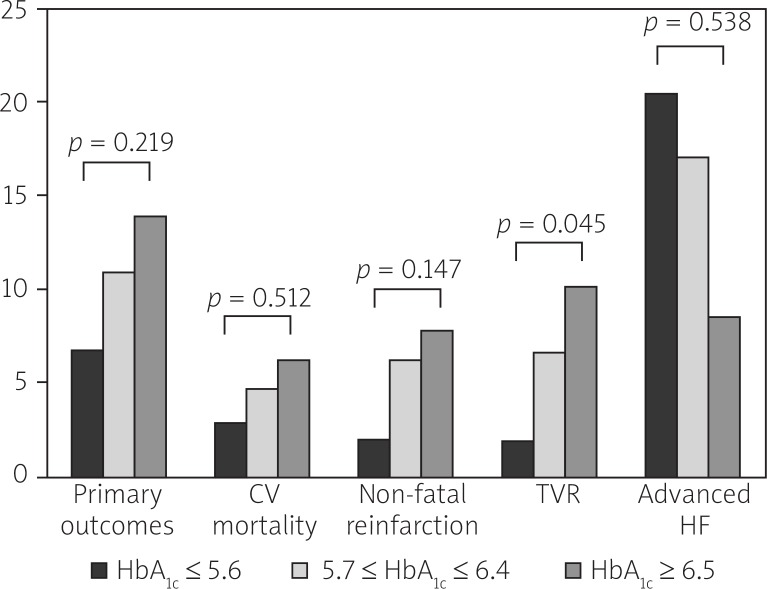
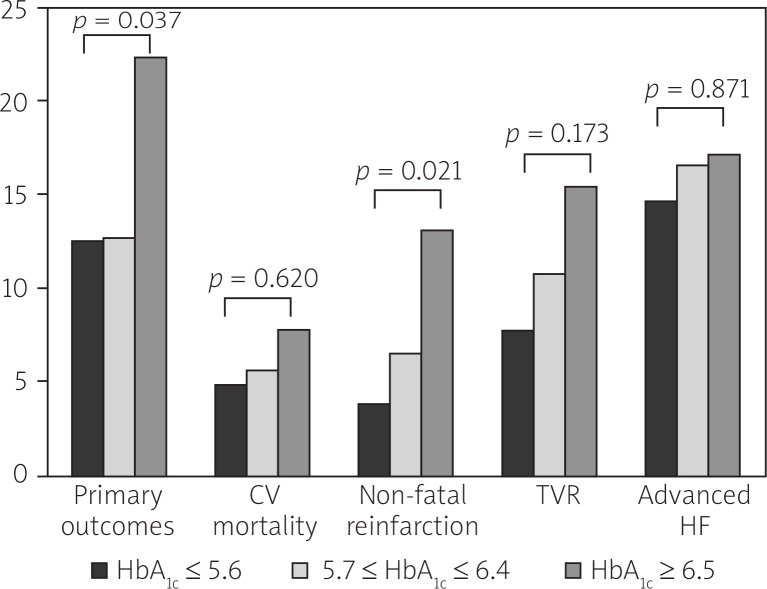
This prospective study included 443 consecutive patients with STEMI who underwent primary PCI between September 2010 and July 2012. The patients were divided into three groups based on admission HbA1c levels: group I (HbA1c ≤ 5.6%), group II (HbA1c 5.7-6.4%), and group III (HbA1c ≥ 6.5%). The in-hospital, 1-month, and 1-year CV events of all 3 patient groups were followed up.
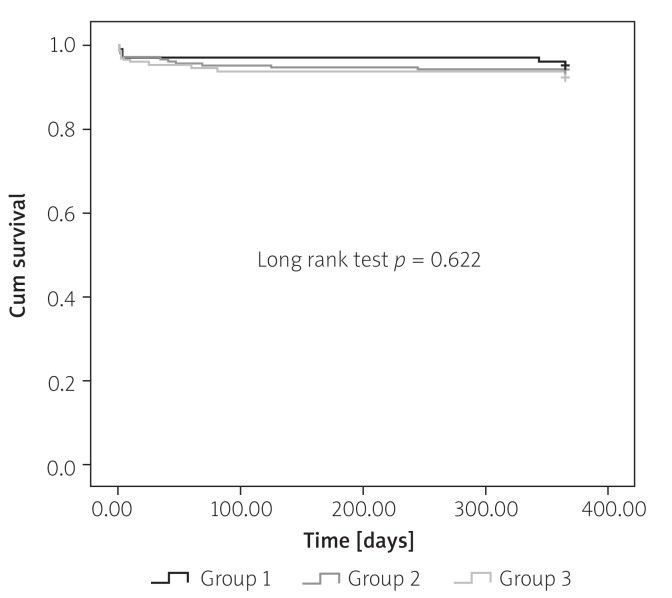
A significant association was found between HbA1c level and 1-year primary clinical outcomes, including CV mortality, non-fatal reinfarction, and stroke (p = 0.037). In addition, age, Killip class > 1, and left ventricular ejection fraction were found to be independent predictors of long-term CV mortality in multivariate analysis (hazard ratios (95% confidence interval) 1.081 (1.020-1.146), 4.182 (1.171-14.935), and 0.832 (0.752-0.920); p = 0.009, p = 0.028, and p < 0.001, respectively).
In this study, we demonstrated that increased admission HbA1c levels were associated with higher rates of major adverse CV events, including mortality, non-fatal reinfarction, and stroke, in patients with STEMI who underwent primary PCI.
许多研究报告了血红蛋白A1c(HbA1c)水平在急性冠状动脉综合征患者中的诊断和预后价值。然而,HbA1c水平在接受经皮冠状动脉介入治疗(PCI)的ST段抬高型心肌梗死(STEMI)患者中的短期和长期预后价值存在争议。
探讨入院时HbA1c水平对接受直接PCI的STEMI患者院内、短期和长期心血管(CV)死亡率及主要不良心血管事件是否具有预后价值。
这项前瞻性研究纳入了2010年9月至2012年7月期间连续443例行直接PCI的STEMI患者。根据入院时HbA1c水平将患者分为三组:I组(HbA1c≤5.6%),II组(HbA1c 5.7 - 6.4%),III组(HbA1c≥6.5%)。对所有3组患者的院内、1个月和1年的CV事件进行随访。
发现HbA1c水平与1年主要临床结局之间存在显著关联,包括CV死亡率、非致命性再梗死和中风(p = 0.037)。此外,在多变量分析中,年龄、Killip分级>1和左心室射血分数被发现是长期CV死亡率的独立预测因素(风险比(95%置信区间)分别为1.081(1.020 - 1.146)、4.182(1.171 - 14.935)和0.832(0.752 - 0.920);p = 0.009、p = 0.028和p < 0.001)。
在本研究中,我们证明,在接受直接PCI的STEMI患者中,入院时HbA1c水平升高与包括死亡率、非致命性再梗死和中风在内的主要不良CV事件发生率较高相关。