Lyu Yanyu, Mirea Lucia, Yang Junmin, Warre Ruth, Zhang Jun, Lee Shoo K, Li Zhu
Department of Child Health Development, Capital Institute of Pediatrics, Beijing, China.
School of Public Health, Peking University Health Science Center, Beijing, China.
BMC Womens Health. 2014 Dec 12;14:155. doi: 10.1186/s12905-014-0155-0.
Improvements in socioeconomic conditions and population health have been linked to declining age at menarche. In China, secular trends in age at menarche following extensive economic reform during recent decades have not been thoroughly investigated. This study examined the overall trend in age at menarche and assessed differences in the rate of change of age at menarche over time, and between urban and rural populations and education levels in southeastern China.
Age at menarche was retrospectively collected from 1,167,119 Han Chinese women born 1955-1985, who registered in the Perinatal Health Care Surveillance System in 19 cities and counties in two southeast provinces during 1993-2005. Multivariable linear regression was used to estimate trends in age at menarche overall and stratified by urban/rural residence and education level.
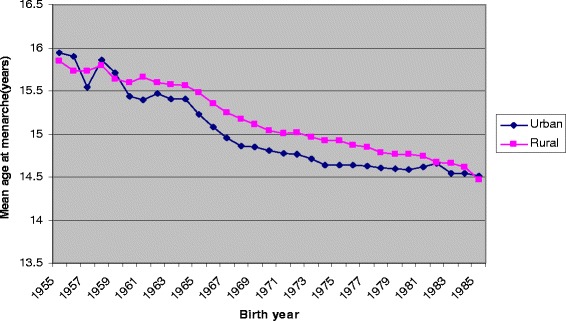
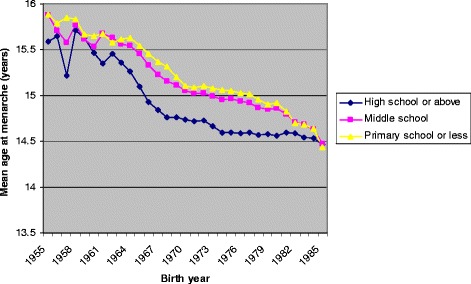
Age at menarche declined by 0.33 [95% CI 0.33, 0.32] years/decade overall, with the fastest decline in women born in 1966-1975. For the earliest birth cohorts (1955-1965), age at menarche declined faster in urban versus rural regions, and for women with high school education or above versus primary school or less. In contrast, age at menarche declined slower among urban women born 1976-1985, and among those with higher education born 1966-1985.
Mean age at menarche declined for women born in 1955-1985 in southeast China. Further study is warranted to identify specific factors contributing to earlier age at menarche and associated health outcomes.
社会经济条件和人口健康状况的改善与初潮年龄下降有关。在中国,近几十年来广泛经济改革后初潮年龄的长期趋势尚未得到充分研究。本研究考察了初潮年龄的总体趋势,并评估了初潮年龄随时间变化的速率差异,以及中国东南部城乡人口和教育水平之间的差异。
回顾性收集了1993年至2005年期间在东南部两个省份的19个市县围产期保健监测系统中登记的1167119名1955年至1985年出生的汉族女性的初潮年龄。采用多变量线性回归来估计初潮年龄的总体趋势以及按城乡居住地和教育水平分层的趋势。
初潮年龄总体上以每十年0.33[95%置信区间0.33,0.32]岁的速度下降,1966年至1975年出生的女性下降最快。对于最早的出生队列(1955年至1965年),城市地区初潮年龄的下降速度快于农村地区,高中及以上学历女性快于小学及以下学历女性。相比之下,1976年至1985年出生的城市女性以及1966年至1985年出生的高学历女性初潮年龄下降较慢。
中国东南部1955年至1985年出生的女性初潮平均年龄下降。有必要进一步研究以确定导致初潮年龄提前的具体因素及其相关健康结果。