Myung Jae Kyung, Cho Hwa Jin, Kim Hanna, Park Chul-Kee, Lee Se Hoon, Choi Seung Hong, Park Peom, Yoon Jung Min, Park Sung-Hye
Department of Pathology, Korea Institute of Radiological and Medical Science, Seoul, Republic of Korea.
Department of Pathology, Seoul National University Hospital, College of Medicine, Seoul, Republic of Korea.
Transl Oncol. 2014 Dec;7(6):712-9. doi: 10.1016/j.tranon.2014.10.002.
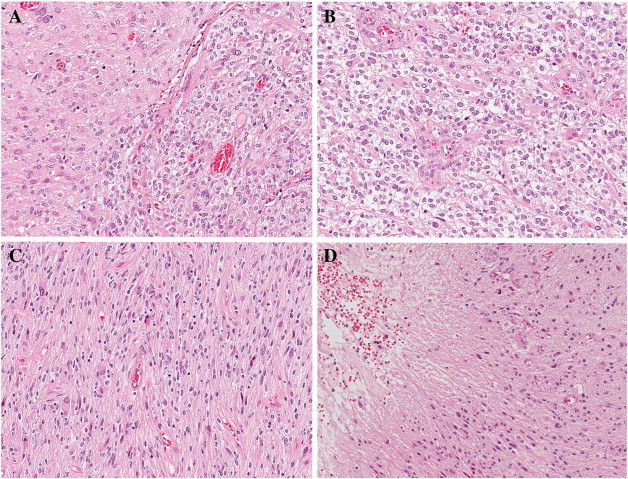
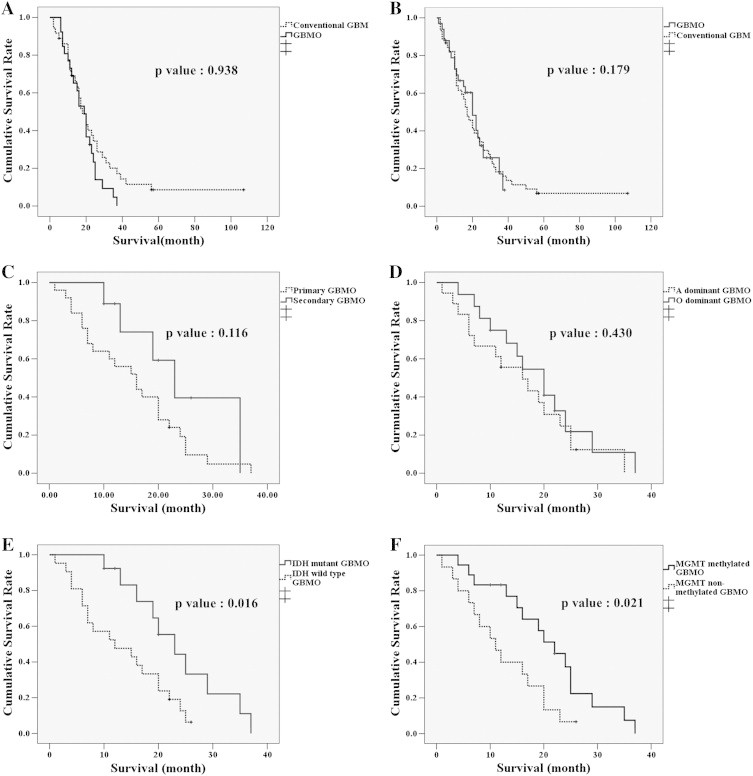
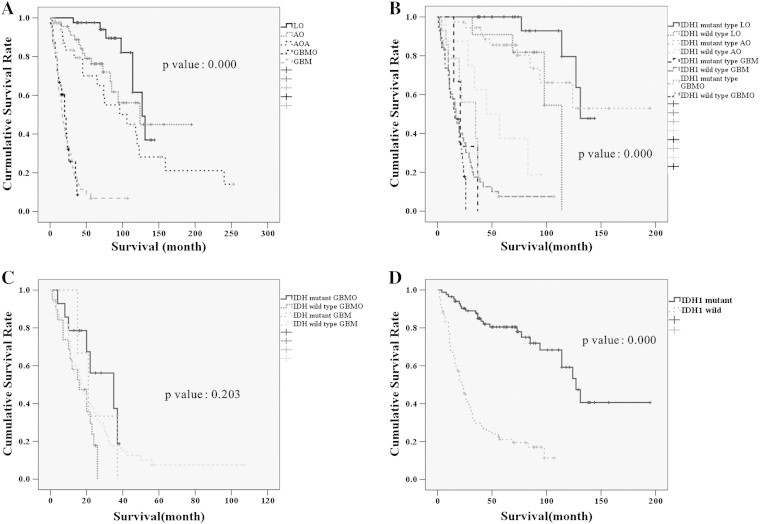
Glioblastoma (GBM) with oligodendroglioma component (GBMO) is a newly described GBM subtype in the 2007 World Health Organization classification. However, its biological and genetic characteristics are largely unknown. We investigated the clinicopathological and molecular features of 34 GBMOs and compared the survival rate of these patients with those of patients with astrocytoma, oligodendroglioma, anaplastic oligoastrocytoma (AOA), and conventional GBMs in our hospital. GBMO could be divided into two groups based on the presence of an IDH1 mutation. The IDH1 mutation was more frequently found in secondary GBMO, which had lower frequencies of EGFR amplification but higher MGMT methylation than the wild type IDH1 group, and patients with mutant IDH1 GBMO were on average younger than those with wild-type IDH1. Therefore, GBMO is a clinically and molecularly heterogeneous subtype, largely belonging to a proneural and classical subtype of GBM. The survival rate of GBMO patients itself was worse than that of AOA patients but not significantly better than that of conventional GBM patients. GBMO survival was independent of the dominant histopathological subtype i.e., astrocyte-dominant or oligodendroglioma -dominant, but it was significantly associated with the IDH1 mutation and MGMT methylation status. Therefore, GBMO should be regarded as a separate entity from AOA and must be classified as a subtype of GBM. However, further study is needed to determine whether it is a pathologic variant or a pattern of GBM because GBMO has a similar prognosis to conventional GBMs.
伴有少突胶质细胞瘤成分的胶质母细胞瘤(GBMO)是2007年世界卫生组织分类中新描述的一种胶质母细胞瘤亚型。然而,其生物学和遗传学特征在很大程度上尚不清楚。我们研究了34例GBMO的临床病理和分子特征,并将这些患者的生存率与我院星形细胞瘤、少突胶质细胞瘤、间变性少突星形细胞瘤(AOA)和传统胶质母细胞瘤患者的生存率进行了比较。根据是否存在异柠檬酸脱氢酶1(IDH1)突变,GBMO可分为两组。IDH1突变在继发性GBMO中更常见,与野生型IDH1组相比,其表皮生长因子受体(EGFR)扩增频率较低,但O6-甲基鸟嘌呤-DNA甲基转移酶(MGMT)甲基化频率较高,且IDH1突变型GBMO患者的平均年龄低于野生型IDH1患者。因此,GBMO是一种临床和分子异质性亚型,主要属于胶质母细胞瘤的神经干细胞样和经典亚型。GBMO患者本身的生存率比AOA患者差,但不比传统胶质母细胞瘤患者显著更好。GBMO的生存与主要组织病理学亚型无关,即星形细胞为主型或少突胶质细胞瘤为主型,但与IDH1突变和MGMT甲基化状态显著相关。因此,GBMO应被视为与AOA不同的实体,必须归类为胶质母细胞瘤的一个亚型。然而,由于GBMO的预后与传统胶质母细胞瘤相似,因此需要进一步研究以确定它是一种病理变异还是胶质母细胞瘤的一种类型。