Albrecht Christina, Malzahn Dörthe, Brameier Markus, Hermes Meike, Ansari Aftab A, Walter Lutz
Primate Genetics Laboratory, German Primate Center, Leibniz-Institute for Primate Research , Göttingen , Germany.
Department of Genetic Epidemiology, University Medical Center, Georg-August-University , Göttingen , Germany.
Front Immunol. 2014 Nov 28;5:600. doi: 10.3389/fimmu.2014.00600. eCollection 2014.
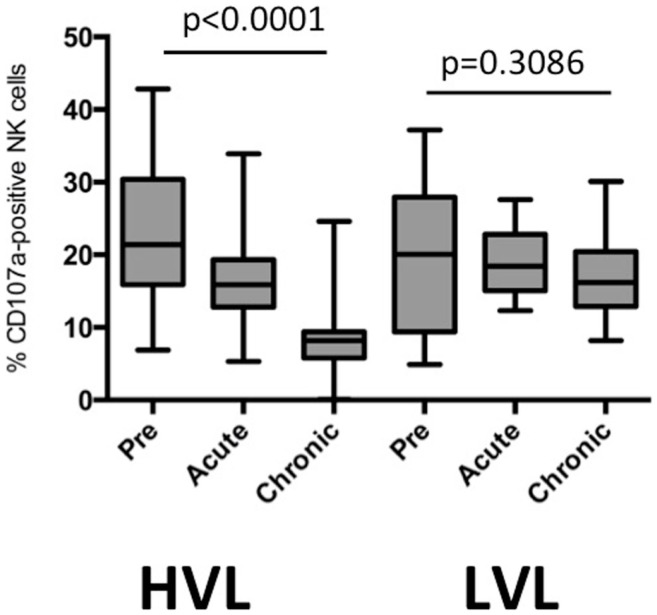
Killer cell immunoglobulin-like receptors (KIR) regulate the activity of natural killer (NK) cells and have been shown to be associated with susceptibility to a number of human infectious diseases. Here, we analyzed NK cell function and genetic associations in a cohort of 52 rhesus macaques experimentally infected with SIVmac and subsequently stratified into high viral load (HVL) and low viral load (LVL) plasma viral loads at set point. This stratification coincided with fast (HVL) and slow (LVL) disease progression indicated by the disease course and critical clinical parameters including CD4+ T cell counts. HVL animals revealed sustained proliferation of NK cells but distinct loss of peripheral blood NK cell numbers and lytic function. Genetic analyses revealed that KIR genes 3DL05, 3DS05, and 3DL10 as well as 3DSW08, 3DLW03, and 3DSW09 are correlated, most likely due to underlying haplotypes. SIV-infection outcome associated with presence of transcripts for two inhibitory KIR genes (KIR3DL02, KIR3DL10) and three activating KIR genes (KIR3DSW08, KIR3DS02, KIR3DS05). Presence of KIR3DL02 and KIR3DSW08 was associated with LVL outcome, whereas presence of KIR3DS02 was associated with HVL outcome. Furthermore, we identified epistasis between KIR and MHC class I alleles as the transcript presence of the correlated genes KIR3DL05, KIR3DS05, and KIR3DL10 increased HVL risk when Mamu-B012 transcripts were also present or when Mamu-A1001 transcripts were absent. These genetic associations were mirrored by changes in the numbers, the level of proliferation, and lytic capabilities of NK cells as well as overall survival time and gastro-intestinal tissue viral load.
杀伤细胞免疫球蛋白样受体(KIR)调节自然杀伤(NK)细胞的活性,并且已被证明与多种人类传染病的易感性相关。在此,我们分析了52只恒河猴组成的队列中的NK细胞功能和基因关联,这些恒河猴经实验感染了SIVmac,随后在设定点被分层为高病毒载量(HVL)和低病毒载量(LVL)血浆病毒载量。这种分层与疾病进程和包括CD4 + T细胞计数在内的关键临床参数所表明的快速(HVL)和缓慢(LVL)疾病进展相一致。HVL动物显示NK细胞持续增殖,但外周血NK细胞数量和裂解功能明显丧失。基因分析表明,KIR基因3DL05、3DS05和3DL10以及3DSW08、3DLW03和3DSW09是相关的,最有可能是由于潜在的单倍型。SIV感染结果与两个抑制性KIR基因(KIR3DL02、KIR3DL10)和三个激活性KIR基因(KIR3DSW08、KIR3DS02、KIR3DS05)的转录本存在相关。KIR3DL02和KIR3DSW08的存在与LVL结果相关,而KIR3DS02的存在与HVL结果相关。此外,我们确定了KIR与MHC I类等位基因之间的上位性,因为当Mamu - B012转录本也存在或Mamu - A1001转录本不存在时,相关基因KIR3DL05、KIR3DS05和KIR3DL10的转录本存在会增加HVL风险。这些基因关联反映在NK细胞的数量、增殖水平和裂解能力以及总体生存时间和胃肠道组织病毒载量的变化上。