van Buul Laura W, van der Steen Jenny T, Doncker Sarah M M M, Achterberg Wilco P, Schellevis François G, Veenhuizen Ruth B, Hertogh Cees M P M
EMGO Institute for Health and Care Research, VU University Medical Center, Van der Boechorststraat 7, 1081 BT Amsterdam, the Netherlands.
BMC Geriatr. 2014 Dec 16;14:136. doi: 10.1186/1471-2318-14-136.
Insight into factors that influence antibiotic prescribing is crucial when developing interventions aimed at a more rational use of antibiotics. We examined factors that influence antibiotic prescribing in long-term care facilities, and present a conceptual model that integrates these factors.
Semi-structured qualitative interviews were conducted with physicians (n = 13) and nursing staff (n = 13) in five nursing homes and two residential care homes in the central-west region of the Netherlands. An iterative analysis was applied to interviews with physicians to identify and categorize factors that influence antibiotic prescribing, and to integrate these into a conceptual model. This conceptual model was triangulated with the perspectives of nursing staff.
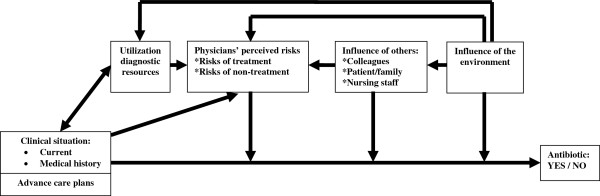
The analysis resulted in the identification of six categories of factors that can influence the antibiotic prescribing decision: the clinical situation, advance care plans, utilization of diagnostic resources, physicians' perceived risks, influence of others, and influence of the environment. Each category comprises several factors that may influence the decision to prescribe or not prescribe antibiotics directly (e.g. pressure of patients' family leading to antibiotic prescribing) or indirectly via influence on other factors (e.g. unfamiliarity with patients resulting in a higher physician perceived risk of non-treatment, in turn resulting in a higher tendency to prescribe antibiotics).
Our interview study shows that several non-rational factors may affect antibiotic prescribing decision making in long-term care facilities, suggesting opportunities to reduce inappropriate antibiotic use. We developed a conceptual model that integrates the identified categories of influencing factors and shows the relationships between those categories. This model may be used as a practical tool in long-term care facilities to identify local factors potentially leading to inappropriate prescribing, and to subsequently intervene at the level of those factors to promote appropriate antibiotic prescribing.
在制定旨在更合理使用抗生素的干预措施时,深入了解影响抗生素处方的因素至关重要。我们研究了影响长期护理机构抗生素处方的因素,并提出了一个整合这些因素的概念模型。
对荷兰中西部地区五家养老院和两家住宅护理机构的医生(n = 13)和护理人员(n = 13)进行了半结构化定性访谈。对医生的访谈采用迭代分析方法,以识别和分类影响抗生素处方的因素,并将其整合到一个概念模型中。该概念模型与护理人员的观点进行了三角验证。
分析确定了六类可影响抗生素处方决策的因素:临床情况、预先护理计划、诊断资源的利用、医生感知的风险、他人的影响以及环境的影响。每一类都包含几个可能直接影响是否开具抗生素处方决策的因素(例如患者家属的压力导致开具抗生素处方),或通过对其他因素的影响间接影响决策(例如对患者不熟悉导致医生感知到更高的不治疗风险,进而导致更高的开具抗生素处方倾向)。
我们的访谈研究表明,一些非理性因素可能会影响长期护理机构的抗生素处方决策,这意味着有机会减少不适当的抗生素使用。我们开发了一个概念模型,该模型整合了已识别的影响因素类别,并展示了这些类别之间的关系。该模型可作为长期护理机构的实用工具,用于识别可能导致不适当处方的局部因素,并随后在这些因素层面进行干预,以促进适当的抗生素处方。