Cao Sheng, Li Chengming, Wang Lin, Shang Minghui, Wei Guodong, Zheng Jinju, Yang Weiyou
1] School of Materials Science and Engineering, University of Science and Technology Beijing, Beijing 100083, China [2] Institute of Materials, Ningbo University of Technology, Ningbo 315016, China.
School of Materials Science and Engineering, University of Science and Technology Beijing, Beijing 100083, China.
Sci Rep. 2014 Dec 17;4:7510. doi: 10.1038/srep07510.
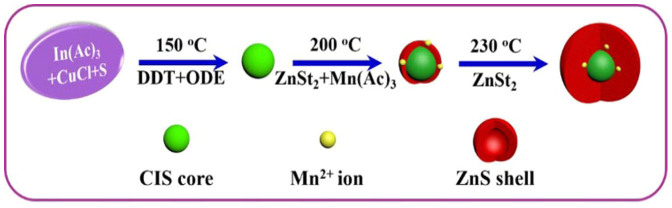
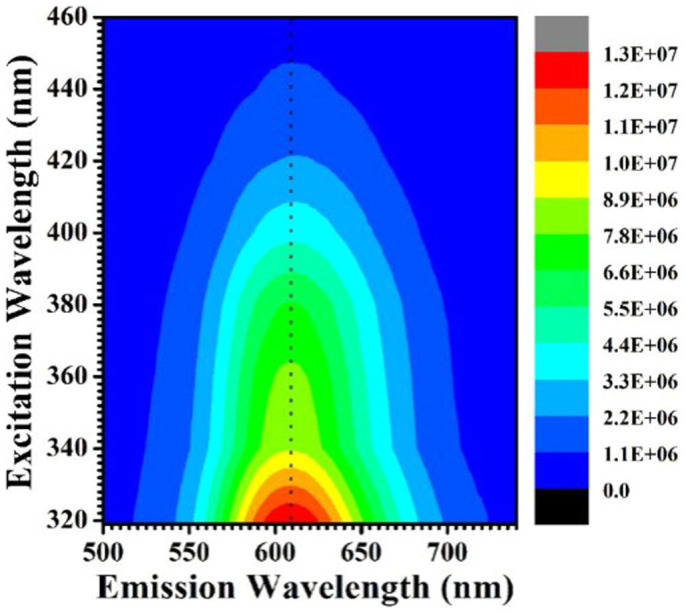
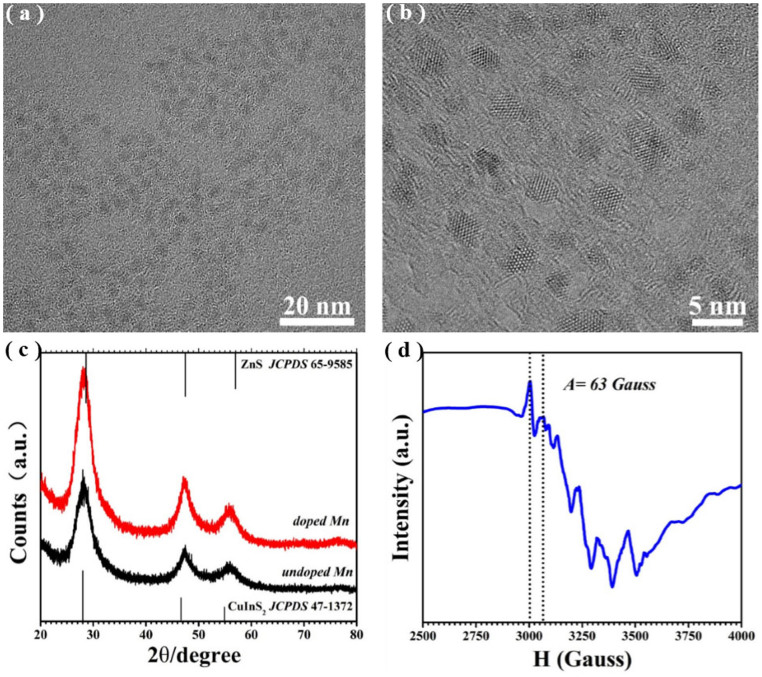
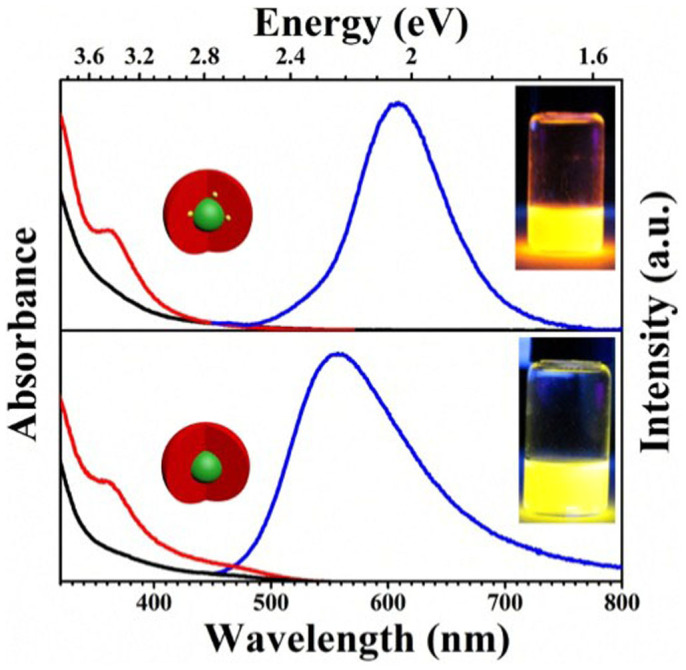
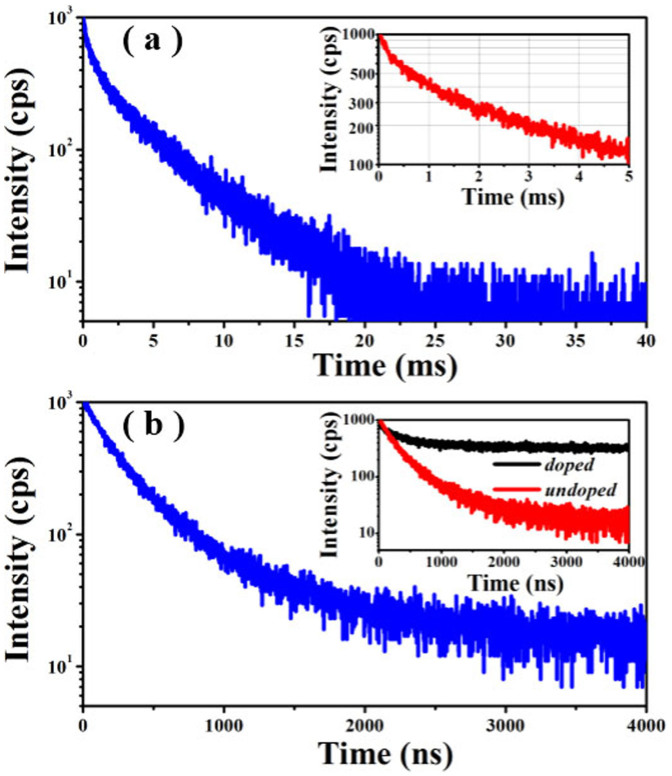
CuInS2 (CIS) quantum dots (QDs) have tunable photoluminescence (PL) behaviors in the visible and near infrared spectral range with markedly lower toxicity than the cadmium-based counterparts, making them very promising applications in light emitting and solar harvesting. However, there still remain material- and fabrication- related obstacles in realizing the high-performance CIS-based QDs with well-resolved Mn(2+) d-d emission, long emission lifetimes as well as high efficiencies. Here, we demonstrate the growth of high-quality Mn(2+)-doped CuInS-ZnS (CIS-ZnS) QDs based on a multi-step hot-injection strategy. The resultant QDs exhibit a well-resolved Mn(2+) d-d emission with a high PL quantum yield (QY) up to 66% and an extremely long excited state lifetime up to ~3.78 ms, which is nearly two times longer than the longest one of "green" QDs ever reported. It is promising that the synthesized Mn(2+)-doped CIS-ZnS QDs might open new doors for their practical applications in bioimaging and opto/electronic devices.
硫化铜铟(CIS)量子点(QDs)在可见光和近红外光谱范围内具有可调节的光致发光(PL)行为,其毒性明显低于镉基量子点,这使其在发光和太阳能收集方面具有非常广阔的应用前景。然而,在实现具有清晰分辨的Mn(2+) d-d发射、长发射寿命以及高效率的高性能CIS基量子点方面,仍然存在与材料和制造相关的障碍。在此,我们展示了基于多步热注入策略生长高质量Mn(2+)掺杂的CuInS-ZnS(CIS-ZnS)量子点。所得量子点表现出清晰分辨的Mn(2+) d-d发射,光致发光量子产率(QY)高达66%,激发态寿命极长,可达约3.78 ms,这几乎是有史以来报道的“绿色”量子点最长寿命的两倍。合成的Mn(2+)掺杂CIS-ZnS量子点有望为其在生物成像和光电器件中的实际应用打开新的大门。