McClintic Abbi M, Garcia Josephine B, Gofeld Michael, Kliot Michel, Kucewicz John C, Loeser John D, Pederson Kristin D, Sparks Rachel E, Terman Gregory W, Tych Rowen E, Mourad Pierre D
Department of Neurological Surgery, University of Washington, Box 356470, Seattle, WA, USA.
Department of Neurological Surgery, University of Washington, Box 356470, Seattle, WA, USA ; Department of Anesthesiology and Pain Management, University of Washington, Seattle, WA, USA.
J Ther Ultrasound. 2014 Feb 25;2:8. doi: 10.1186/2050-5736-2-8. eCollection 2014.
Potential peripheral sources of deep pain can require invasive evocative tests for their assessment. Here we perform research whose ultimate goal is development of a non-invasive evocative test for deep painful tissue.
We used a rat model of inflammation to show that intense focused ultrasound (iFU) differentially stimulates inflamed versus control tissue and can identify allodynia. To do so we applied iFU to inflamed and normal tissue below the skin of rats' hind paws and measured the amount of ultrasound necessary to induce paw withdrawal.
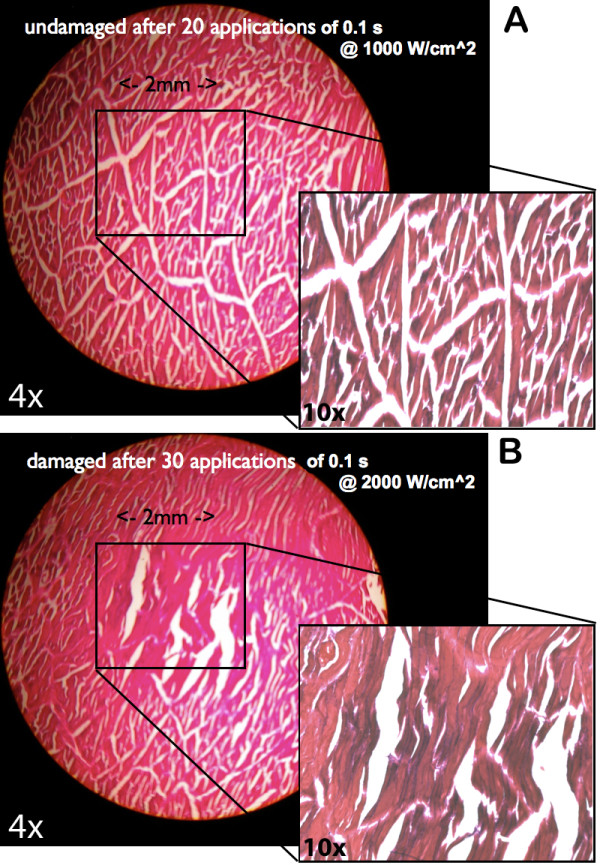
iFU of sufficient strength (spatial and temporal average intensities ranged from 100-350 W/cm(2)) caused the rat to withdraw its inflamed paw, while the same iFU applied to the contralateral paw failed to induce withdrawal, with sensitivity and specificity generally greater than 90%. iFU stimulation of normal tissue required twice the amount of ultrasound to generate a withdrawal than did inflamed tissue, thereby assessing allodynia. Finally, we verified in a preliminary way the safety of iFU stimulation with acute histological studies coupled with mathematical simulations.
Given that there exist systems to guide iFU deep to the skin, image-guided iFU may one day allow assessment of patient's deep, peripheral pain generators.
深部疼痛潜在的外周来源可能需要通过侵入性激发试验来评估。在此,我们开展研究,其最终目标是开发一种用于深部疼痛组织的非侵入性激发试验。
我们使用炎症大鼠模型来表明高强度聚焦超声(iFU)对炎症组织与对照组织的刺激存在差异,并且能够识别痛觉过敏。为此,我们将iFU应用于大鼠后爪皮肤下方的炎症组织和正常组织,并测量诱导爪子缩回所需的超声量。
足够强度的iFU(空间和时间平均强度范围为100 - 350W/cm²)会使大鼠缩回其发炎的爪子,而将相同的iFU应用于对侧爪子则不会引起缩回,其敏感性和特异性通常大于90%。iFU对正常组织的刺激产生缩回所需的超声量是炎症组织的两倍,从而评估了痛觉过敏。最后,我们通过急性组织学研究和数学模拟初步验证了iFU刺激的安全性。
鉴于存在将iFU引导至皮肤深部的系统,图像引导的iFU也许有一天能够用于评估患者深部的外周疼痛源。