Flajnik Martin F
Department of Microbiology and Immunology, University of Maryland Baltimore, Baltimore, MD 21201, USA.
Curr Biol. 2014 Nov 3;24(21):R1060-5. doi: 10.1016/j.cub.2014.09.070.
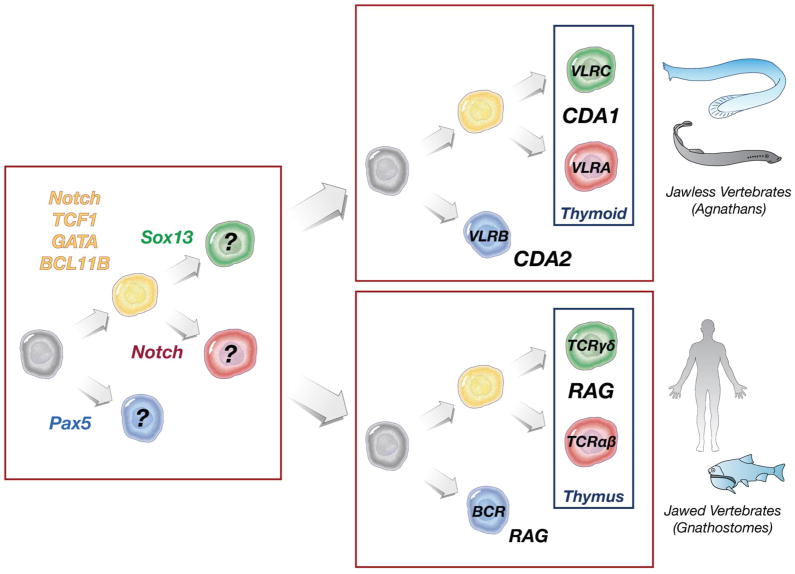
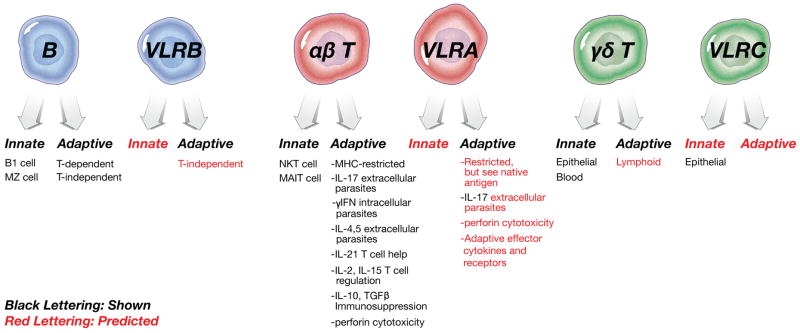
Classically the immunological 'Big Bang' of adaptive immunity was believed to have resulted from the insertion of a transposon into an immunoglobulin superfamily gene member, initiating antigen receptor gene rearrangement via the RAG recombinase in an ancestor of jawed vertebrates. However, the discovery of a second, convergent adaptive immune system in jawless fish, focused on the so-called variable lymphocyte receptors (VLRs), was arguably the most exciting finding of the past decade in immunology and has drastically changed the view of immune origins. The recent report of a new lymphocyte lineage in lampreys, defined by the antigen receptor VLRC, suggests that there were three lymphocyte lineages in the common ancestor of jawless and jawed vertebrates that co-opted different antigen receptor supertypes. The transcriptional control of these lineages during development is predicted to be remarkably similar in both the jawless (agnathan) and jawed (gnathostome) vertebrates, suggesting that an early 'division of labor' among lymphocytes was a driving force in the emergence of adaptive immunity. The recent cartilaginous fish genome project suggests that most effector cytokines and chemokines were also present in these fish, and further studies of the lamprey and hagfish genomes will determine just how explosive the Big Bang actually was.
传统上,适应性免疫的免疫学“大爆炸”被认为是由于转座子插入免疫球蛋白超家族基因成员,在有颌脊椎动物的祖先中通过RAG重组酶启动抗原受体基因重排所致。然而,在无颌鱼类中发现了第二种趋同的适应性免疫系统,即所谓的可变淋巴细胞受体(VLR),这可以说是过去十年免疫学中最令人兴奋的发现,并且极大地改变了对免疫起源的看法。最近关于七鳃鳗中一种由抗原受体VLRC定义的新淋巴细胞谱系的报道表明,在无颌和有颌脊椎动物的共同祖先中有三种淋巴细胞谱系,它们选择了不同的抗原受体超类型。预计在无颌(无颌类)和有颌(有颌类)脊椎动物的发育过程中,这些谱系的转录控制非常相似,这表明淋巴细胞之间早期的“分工”是适应性免疫出现的驱动力。最近的软骨鱼基因组计划表明,这些鱼类中也存在大多数效应细胞因子和趋化因子,对七鳃鳗和盲鳗基因组的进一步研究将确定“大爆炸”实际上有多剧烈。