Park Chanki, Lee Boreom
School of Mechatronics, Gwangju Institute of Science and Technology (GIST), Gwangju, South Korea.
Biomed Eng Online. 2014 Dec 17;13:170. doi: 10.1186/1475-925X-13-170.
Many researchers have attempted to acquire respiratory rate (RR) information from a photoplethysmogram (PPG) because respiration affects the waveform of the PPG. However, most of these methods were difficult to operate in real-time because of their complexity or computational requirements. From these needs, we attempted to develop a method to estimate RR from a PPG with a light computational burden.
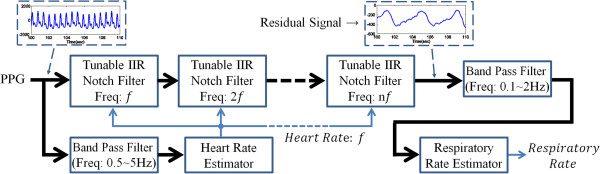
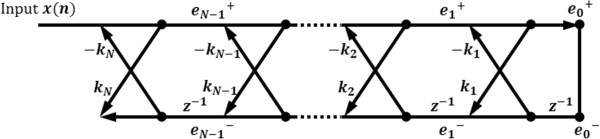
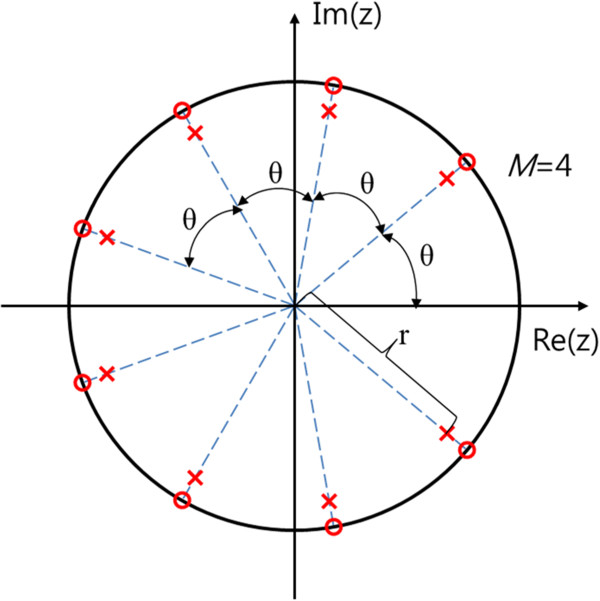
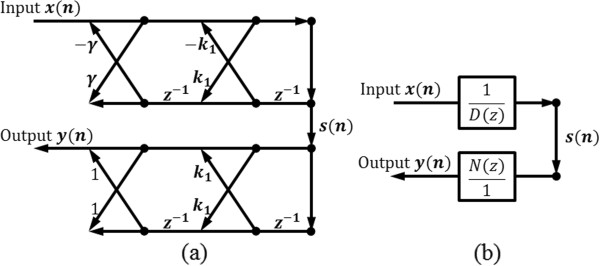
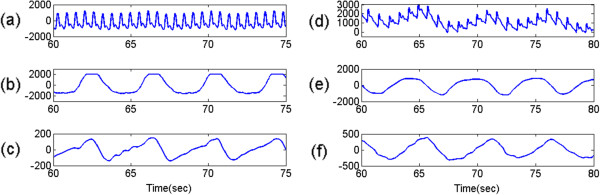
To obtain RR information, we adopt a sequential filtering structure and frequency estimation technique, which extracts a dominant frequency from a given signal. In particular, we used an adaptive lattice notch filter (ALNF) to estimate RR from a PPG along with an additional heart rate that is utilized as an adaptation parameter of our method. Furthermore, we designed a sequential infinite impulse response (IIR) notch filtering system (i.e., harmonic IIR notch filter) to eliminate the cardiac component and its harmonics from the PPG. We compared the proposed method with Burg's AR modeling method, which is widely used to estimate RR from a PPG, using open-source data and measured data.
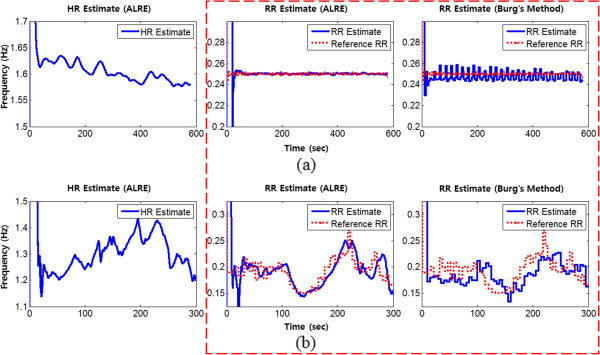
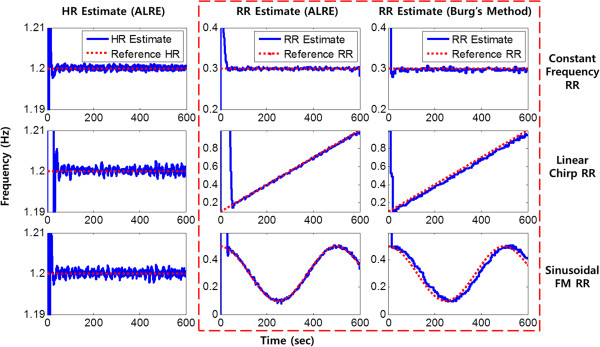
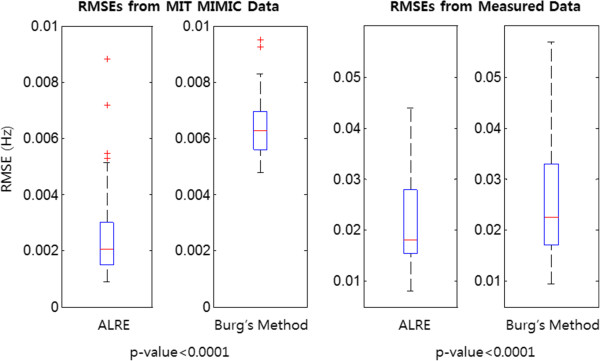
By using a statistical test, it was determined that our adaptive lattice-type respiratory rate estimator (ALRE) was significantly more accurate than Burg's AR model method (p <0.0001). Furthermore, the ALRE's tracking performance was better than that of Burg's method, and the variances of its estimates were smaller than those of Burg's method.
In short, our method showed a better performance than Burg's AR modeling method for real-time applications.
由于呼吸会影响光电容积脉搏波描记图(PPG)的波形,许多研究人员试图从PPG中获取呼吸频率(RR)信息。然而,这些方法中的大多数由于其复杂性或计算要求而难以实时操作。基于这些需求,我们试图开发一种计算负担轻的从PPG估计RR的方法。
为了获得RR信息,我们采用了顺序滤波结构和频率估计技术,该技术从给定信号中提取主导频率。特别是,我们使用自适应格型陷波滤波器(ALNF)从PPG估计RR,并将额外的心率用作我们方法的自适应参数。此外,我们设计了一种顺序无限脉冲响应(IIR)陷波滤波系统(即谐波IIR陷波滤波器),以从PPG中消除心脏成分及其谐波。我们使用开源数据和实测数据,将所提出的方法与广泛用于从PPG估计RR的Burg自回归建模方法进行了比较。
通过统计检验,确定我们的自适应格型呼吸频率估计器(ALRE)比Burg的自回归模型方法显著更准确(p<0.0001)。此外,ALRE的跟踪性能优于Burg的方法,其估计的方差小于Burg的方法。
简而言之,对于实时应用,我们的方法比Burg的自回归建模方法表现更好。